 @mc5punk
more from that month
@mc5punk
more from that month
Short story: The Silent Game: Intrigue in the Halls of Rome
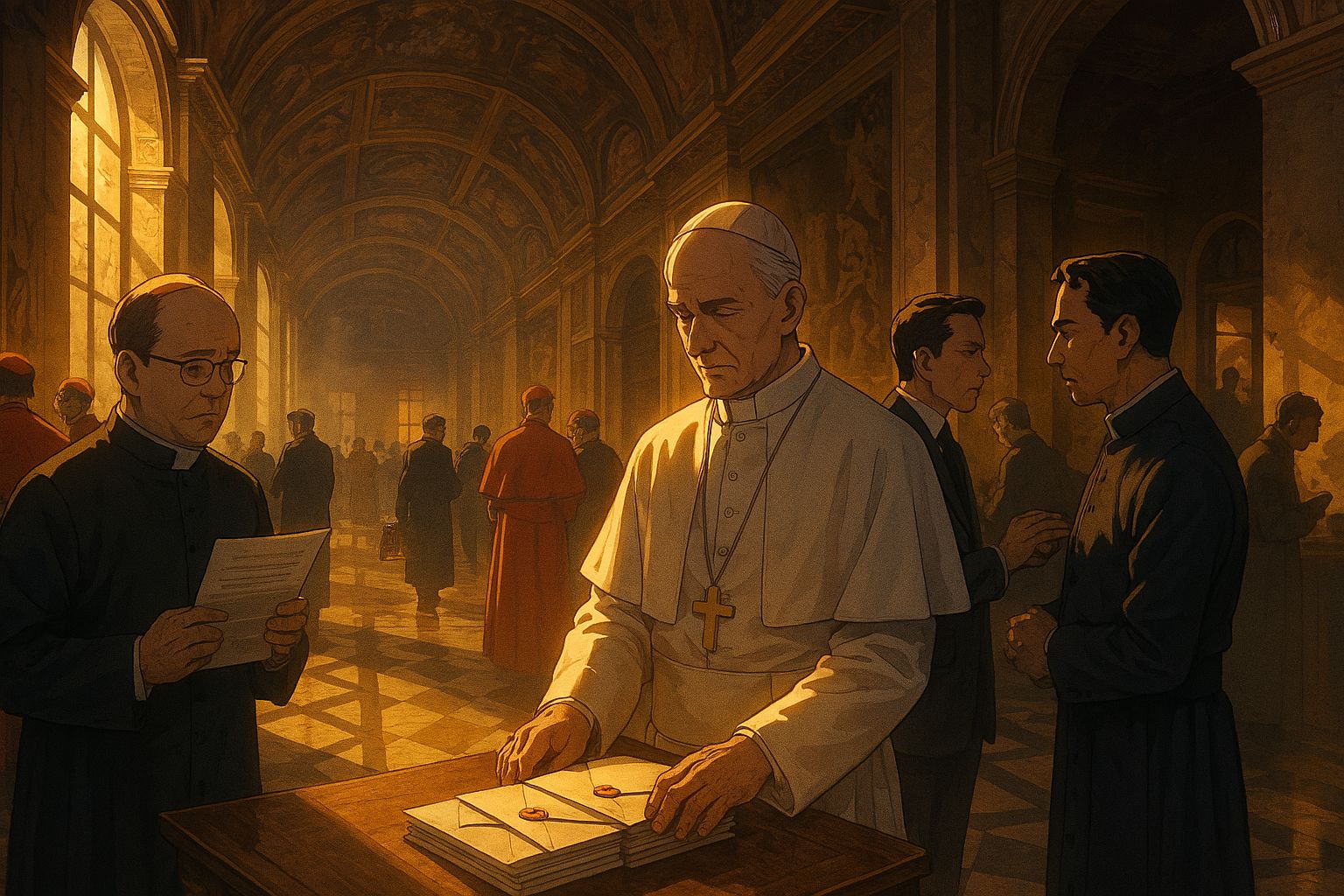
Five months after the election of Leo XIV, the City of the Vatican breathed a tense silence, the kind that precedes a storm. The bells of St. Peter’s still marked the hours with the same immutable cadence, but in the corridors of the papal palaces—in offices with frescoed ceilings and in rooms where yellowed files were kept—shadows moved that no longer trusted eternal certainties. —Have you seen the envelope on the boy’s desk? —the secretary murmured in a weak voice as he approached the prelate’s study. —It has no sender. —Do not open it here, —the prelate replied without looking up—. Take it to the archive and copy everything. Let no one touch it until I see it. The leak had been minimal: an encrypted email, a coded message, an envelope with no return address left on a sacristan’s table who thought he had found a protocol error. The content, however, set corridors and offices alight. Leo XIV, according to those internal sources, had not come to break with what his predecessor Francisco had begun, but to finish it. Not with a crash, but with a series of administrative maneuvers as precise as they were ruthless that, within months, placed the powerful, century-old organization Opus Dei under an official magnifying glass that no one had dared to fully open before. —Daily reports, —ordered Leo XIV in a private audience with his secretary—. I want to know who signs each transfer and what relationship those signatures have with appointments in strategic dioceses. —Your Holiness, —the secretary replied, bowing his head—. It will be done. Do you also want audiences with the Prefect of the Clergy? —Yes. And discretion. Have the requests presented as routine procedures, —the pontiff said, with the calm that makes a decision implacable. The first moves were bureaucratic: surprise inspections, requests for documentation that seemed trivial and that, once ordered, revealed veins where before there had only been assumed gold. Notices signed by third offices of the Vatican crossed with names and figures that, read together, pointed to networks of influence, discreet donations, appointed posts, and returned favors. Leo XIV spoke in public of reform, transparency, and maintaining the unity of the Church. In private, his letters ordered “verify and regulate,” a euphemism with a scalpel’s edge. —If they open that black box, the whole building will tremble, —said the Opus Dei’s financial director at a closed meeting—. It’s not just documents; they are relationships that sustain decades of projects. —Then let’s clean what can be cleaned, —replied a younger voice—. If we don’t act now, they’ll drag us down with everything. The leaders of Opus Dei, accustomed to weaving discretions as one sews fine cloth, suddenly found themselves exposed. Some believed that showing correct papers and conciliatory speeches would be enough; others, older, saw in the pontiff’s gesture the sign of a slow, methodical purge. Among its members, some began to seek allies in dioceses that still held territorial influence, while others simply reinforced internal loyalty: stricter controls in formation, closed meetings, oaths of discretion. —We cannot allow ourselves to be fragmented from within, —the lay moderator said in one of the night conversations—. We will preserve what is essential: our works and our centers. We will negotiate, not confront. —And if they refuse to negotiate? —asked the priest in charge of communications—. If they want to see us fall as an example? —Then we will prepare canonical defenses and documents that prove the legitimacy of our actions, —the moderator replied with a tense smile—. But first, let us try the quiet path. But politics does not respect a single front. In Rome, the Curia split with lethal subtlety. One faction saw the papal initiative as an opportunity to undo clienteles and recomposite balances; another read it as an intrusion into well-established networks. Some cardinals, who had built careers mediating between curias and orders, began to measure their public words and their private pacts. Robed spies—curials who leaked conjectures to friendly journalists—activated a low-intensity war in opinion columns and anonymous editorials. —If we publicly support the Holy Father, we lose the backing of those who sustain social projects, —a cardinal pondered in the sacristy—. If we do not, we will appear complicit in obscurantism. —History will judge those who chose discretion to avoid getting wet, —answered another cardinal, younger—. I prefer to risk losing allies than to remain part of the problem. The press, for its part, played its role voraciously. Vatican weeklies and international papers published contradictory versions; some articles presented Leo XIV as Francisco’s continuer and others painted him as a far more aggressive reformer. Between scandalous headlines and sharp retractions, global public opinion—that mass that vibrates with symbols and scandals—soon took sides. Social networks, stuffed with rumors, offered conspiracy panoramas where real truth became a toy. —That article makes us look like executioners, —complained the Congregation’s spokesperson—. Do we respond with an official statement or ignore it? —Silence for now, —ordered the undersecretary—. Every response is ammunition for someone. In the midst of that climate, the accident nobody expected occurred: a compromising archive, partially destroyed by a fire in a secondary office. The official version spoke of an electrical short. Unofficial sources—the same ones that had whispered the continuity of the process—mentioned envelopes with contracts, transfers, and lists of foreign benefactors. The fire consumed pages and certainties; it left, however, recovered digital images that began to circulate in closed circles: photos of nocturnal meetings, names on agendas, bank addresses. —It was not an accident, —whispered the priest in charge of archives, his fingers still stained with ash—. Someone wanted to erase evidence. —Do you have proof of that? —asked the bishop supervising the investigative commission. —Only fragments of hard drives and some recovered images. But there are patterns. Dates, names that repeat in transfers, —the priest said—. It is not coincidental. Leo XIV did not react theatrically. He maintained papal calm, summoned private audiences, and signed minor decrees that, in chain, reorganized competencies and demanded new audits. His strategy was clear: strike without noise, dismantle structures by showing that administrative reason was the ethical hammer. Those who accused him of revenge received cold responses in documents. Those who praised him argued the Church had to renew itself from the inside out. —I do not seek to punish anyone, —the Pope said in an audience with a group of cardinals—. I seek to heal the Church. Transparency is not a defeat; it is an obligation. —Your Holiness, —replied one of the cardinals, his voice broken—. There are those who interpret each step as an attack. You need clear allies. —I will have allies in truth, —Leo XIV answered firmly—. No more pacts of convenience. Meanwhile, within Opus Dei the figure of a moderator consolidated—a low-profile layman with connections in banking and several dioceses—who began negotiating with moderate curials the preservation of essentials: its social work, its study centers, and its role in priestly formation. Conversations took place in discreet salons, over coffee and confidences, and in encrypted messages that avoided the word “power.” The real question, however, remained: to what extent could an organization whose influence was woven into the ecclesiastical architecture be reformed without breaking it? —If we give up everything, we will destroy decades of work, —the moderator told the cardinal representing the Curia—. Let us negotiate reasonable limits. —And how do you define “reasonable”? —asked the cardinal—. For some, reasonable means keeping privileges; for others, only absolute surrender. On the periphery of the drama, younger voices raised other questions: wasn’t it time to open debates about accountability in all congregations? Should the Church not modernize its processes of appointments and financing? Some priests, tired of secrecy, began to publicly support greater transparency. That youthful current found echo among certain bishops who saw reform as an opportunity to revitalize parishes and return trust to disillusioned faithful. —Shouldn’t we publish the accounts? —asked a young priest in a café near St. Peter’s Square—. People have a right to know. —Transparency has a price, —warned a veteran prelate—. If you expose everything, you lose indispensable allies for social works. Alliances shifted quickly. A traditionalist cardinal, always close to financial networks, was suddenly sidelined from a key commission; a mid-level bishop, known for doctrinal firmness and an impeccable reputation, gained prominence to the astonishment of old guardians. In Vatican forums, votes were no longer simple gestures: each appointment was a move on a board where reform and preservation vied for advantage. —We didn’t expect that vote, —confessed the Vatican diplomat—. Someone moved pieces quickly. —There are new hands behind it, —said the promoted bishop—. It is not only administrative reform; it is a retraction of powers. The intrigue, however, did not stay within the walls. Foreign governments, foundations, and donors watched worriedly. Some sent discreet emissaries to measure the pulse; others pressured through diplomatic channels to ensure their social investments would not be compromised. The mix of religion and economic power, as old as the Church itself, showed again all its disruptive potential. —Our support depends on stability, —said an emissary from a European foundation in a meeting with the lay moderator—. We cannot fund something at risk from internal disputes. —We understand, —the moderator replied—. What we ask is time to prove our works continue. One day, in an audience that was not on the public agenda, Leo XIV received a group of abuse survivors and a financial transparency committee. The official images were measured: the pontiff’s concern, the promise to investigate, the plea for patience. —I come for justice, not for vengeance, —said a woman, her voice contained—. We want to see actions, not words. —You have my word, —answered Leo XIV, bowing his head—. I will investigate and act according to the truth we find. There will be no protection for those who have done wrong. In private, however, his words were more direct: the Church must recover credibility, and that required reviewing not only moral conduct but also structures of influence. —It is not vengeance, —he whispered to his secretary at the end of the audience—. It is healing. That phrase later circulated, leaked, like a staff some took with hope and others with fear. As months passed, the administrative remodeling consolidated in decrees, reassignments, and, in some cases, voluntary resignations. A handful of leaders—not all, but enough to show effect—left their posts or accepted honorary positions without operational power. Others resisted and sought legal and canonical routes to challenge decisions. The tension remained alive, now less visible but deeper-rooted: the reform had not finished; it had changed form. —I will not go without a fight, —one of those who accepted an honorary post said privately—. This will continue in courts. —Let them go to court, —his successor replied—. I prefer to work quietly to rebuild trust. In the cafés and taverns around St. Peter’s Square, young seminarians and veteran curials debated the future. Some proposed broader structural changes: external oversight, periodic audits, transparency in accounts. Others defended discretion as part of institutional effectiveness. Among them circulated an unsettling, seductive idea: that the Church, in its attempt to purify itself, could trade power for fragility or, worse, lose its capacity for social action if cooperation networks unraveled. —If we sacrifice the networks, we lose the capacity to help, —said a veteran curial—. The visible is not always the effective. —But if we don’t change, no one will trust us, —replied a seminarian—. Without trust, no work makes sense. The story, therefore, remained open. Leo XIV had initiated a chess game where every move was watched under a magnifying glass. Opus Dei, wounded but not defeated, sought to reinvent itself under the pressure of a Church deciding to confront its shadows. And while Rome breathed with prudence, the world watched: some hoped for a more transparent Church; others expected a recomposition of old loyalties. In the Vatican offices, the word most whispered in hushed tones was the same that always governs humans at decisive moments: power. —Who will win the game? —someone asked in the penumbra of a sacristy. —I do not know, —another voice replied—. But I know each piece moves another, and none surrenders easily. The intrigue continued, then, not as a dramatic explosion but as a prolonged pulse: meetings, decrees, leaks, resistances small and large. And in that process, the fundamental question remained unanswered: can the institution renew its structures of influence without losing what sustains it, or will reform produce a new landscape where old guardians will seek, by any means, to regain their place? Rome, as always, awaited the next move. Source of the images. Image created with Bing.
2 comments
Thank you for sharing. Worth reading.
Thanx. You are welcome 😄👍