 @mc5punk
Short story: 127 Years of Screens and Sofas
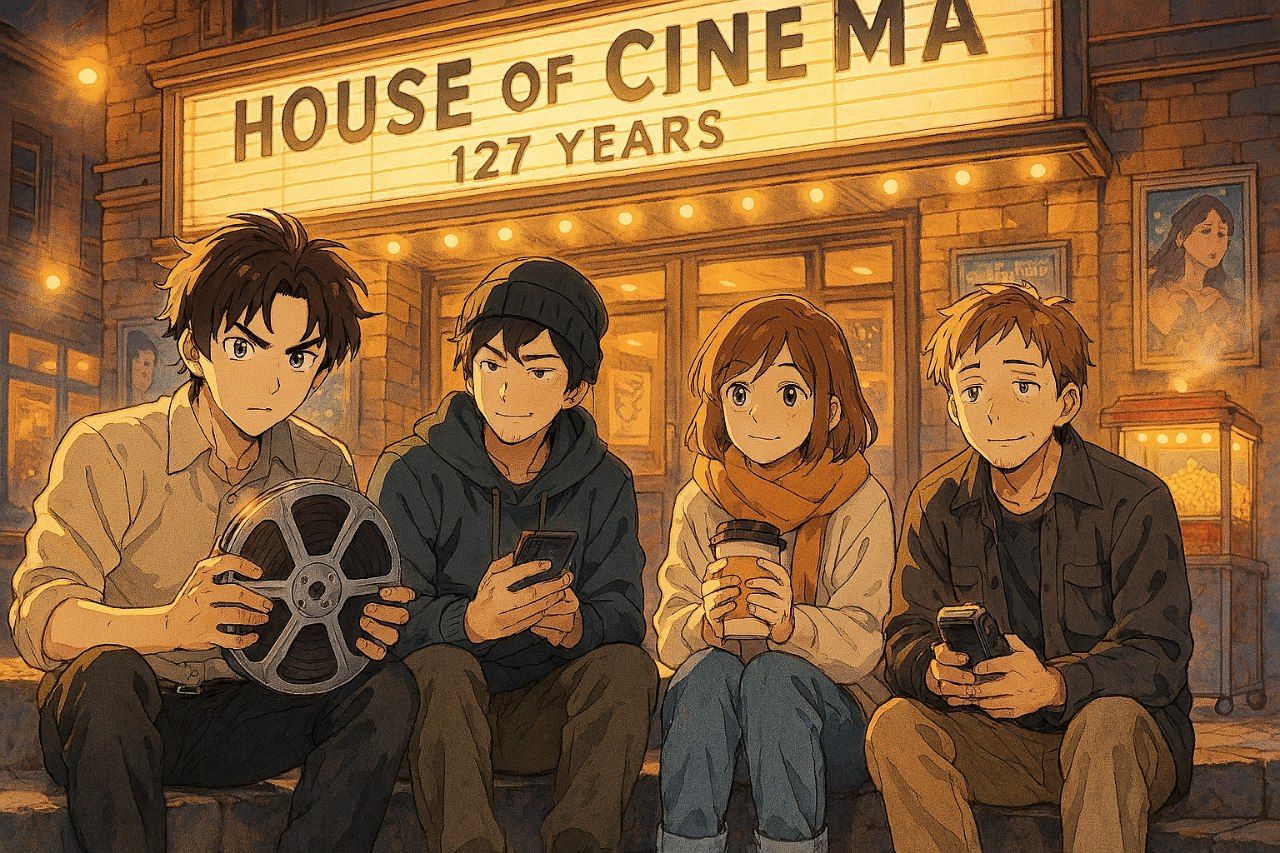
It was the afternoon of January 28 and the small plaza in front of the House of Cinema buzzed with murmurs and contained laughter. Despite the breeze carrying the smell of popcorn from a nearby stand, there was a certain melancholy in the air: the recent figures spoke for themselves. Cinema attendance had shown a sustained decline, with notable drops of 8% and 8.8% in 2024 and 2025 compared to the previous year, consolidating a downward trend far from pre-pandemic levels. In 2025, only 54,041 people went to theaters to see national films, a decrease of 28.36% compared to 2024 (75,436 viewers) and an alarming plunge of 73.61% compared to 2023. That day, commemorating the first projection of Venezuelan short films in 1897 — National Cinema Day — seemed to demand, more than grand celebrations, small actions to remember why theaters were once collective temples. On the terrace of the House of Cinema four friends met, young in their own ways, with different backgrounds and a shared concern: Venezuelan film. They gathered there every January 28 out of habit, nostalgia, or simply the perfect excuse to share popcorn and debate until nightfall. Diego, 25, had chosen to study film after a childhood of matinees and homemade shorts; his gaze was intense and his speech full of metaphors. Mateo, 24, was a software engineer and wielded irony as a shield; he found thinking aloud through laughter. Valeria, 22, worked as a content creator; she loved the comfort of home and the practicality of streaming, but still felt a romantic attachment to films in theaters. Joaquín, 26, a sound technician, knew the background of every screening: lights, speakers, long shifts that rarely saw fair credit. As the sun descended, the four sat on the steps and began to talk with the familiarity of people who share cultural memory. Diego evoked the history of the Baralt Theatre and the first screenings: in 1897 pieces like A Celebrated Specialist Pulling Teeth at the Gran Hotel Europa and Boys Bathing in the Maracaibo Lagoon were shown — pioneering works whose simplicity marked the beginning of an industry. He spoke of Manuel Trujillo Durán and how, from those first moments, Venezuelan cinema had grown with milestones such as the creation of Bolívar Films in the 1940s and the Villa del Cine in 2006. He spoke of identity, memory, and the audiovisual heritage that the National Film Archive Foundation sought to preserve. Mateo smiled and, in his usual tone, noted that nostalgia was good fuel for speeches, but that the numbers were merciless: the sustained drop in attendance, driven by the rise of streaming, high ticket prices, lineups saturated with sequels, and the preference for home comfort, was leaving seats empty. He mentioned that 2023 had offered a respite — 204,821 spectators for local productions thanks to the phenomenon Simón, which alone drew more than 117,000 people — but that the industry had not managed to repeat that momentum. “It’s like people went out once to see something that shook them and then went back to the couch,” he said, while sending a silent message to his chat group. Valeria, naturally living among algorithms and trends, defended comfort: platforms offer premieres without leaving home, with increasingly theater-like picture and sound quality. She recalled ticket prices, queues and logistics: for many, watching a film in pajamas with delivery is a rational choice. Still, she admitted, she felt some guilt about how coldly audiences treated national cinema: “If there were more films that spoke about us in an authentic way, maybe more people would go out.” Joaquín nodded with technical conviction. He spoke of small festivals, of endless shifts in projection booths and of how those who make a screening possible often remain in the shadows. He noted that the saturation of sequels in lineups was real: more and more he saw the phenomenon of franchises attracting crowds commercially but leaving little room for original projects. “The solution isn’t for people to stop watching blockbusters,” he said, “but to have an ecosystem with windows, incentives and a diverse lineup that allows commercial and local productions to coexist.” The conversation turned to concrete proposals. Diego suggested working through education: introducing young people to the history of national cinema — from the pioneers who screened at the Baralt to the achievements of the Villa del Cine — so they grow with a sense of belonging to those stories. Mateo proposed technological and commercial ideas: hybrid screenings, partnerships between theaters and platforms, promotions that make the experience affordable — cheaper tickets for certain screenings, combos that include ticket and popcorn. Valeria spoke about the power of social content: if a local film convinced the algorithm or became a social phenomenon, it could replicate the Simón effect. Joaquín, with a mix of realism and affection for his craft, suggested improving working conditions and visibility for technicians and workers: visible credits, campaigns to recognize their work, and festivals with juries and awards that provide real recognition. Throughout the conversation the figures returned as a reminder: in 2025 only 54,041 spectators supported national cinema, a number that hurt in terms of sustainability. There was also the figure of 127 years since that first day in 1897; that celebration could not be limited to data in an official statement. It was, they agreed, an obligation to keep the flame of cinematic memory alive: the images that build identity and heritage, the stories that speak of a country and its people. Diego, imagining a film that recreated those first screenings, described a scene: the projection at the Baralt Theatre, people astonished by the moving image, simple and direct titles like A Celebrated Specialist Pulling Teeth at the Gran Hotel Europa — stories so simple that today they might seem delightfully strange. He proposed that contemporary cinema recover that spirit — curiosity, the humility of early takes — and blend it with new narrative forms to attract an audience that rarely leaves home. The afternoon turned into evening and the plaza began to empty. Before leaving, the four devised a small but determined plan: organize a special screening at the House of Cinema that would include historical shorts, a recent national title, and a post-screening conversation with filmmakers and technicians. They decided to invite friends who had never set foot in a theater and to offer tickets at symbolic prices. They did not arrogantly promise to reverse the 8% and 8.8% decline overnight or to rebuild 2023’s growth, but they committed to making a concrete gesture so that, at least for that day, seats would be filled with voices and looks that dialogued with the present and memory. As they walked toward downtown, Mateo joked with a peculiar idea: to create an app that emulated the feeling of a theater on the sofa — programmed whistles, seat vibration and subscription popcorn scent. Valeria laughed and said she’d produce it as content. Joaquín, with a tired smile, asked that they not forget technical credits when celebrating; his symbolic reward would be to see his name on a full screen and not in the darkness of the backstage. That January 28 commemoration did not erase statistics or challenges: the immediacy of platforms, the appeal of domestic comfort, the high costs of exhibition and the absence of a lineup offering variety remained real barriers. But the night left one certainty that resonated among them: honoring filmmakers, artists and workers who bring local stories to the big screen is more than an act of nostalgia; it is a collective action that can open doors to new audiences, generate synergies and keep alive an audiovisual heritage that, from Manuel Trujillo Durán to current projection teams, has woven the country’s cultural memory. When they said goodbye, the lights of the House of Cinema glowed like a faint promise. They had not solved the sustained decline nor guaranteed that attendance would return to former numbers, but that night preserved something essential: the decision of those who love cinema to keep creating events, screenings and encounters so the screen can continue telling local stories. And as the dawn neared the avenue’s illuminated signs, one of them murmured, half-joking, half-serious: if this works, at least we’ll have an excuse to eat popcorn together again. Source of the images. Image created with Bing.
No comments yet