 @mc5punk
more from that month
@mc5punk
more from that month
Short story: Colors on the Threshold
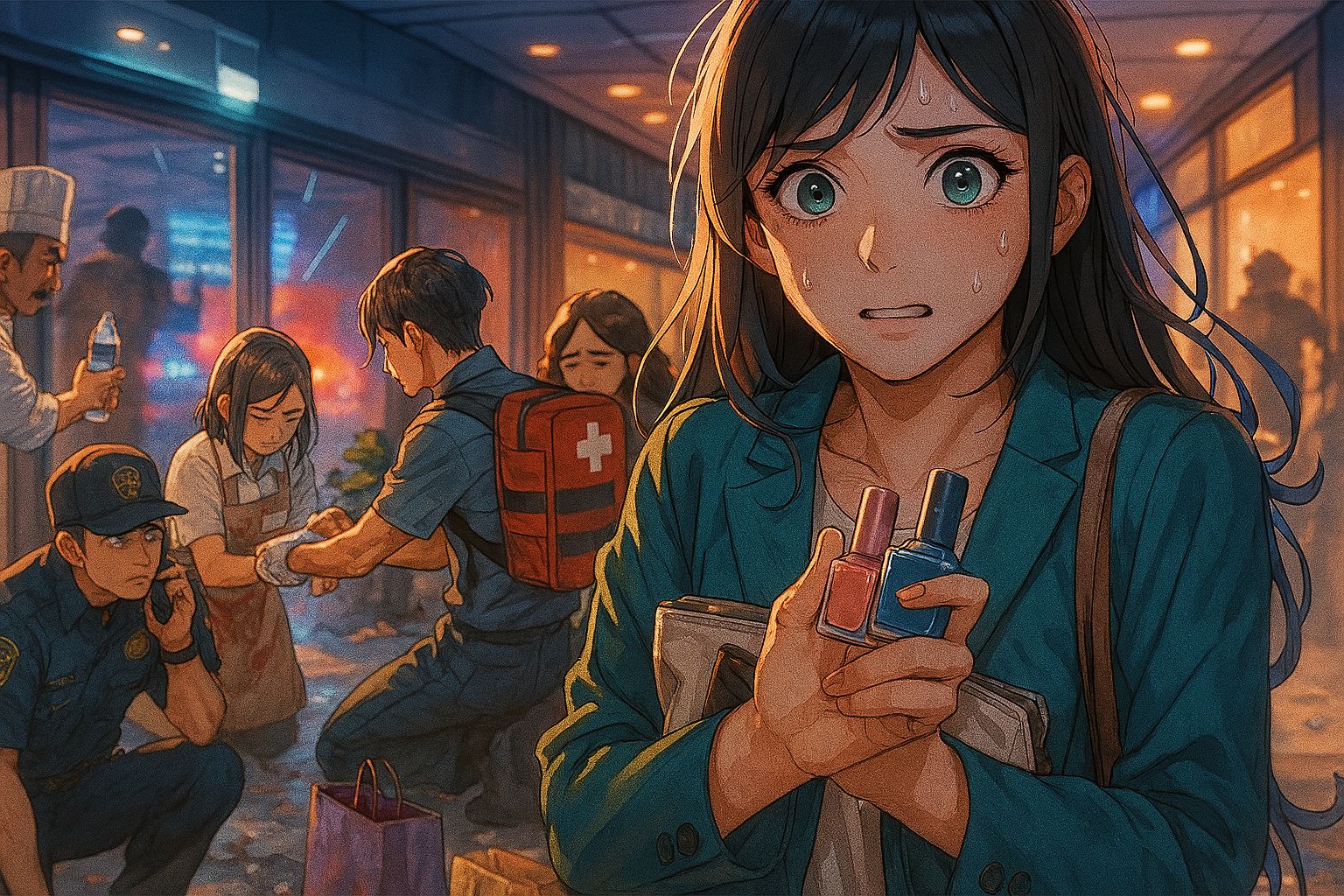
I I hold two small bottles of nail polish in the palm of my left hand: one coral, one deep blue. I study them as if they were a tiny bouquet of color; their shine returns the feeling of having granted myself an allowed indulgence. I had spent more than half an hour hesitating between brands and finishes, comparing textures under the store’s white light; in the end I weighed price and quality and told myself I deserved to take them. I close them carefully and put them away; they are insignificant and yet accompany me like a promise of normalcy as I leave the shop. As I walk toward the doors, a tall, shabby man stumbles into me. He almost loses his balance; his weight pushes me. I look up, annoyed by the slight. “Watch out!” I say, adjusting my bag. He looks at me for a moment and his only reply is a murmured word, without attention: “Sorry… I can’t now.” The indifference irritates me, but I decide not to turn it into a confrontation. I breathe and continue. The mall’s fluorescent light has that tint that makes everything feel slightly unreal: display windows, ads, the constant hum of background music. In the main corridor I see Marcos, a boy I recognize from the neighborhood café: always with a backpack, always calm. Today he carries a bag with a comic under his arm. “You okay?” he asks me with the familiarity of someone who has shared lines without really knowing each other. “Yeah, just a shove,” I reply. “And you?” “For the new issue,” he tells me with half a smile. “It’s crowded today.” We exchange a few words and then return to anonymous routine. There’s no rush, although people move densely through the halls. Some jostle impatiently; others, like me, trail small purchases that leave a wake of paper and plastic. II Suddenly the atmosphere breaks. A dry, sharp sound cuts through the murmur: a gunshot. It’s not a festive blast; it lacks the cheerful cadence of fireworks. There is a pause. Then another bang, just as dry. The place’s heartbeat speeds up. Those around freeze for a moment, searching for meaning. A street vendor, Don Luis, drops the box of earphones he was holding; his eyes widen as if disbelief has knocked the air from him. “What was that?” he asks aloud, trembling. Some speculate in low voices; others look toward the exits. The shots repeat, with irregular pauses that fracture time: two, three, then silence, then another. Panic takes root with the same speed a shadow spreads: at first subtle, then impossible to ignore. A mother, Carla, pushes the stroller with Mateo inside and yanks him as if running will save a scene she doesn’t yet understand. I stash the polishes in my bag, an instinctive gesture trying to keep some order inside the shock. I press myself against the wall, watching, searching for a route that doesn’t yet exist. I see Ana: young, kind-faced, her cosmetics-store uniform still bearing the tag of responsibility. She runs, grabs something, trips and falls near the threshold. Her blouse begins to stain in a shadow that spreads with an unspeakable slowness. Time turns viscous: each second stretches until it becomes unbearable. “Help!” Ana cries, voice breaking. “Someone help!” Rubén, the security guard, appears with his radio on. His hands are steady; his voice is hoarse from training and tension. “Security! On the floor!” he shouts. “Stay away from the doors. No one exit that way.” The order is an attempt to contain the uncontainable. Some drop to the floor; others run to a side exit. Marcos grabs my arm with decision. I see in his face the mixture of surprise and the sudden need to act. “There’s a side exit this way,” he says. “Follow me.” We don’t speak further. Together we push toward a less crowded corridor. Along the way we take in Carla, whose face is pale, and Mateo, who cries with the confusion of a child who cannot understand why everything familiar has become dangerous. Don Luis, having regained his balance, offers bottles of water to those gathered in that improvised corner; his voice is a thread trying to stitch the tension. “Calm down, help is coming,” he murmurs, with the precariousness of someone praying with whatever they have. III The next minutes become a succession of gestures that organize the anarchy: Marcos pulls a small backpack I didn’t know he had and opens it. He has bandages and gauze — he volunteers on weekends. Like a practical miracle, the routine of his commitment becomes a real tool. “Pass me the towel,” he says. “Apply pressure to the wound, quick.” Voices overlap: instructions, pleas, a sharp cry from farther ahead. Rubén coordinates via radio the arrival of ambulances and police backup; his authoritative voice stabilizes something within the chaos. Mr. Ramírez, an older man with a handkerchief, moves among the groups and pleads for calm with the serenity of someone who has survived tragedies and knows composure is the glue of the human. When paramedics arrive, everything takes on a clinical, brutal character: they assess, load, transport. Ana is immobilized; a soaked towel presses where the blood first surfaced. Life and death entwine in an array of objects: a stretcher, a monitor, hands that press and release. Some are escorted out by officers; others, like us, are led to a provisional waiting room where we’re asked to confirm we weren’t involved. Police take statements. Rubén, his voice increasingly dry, recounts what he saw: hurried steps, a body that bent, two separate shots. Outside, the investigation begins: camera footage, footprints, reconstructing a time that suddenly must be measured in fatal seconds. IV Later, when the mall empties and the echo is trapped in the walls, the news spreads. On social media words move faster than facts: “shots,” “attack,” “hitman.” The TV shows footage of the scene — a shot that reveals storefronts drenched with tension and the blurred silhouette of a stained apron. In one grainy frame I recognize Ana’s face, young and already marked by what happened to her. At home that night I follow the coverage with contained breath. The newscasters speak with the coldness required to name everything without naming it completely: they confirm a store manager died after being shot several times and that the first hypothesis points to an execution; they mention a suspected hitman. Images replicate, witness accounts accumulate. There are messages of outrage, disbelief, demands for answers no one can yet give. Marcos texts me: “Did you get home okay?” I reply with an emoji that tries to compress my gratitude and the heaviness pressing on my chest. I call Don Luis; his voice is hoarse. “Thanks for helping,” he says. “It was terrible to see Ana.” “I can’t get it out of my head,” I confess. “Everything happened so fast.” Don Luis sighs. He says he almost went to call for more help before the scene closed like a shell; he chooses silence — there are no words that serve as instant balm. V That night I sit under the dim light of my living room. On the table the two nail polish bottles seem to keep their innocence: clear, unblemished colors. I hold them between my fingers, like one who observes an object that belonged to another everydayness. I think of Ana, of Rubén and his commanding voice, of Marcos and the backpack he carried, of Don Luis and his offer of water; of Carla and the desperation etched on her face for little Mateo. The scene loops in my mind as a mosaic that refuses to be ordered: faces, clipped words, the sense that normalcy is more fragile than I imagined. I ask myself why I chose not to confront the man who shoved me earlier, why I accepted indifference then and yet later could hold a child’s hand to soothe him. The contradiction passes through me like a thread and leaves me cold: sometimes courtesy is a way to avoid conflict; other times it is a bridge we build to hold one another when contingency hits. Before sleeping I leave the polishes on the nightstand. I look at them one more time, not with the simple pleasure that motivated the purchase but with a mixture of gratitude and remorse. Two bright colors that now carry a layer of memory: the memory of an afternoon when noise turned into gunfire; the memory of those who helped without asking why; the memory of an end that others will have to investigate. I lie down with my phone in my hand, notifications and news alerts piling up. I think of Ana and the possibility that her family will seek answers; of Rubén, who will return tomorrow to his rounds with his routine broken; of Marcos, who will likely go back to his volunteer work with the certainty that what he does matters. I think of Don Luis, who will tomorrow set up his stall again with earphones and chargers, his face imprinted by what he saw. The sirens, now a distant echo, beat in the city like a warning. Normality returns in layers: cleaners washing the floor first, then storefronts lighting again, and more slowly conversations that rebuild themselves around a tragedy. But something doesn’t come back: the exactness of the moment when everything broke. Meanwhile, I put the polishes in a drawer — not out of forgetfulness but as a tangible reminder: two bright colors that remind me of the fragility of the everyday and the silent demand to hold one another when the noise becomes alarm. Source of the images. Image created with Bing.
No comments yet