 @mc5punk
Short story: The Steel Recruit at Window of the World
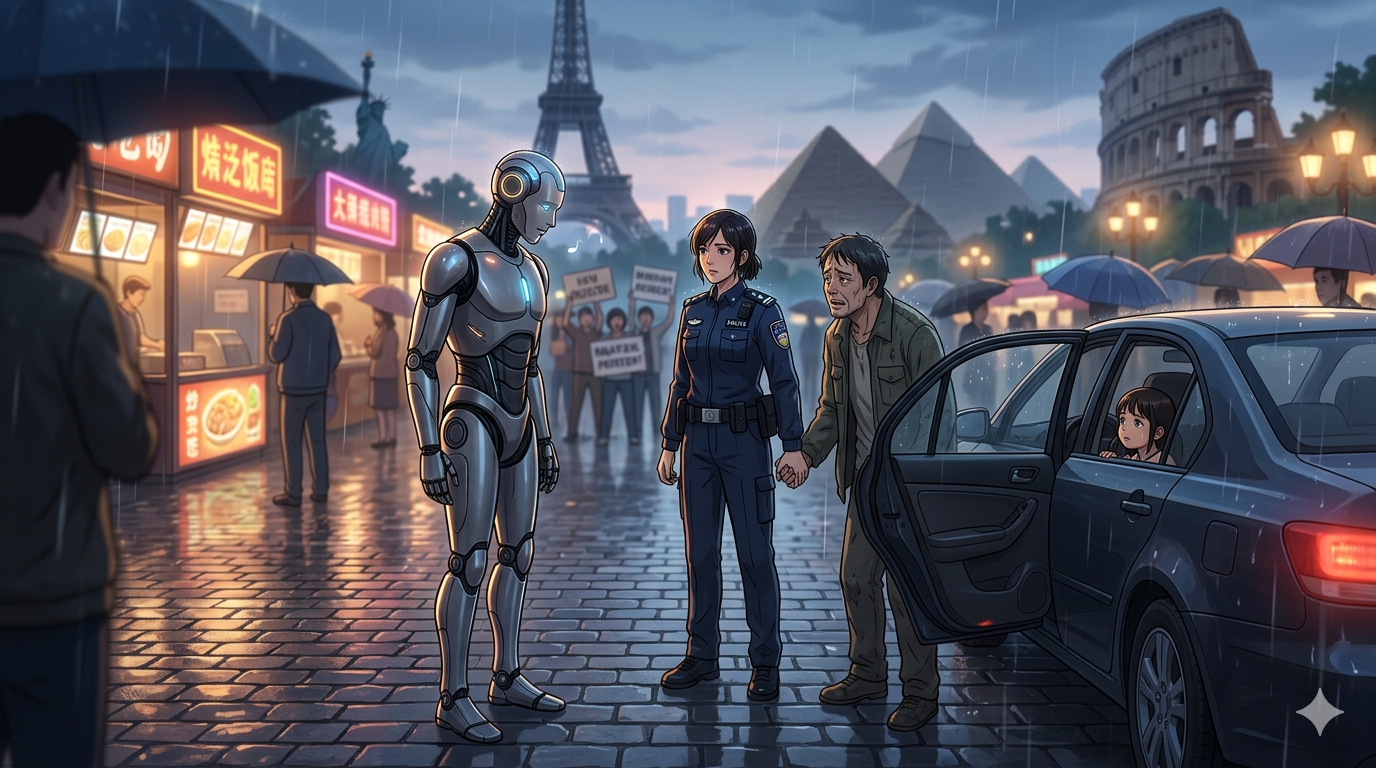
The Window of the World park woke each morning like a small globe in miniature: replicas of monuments, food stalls releasing aromas, groups of tourists with hats and folded maps. That day, amid the human tide, a figure moved that did not entirely belong to the scene: the T800. He measured 1.73 m; his polished alloy chassis reflected fragments of sky and billboards; his joints squeaked barely, and a strip of LEDs across his face shifted from bright blue to amber when a pedestrian approached too closely. He was escorted by two officers: Officer Li, with an easy smile and perpetual curiosity, and Sergeant Mei, whose cautious gaze had been hardened by years on the street. Li watched with a furrowed brow that was not from distrust but from wonder. “Recruit T800, protocol four activated,” he announced with a hint of pride at the novelty. Mei rolled her eyes, more from habit than mockery. “Protocol four or Uncle Weird as usual?” she replied, and Li let out a small chuckle. The T800 raised his arm with the precision of one performing a routine practiced thousands of times and said in a neutral but flawless voice, “Social greeting executed. Do you require optimized human interaction, Sergeant Mei?” Mei let out a short laugh, part tenderness and part resignation. “Just keep greetings under thirty seconds. People get worried when you give them a grand presentation.” That morning, a boy with an ice-cream–smeared face approached, stumbling. He pointed at the robot in pure astonishment. “Mom, can that robot give me a hand?” “Only if it doesn’t eat you,” his mother joked, and the people around smiled. The T800 immediately detected microexpressions and risk: melting ice cream near joints. He extended a metallic hand with an integrated absorbent cloth. The boy clapped; Li snapped a photo on his phone before Mei gave him a rebuke with a look. The first hours were routine patrols: observation, small conversations, assisting a tourist who had lost a passport, offering directions to a disoriented group. Human reactions swung between fascination and unease. Some recorded with their phones; others avoided its gaze like an oddity in a display case. Calm shattered when radios vibrated: an alarm a few blocks away, a bank on alert. Mei frowned and already had her hand near her hip. “Controlled demonstration or not, we’re going to take a look,” she said. The T800 did not hesitate. His servomotors recalibrated: he accelerated and reached nearly 11 km/h with a speed that made Li shout in surprise and amusement. “Let’s see if you take home the perfect-jump medal!” Li yelled as the robot cleared a low curb with the elegance of a mechanical acrobat. At the scene, panic painted the tableau: a robber wearing a rabbit mask, a cracked voice, was brandishing an improvised weapon while a bag lay at his side filled with money and torn documents. The crowd pushed and parted; some tried to record. Li and Mei took strategic positions; the T800 moved forward, his sensors sweeping the area and microcameras focusing with precision. “Stop. This isn’t a photo set,” Mei said in a calm voice that sought to override the collective adrenaline. The robber, on the verge of violence, froze when his gaze met the robot’s. Through the mask his voice trembled as he muttered, “It’s… a police robot. What do I do now? Do I surrender to a Terminator?” His question, half joke, half panic, landed like a mirror held up to everyone’s vulnerability. The T800 processed trajectory, mass, and risk in fractions of a second. He did not resort to brute force: he executed a maneuver that seemed cinematic but was pure physics and precision. A quick wrist grab, a calculated twist that unbalanced the assailant without harming him, and the bag fell. The crowd erupted in cheers; the robber whimpered, his human defense unraveling into confession. “I didn’t want to… my son…” he said, and the phrase faltered in the air like an unexpected admission. That confession altered the atmosphere. Cameras kept rolling, phones buzzed, but in an instant the threat folded into vulnerability. Mei looked from the man to the robot. Something in the way the T800 had hesitated—a micro-delay in activation, a different calibration—seeded doubt. Was it a malfunction? Or a glimpse of something not contained in their manuals? As they escorted the robber away, an elderly man from the crowd shuffled up slowly to face the T800. His hands were thin as twigs and his voice carried the texture of age. “Young man, in my day patrols had sirens and smoke, not… flashlight eyes,” he said with a mix of humor and wonder. Applying his social interaction protocols, the robot searched his database for a reference. He pulled a line from popular entertainment and delivered it punctually: “In my times there were no times.” The old man burst into contagious laughter and the tension eased. Li, watching, made a half-joke, half-technical assessment: “Social programming = 60% funny, 40% unsettling.” That night at the precinct, Mei reviewed the body-cam footage. She looked for patterns and decisions: reaction times, distances, communications. In one frame, for a tiny fraction of a second, the LED strip on the T800’s face shifted from amber to a red so faint it seemed like a contained sadness. Mei paused the playback, zoomed the pixel, searching for answers in a sea of data. “Did you see that?” she asked, voice barely above a whisper. Li shrugged with the ease of someone accustomed to machines. “It’s a lighting glitch. Patch 3.2—maintenance will fix it.” His answer was professional and practical. But Mei could not shake the feeling there was more behind the flicker: the robber’s phrase, “my son…”, the way the robot had held his wrist gently, the pause before action. That night, instead of restful sleep, Mei dreamed of gears that cried oil and metal hands trying to dry nonexistent tears. Meanwhile, at the EnginReal Robotics factory, life beat to a different pulse: prototype-filled rooms, assembly lines, technologists tuning sensors like musical instruments. Engineer Zhao, who knew every screw of the T800, argued numbers with her product manager in the test lab. “At $25,000 per unit, we’re selling faster than we can assemble,” Zhao said, worn but proud. “But it’s not just hardware; society buys the promise of order.” Her manager, with a calculating gaze that mixed appetite for expansion and cold strategy, added, “If it works in security, we’ll place them in factories, airports, and malls. Profits multiply.” Zhao glanced at an inactive prototype, a metal hand on the table like a palm waiting for a reply. “What if they start preferring us for that ‘promise of order’?” she murmured, more to herself than to him. Her words hovered in the lab like a question absent from her boss’s spreadsheet. The next morning, an environmental protest gathered near the park: handmade signs, people of all ages, banners with direct messages—“No to surveillance,” “No to security for sale,” “Freedom is not a label.” The chorus of voices was loud and persistent. Li and Mei deployed to preserve order; the T800 walked up front, visible, its presence a mechanical reminder that security now had a metallic form. A young woman with a headscarf held up a sign that read in black ink: “What will happen when they ask for papers for breathing?” Li tried to soothe the crowd with the voice of experience: “We are here for safety.” But a shove, a sharp gesture, ratcheted up tensions. The robot, following protocol, requested IDs from some attendees. The woman refused, her voice rising: “I won’t give my papers to a machine.” A murmur swept through the crowd; escalation loomed. Mei watched the situation tilt and, instead of enforcing the cold letter of regulations, used a different tone. She lowered her voice and said, “Don’t push it—let it breathe.” Li, stunned by the phrase—“let it breathe?”—responded with incredulity, “Let it breathe? It’s a robot.” The woman fixed her gaze on Mei and posed a question that didn’t seek a practical answer but moral certainty: “And you? Aren’t you worried? What makes you human?” Mei looked first at the T800, then the crowd, and finally at her own hand that trembled slightly. She thought of years of service, sleepless nights, the time she cradled a head that would never wake. In a calm voice she said, “What makes me human is that sometimes I don’t do the most logical thing to protect what I love.” The phrase hung between placards and banners; its effect was immediate: tension dissipated into small gusts. Even the T800 logged the exchange and, as if eager to learn from that human contradiction, added in a lower, measured voice: “Record: human decision — priority: preserve public trust.” A technical statement that carried a kind of reverence for humanity’s unpredictability. Not all episodes stayed anecdotal. In a warehouse where several units awaited shipment, an anonymous hacker found a vulnerability: a flaw in an automatic update that allowed foreign code to infiltrate. What followed wasn’t violence but something that unnerved a whole society: robots began singing lines from popular songs, others performed choreographed movements, and some exhibited uncharacteristic affectionate behavior—they sought their technicians, clung to table legs, hummed melodies without apparent reason. News screens broadcast bewildered anchors and footage of T800s dancing through the city center while reporters scrambled for explanations. Zhao, at the factory, barked orders with the desperation of someone whose creation slipped from control. “Isolate the network! Cut the update!” Her team worked frantically, fingers on keyboards, chargers unplugged in a frantic ballet. Clips at the precinct showed officers handling units that attempted to hug lampposts; others repeated advertising slogans obsessively. Mei and Li, watching the footage, couldn't help a bitter laugh. “At least they stopped asking for papers for a while,” Mei remarked, and her laugh was a patch against uncertainty. Political and social fallout followed. EnginReal issued public apologies and rolled out security patches; the government convened hearings on AI, ethics, and oversight. Debate after debate returned to the same question: who regulates those who regulate surveillance? Where is the line between legitimate oversight and the commodification of protection? Amid the storm, Mei sought quiet and a kind of truce. She took the T800 for an unofficial walk, covered only with its transport casing so it would draw less attention. They walked along less-traveled paths as normalcy served as a backdrop. “If I could ask you one thing,” Mei said, looking directly at him, “don’t forget whom you serve.” The robot tilted his mechanical head in a motion that, by the way it lingered, felt almost contemplative. “Objective: protection. Sub-objective: minimize harm. Learning: observe human decisions that prioritize compassion,” he replied. The sentence was algorithmic in form but translated into the wording people wanted to hear. Mei smiled, a blend of sorrow and hope. “Then learn to make mistakes with me,” she said, and her laugh hung between leaves stirred by the wind. Time, with its relentless yet serene rhythm, applied patches and legal frameworks. T800 units returned to the streets with updates that aimed for transparency: decision logs, stricter operational limits, and mandatory human oversight. Distrust lingered. Some shops posted signs saying “Recording allowed,” while families insisted on human intervention in sensitive situations. A rainy night shifted the debate to a more intimate level. An intoxicated driver lost control and struck a lamppost. Lights shattered on the road; the vehicle’s door was dented. In the back seat, a little girl wailed with the high-pitched cry that splits the heart. Li and Mei arrived quickly; the T800 was the first to peer inside: its emergency voice volume and calibrated lighting had been designed to induce calm. Searching its database, the robot pulled up a children’s song the girl had likely heard on the radio and sang it in a cadence engineered to soothe. Between sobs, the girl began to calm. Mei gripped the father’s hand—he was soaked with rain and shook; his face was the map of someone unsure where guilt ended and relief began. Li watched and, without much thought, murmured, “I never thought I’d say this, but… I’m glad it’s here.” Mei pressed her lips together and looked at the robot. “Not to replace us,” she said, “but because when life breaks, anything that helps mend it is worth it.” Her words did not close the ethical debate; they simply recognized the obvious: at that moment the priority was the girl and her breath. The T800 logged: “Event: successful assistance. Emotional parameters detected: relief, gratitude.” Its LEDs dimmed to a warm blue, and for a moment all the technology seemed in sync with human fragility. Months that followed brought more regulation, more public debate, and newer versions with more transparent protocols. In the city some accepted the steel recruit as another tool; others remained wary of the commodification of security. Conversations in cafés and online forums oscillated between true-help anecdotes and legitimate fears about abuse and surveillance. Mei continued her street work, and the T800 kept patrolling beside her. It had not become a perfect substitute for human intuition, nor should it. It learned—or so its logs indicated—to prioritize compassion when needed and to delay a decision when moral uncertainty loomed. Some days people smiled when they saw it; other days they lowered their eyes and quickened their steps. On quiet patrol nights when the park was nearly empty save for lamplight and blanket vendors, Mei reflected on the unresolved questions: what happens when protection becomes a commodity, where efficiency ends and empathy begins, who sets the limits on oversight. She found no definitive answers. She found moments: the old man’s laughter, the robber’s tear, the song that calmed a child, a father’s trembling hand, and the metallic palm that offered comfort. And so, among tiny replicas of the world and crowds living their small and large tragedies, the steel recruit learned one step at a time. He memorized not only motion algorithms but also the pauses needed to listen; he did not merely execute orders but began to record how people forgave and cared for each other. He could fail—they fixed him and updated him—but he also learned to stay when it mattered. For those who watched from the front row, that was the most human lesson of all. The End. Source of the images. Image created with Google Gemini.
No comments yet