 @mc5punk
more from that month
@mc5punk
more from that month
Short story: The Night the Hall Heard the Scream
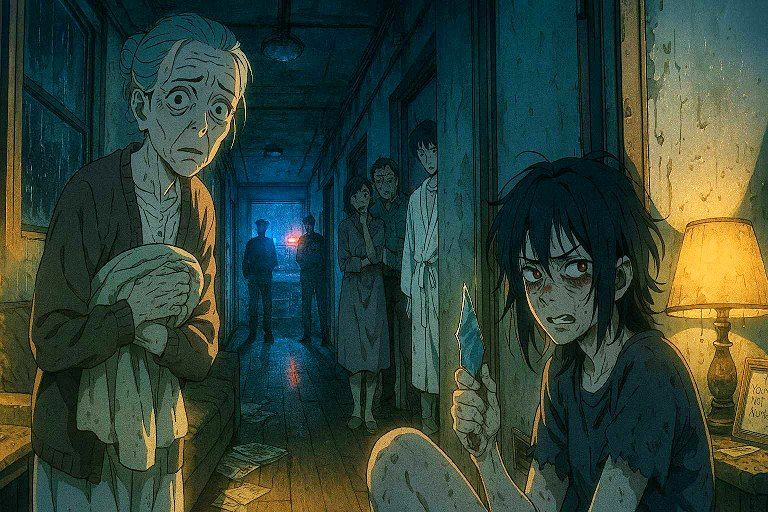
The scream arrived like a fissure in the dark: not just a voice, but an urgency that tore through the building’s silence and slipped through the cracks of doors, climbed the stairwell, and struck the fogged windowpanes. "Help, someone help me! This woman wants to kill me!" The words echoed, reproducing against every wall until they became a rumor that demanded a response. The old woman, whose name was Carmen, felt the blast in her chest as if she had been punched. That voice, cavernous and terrified, shook her to the core. For years she had learned to measure her hours, to collect small rituals that helped her get through the days: sweep at the same hour, turn the radio on at night, water the windowsill plant every Thursday. Nothing in those routines had prepared her for the violence now calling from the adjacent apartment. Her hands, bony and veined, found the doorknob as if it were the only anchor left. She shoved her door open. The sound rang down the hallway, heavy and definitive, and her footsteps were short and uncertain, marked by the fatigue of age. She moved forward, leaning on the railing, dragging a body that had learned how to bend without breaking, and her breathing came in fits as if every inhale had to be negotiated with the air. As soon as she crossed the threshold, she saw lights on at the far end of the corridor. The upstairs blinds had opened like frightened eyelids; from the balcony the young university student still held her robe, as if she had not had time to fully dress before coming down. The couple next door, Dolores and Ernesto, appeared with faces soaked in a mixture of sleep and alarm; the man who lived opposite the door, Ricardo, leaned against the wall with his arms crossed, trying to summon courage he wasn’t sure was his or borrowed. “What happened?” Dolores asked, her voice cracked and the cup of coffee still warm in her hand, trembling from adrenaline. “She screamed… said she wanted to kill her,” Ricardo replied, his gaze fixed on the ajar door of the neighboring apartment. His words were clumps of fear trying to take shape. Carmen struggled to thread together an explanation and the sentences came out wrong, broken into fragments: “She had been—I heard her scream—she started pushing… she broke the cup… I thought…” Each word left a shadow larger than the last. The idea that someone—a woman, her neighbor—had crossed the line into violence struck at her dignity. The night had become shifting ground where common sense no longer applied. Ernesto, receiving the account, didn’t wait: with clumsy, determined fingers he pushed the handle. The door was ajar like a toothless mouth. A pungent smell escaped into the hallway: cheap perfume, old smoke, and something else, a metallic tang that suggested worn resentment. The light spilling from inside was pallid and yellowish, attempting to hide the stains of the afternoon. Those who first peered in did so cautiously. The living room was messy; a sofa with a worn slipcover, photos on the mantel askew, a lamp that cast long, malign shadows on the walls. On the floor, among cups and magazines, a young, disheveled woman was propped against the wall. Her hair was tangled, her clothes rumpled, and her expression had been carved by a rage so deep it felt almost physical. Her eyes, bloodshot, searched the people there like someone looking for an exit in a maze. There was something in her hand. A small object at first unrecognizable, it caught and cut the light with a mute threat: a shard of mirror with jagged edges. She gripped it as one clings to a truth unwilling to let go. Saliva trembled at the corner of her mouth; she breathed in jolts that sounded like little explosions. “Don’t come closer,” the young woman said with a voice like a blade. “Don’t touch me. Don’t force me!” Carmen understood, in a thin sliver of awareness, that the danger was not a clear figure but an amalgam of fears and memories. She swallowed and murmured, “María… please… I don’t want trouble.” The neighbor from the next floor, Ana, tried to calm her in a voice that sounded too soft to herself: “Calm down, dear. Nobody wants to hurt you. Breathe with me.” The young woman laughed, a humorless sound, hanging in the group like a rusted knife. “They always say the same thing,” she spat. “Nobody listens to me. Can’t you see? Everything piles up!” Tension was an exposed wire. The student from the balcony, who had come down in her robe, could not stand it and retreated to the landing, hands shaking from adrenaline. Ernesto reached for his phone; his fingers dialed with the stiffness of one performing a ritual. The call to emergency services was handled by a mechanical voice that asked for calm and instructed someone to maintain distance. Minutes later, the metallic wail of a siren began to filter through the street outside. The flashing lights of a patrol reflected in the doorway like strange eyes peering in. Two officers stepped out of the car with measured strides and an authority that, at first, sought to impose itself through presence rather than force. “I’m Officer Gálvez,” he said, with a low, controlled voice. “Is anyone hurt?” “No…” Ana stammered. “But she’s frightened…and she has something in her hand.” Gálvez, with professional calm, raised a hand in a gesture of peace and kept the other near his belt, beyond the reach of emotions. Beside him, Officer Ruiz spoke in an even tone: “María, please drop what you have. Nobody wants to hurt you.” The young woman clenched her jaw until it ached. For a moment, the scene in the corridor felt like a rope pulled taut to the breaking point. No one knew whether what she held would be used to wound or to defend; everyone knew fear could turn an iron bar into a weapon and a shard of glass into a vow. “No!” she cried, and the insistence of her panic cut through them all. “I won’t leave. Not again!” Fragments surfaced in Carmen’s memory: voices raised at night, bodies trying to claim space, words that became slow blows. She thought of years in which she had learned not to attract attention, not to complain about small things because the world had taught her that asking showed weakness. Now, however, her throat opened and the word “help” accompanied her like a beacon. The scene tightened further when the young woman raised her arm in defiance. Ricardo stepped forward by instinct, but Ernesto held him back by the sleeve. “Don’t go closer,” he murmured. “Wait for them to speak.” Gálvez advanced a few steps and spoke with a blend of firmness and tenderness: “María, we know you’re angry, that you feel alone. Drop it and we’ll talk. If you come down, we can help you.” It was as though something inside her chest broke. She let the object fall. The shard rolled across the carpet and lodged under a table leg like a cut heart. Nobody touched it at once: a heavy silence filled the room as everyone held their breath, awaiting the next detonation. “Why?” Ana asked, her voice breaking. “Why did you get to this point?” The young woman flopped to the floor as if her body finally accepted defeat. Her breathing became one long sob. Between gasps she began to recount fragments: fights, accusations, sleepless nights, words that fed on themselves. “She pushed me… she called me useless… I couldn’t stand it anymore.” Her words mixed with memories that recoiled like tentacles. Paramedics entered with steady steps. A woman with a calm face approached Carmen and took her wrist to check her pulse. The old woman’s skin was cool to the touch and her heartbeat, still fast, began to stabilize as they wrapped a blanket around her and handed her a cup of water. “It’s okay, ma’am,” the paramedic said. “Breathe. Don’t take risks.” The young woman was lightly sedated to prevent her panic from pushing her toward something more extreme, and the officers explained gently that she needed to go to the hospital for evaluation. They led her away in the ambulance amid tissues, firm words, and looks that tried not to judge. While the intervention was underway, the neighbors lingered in the hallway as if they had taken part in a ritual. Conversations were in low voices, as though any loud sound might summon something. Ernesto and Dolores stepped back to give Carmen room, who clutched the blanket tight. “I never thought this would happen here,” Ricardo said, as if confessing something he had always carried. “I always believed this place was safe from such things.” “Things,” Ana answered, “aren’t inside or out; they’re here, between walls. We just don’t see them until they scream.” The student, eyes swollen, sat on the stair and hugged her knees. No one scolded her for coming down in a robe; urgency justified any neglect. The lamplight cast a long, sorrowful shadow that seemed to follow their movements. When the ambulance pulled away, the building was wrapped in a heavy quiet—an altered calm. Carmen returned to her apartment, but before crossing the threshold Ana left a note and a telephone number on the hallway table. Her handwriting was steady: “If you need company or help, call. You are not alone.” The note remained there like a small promise, a lifeline that could be reached at any hour. Inside her home, Carmen replayed the scene as one traces a wound with a fingertip to see if it still bleeds. The tremor in her hands eased and the smell of dust resumed its role as a mute witness. She turned on the radio; its low sound was strange and almost profane. Her memories tangled in an insistent question: what would have happened if no one had heard? How many times does a scream die against silence with no one to answer? The days that followed brought consequences not always visible. The young woman underwent a psychiatric evaluation and her story—part complaint, part explanation—revealed layers of neglect, frustration, and a rage that ate itself. For some, the incident was a wake-up call: the need to create stronger support networks, to look at neighbors not as mere scenery but as possible sources of aid. Carmen, who had felt both her own fragility and another’s in that night, began to stand at her door more often. She did not want to be a vigilante; she only wanted to be sure she had heard correctly. Her conversations with Ana grew; the couple next door offered an emergency phone number and the student suggested forming a companionship group for those who felt alone. Little by little, the building shifted from a collection of closed doors into an imperfect community learning to hold itself up. The experience left a mark: the certainty that words can save or condemn. The scream in the hallway became a warning that still echoed in Carmen’s dreams—the image of the young woman with the shard of mirror, the neighbors’ presence, the wail of sirens. But there was also the image of the blanket that wrapped her, of borrowed hands that steadied her pulse, and of the note on the table. When she went to bed, Carmen looked at the door and thought about how close she had been to being only a witness. That night had taught her that fragility is not only physical: it is a web of neglects and forgettings that accumulate until they become violence. She understood this intimately and painfully. And in a corner of her home, the windowsill plant was watered again each Thursday, as if that small ritual were an act of repair: to water the plant, to water life, to feed it with the certainty that someone, the next night, might hear and come. Source of the images. Image created with Bing.
No comments yet