 @mc5punk
Short story: The Gesture in Soles Plaza
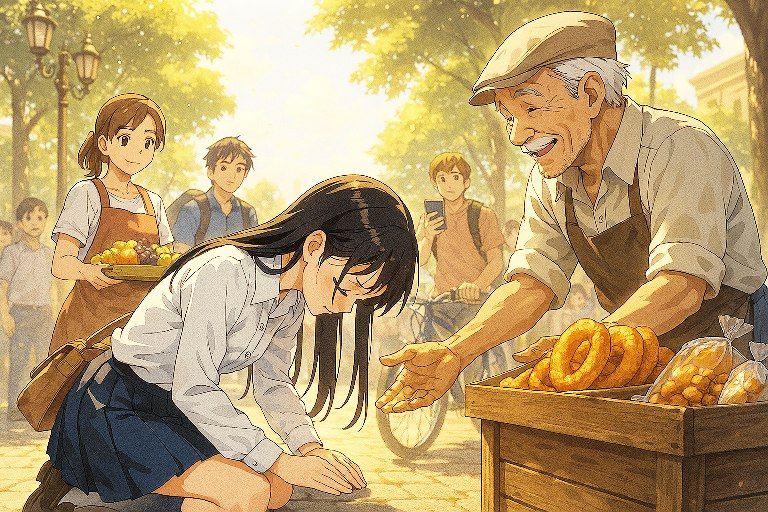
Soles Plaza was bathed in the golden light of midday; vendors, exercisers, and tourists filled the corners between the trees and the old lampposts. At one of the busiest stalls, Don Marcos, a man with weathered hands and an easy smile, carefully arranged his small sweets and picarones on a wooden tray. In front of his stall, a Japanese tourist, Aiko, watched with anxious eyes, replaying in her mind a misunderstanding that visibly upset her. Aiko approached again with hesitant steps, and unable to contain the impulse to make amends, she bowed deeply. Passersby stopped. Some set down their purchases; others peered from neighboring stalls. Aiko, already crouched, took a breath and then knelt, placing her hands on her knees in a solemn, almost ritual gesture. Aiko (with a trembling voice, speaking clear Spanish but with an accent): —Don Marcos, please forgive me. I made a mistake… I thought… I thought you were a scammer. I shouldn't have judged you like that. I am so sorry. Silence settled near the stall; the market’s usual noise seemed to fade for a moment. Don Marcos, surprised, set down the spatula he had been using and stepped forward calmly. His eyes, which had seen many stories in the plaza, softened at the sight of the young woman so contrite. Don Marcos (in a calm, kind tone): —My girl, don’t worry. The important thing is that you came to apologize. No one gets angry about a mistake when it’s acknowledged. Are you okay? Do you feel unwell? Aiko bowed her head, wiping a tear with the back of her hand. Aiko: —I feel ashamed. I didn’t mean to disrespect you. In my country, when you make a grave mistake in front of someone, we often show remorse this way. I wanted you to know that I truly regret it. Don Marcos smiled warmly and, with a slow and respectful movement, slightly bowed in return. Don Marcos: —What matters is that you understood what happened. Also, I’ve learned that sometimes fear makes people act without thinking. Don’t worry. From the next stall, Lucía, a woman who sold fruit and had known Don Marcos for years, watched the scene with moist eyes. She wiped her hands on her apron and moved closer. Lucía (with voice broken by emotion): —You don’t see a gesture like this every day. It must be valued. Much respect, miss. A few meters away, Ricardo, a deliveryman returning from a drop-off, leaned his bicycle against a lamppost and stuck his head out. A local tourist, Mateo, who had been walking with his phone in hand, had recorded the first seconds of the encounter without imagining the intensity of the moment; now he watched the screen, moved. Ricardo (smiling, trying to ease the tension): —Sometimes it’s enough to acknowledge the mistake. No need for a fight. Do you want me to help you up? Aiko nodded gratefully and, still with a broken voice, answered: Aiko: —Yes, please. I feel a little dizzy from the shame. Don Marcos extended his hand with firmness and gentleness. His fingers, rough from years of work, held Aiko’s wrist securely. Don Marcos: —Come, take my hand. There’s no grudge here. Just learn and move forward. As he helped her to her feet, Mateo, with his phone still in hand, hesitated for a moment before speaking. Mateo (respectfully): —Excuse me, do you mind if I share this on social media? I think more people should see this example. Aiko, somewhat uneasy at the attention, frowned slightly as she searched Don Marcos’s eyes for an answer. Aiko: —If it helps people reflect and not judge so quickly… it’s fine. But I don’t want this to become a joke. Don Marcos nodded with a calm smile. Don Marcos: —If you’re going to show it, show it respectfully. If not, let it stay between us. The important thing is that everything is fine. Lucía, now nearby, let a few coins drop into her stall’s scale as a symbolic sign of support and added, with a steady voice: Lucía: —I hope those who see this remember that courtesy and patience are worth more than haste. Sometimes haste makes us lose sight and compassion. Ricardo, wiping his hands on his pants, joked gently to lighten the mood. Ricardo: —And that before accusing someone, it’s better to ask. It costs nothing. Don Marcos chuckled softly, showing teeth stained by years but sincere. Don Marcos: —If you want to celebrate that everything is okay, I’ll offer some picarones. I have a fresh batch today. Aiko, now calmer and still with damp cheeks, took a deep breath and smiled for the first time since the incident. Aiko: —Thank you… I would love that. I didn’t expect so much kindness. Mateo stopped recording for a moment and put his phone in his pocket, watching the scene with a mix of relief and admiration. Mateo: —I think this is worth sharing. Among so much negative news, seeing something like this can inspire. The people present gathered around Don Marcos’s stall. Some neighbors brought chairs; others offered cups of water. Voices dropped to low tones as they commented on the rarity of finding such sincerity gathered in a single gesture. Aiko’s apology, her bow, and Don Marcos’s outstretched hand became the center of a small human stir: a misunderstanding transformed into a lesson. Lucía brought a tray of fruit to share and Ricardo told an anecdote about a time he himself had judged someone wrongly and then had to apologize. The stories intertwined, and within minutes the plaza filled with voices celebrating reconciliation—not as a spectacular event, but as a simple reminder of empathy. Aiko, now composed, spoke in a serene voice: Aiko: —In my family we were taught that asking forgiveness has power. It doesn’t erase what happened, but it changes what comes next. Today I learned that people can be understanding even when you make a mistake. Don Marcos looked at her as if she were a distant granddaughter and replied tenderly: Don Marcos: —And I learned that, although customs differ, remorse and humility transcend borders. Thank you for coming and apologizing from the heart. As the sun descended and the plaza returned to its usual rhythm, the story of the moment lingered in murmurs and smiles. Some would post it on social media within hours; others would carry it in their memory as a small everyday fable. For Aiko, it was a lesson in respect and courage; for Don Marcos and the neighbors, a reaffirmation that tolerance and generosity remain alive in the simplest corners of the city. When people dispersed, Don Marcos packed up his stall with the satisfaction of someone who had seen a misunderstanding turn into reconciliation. Aiko, holding the empty tray from the picarones and with the light feeling of a duty fulfilled, walked away toward her hostel, carrying with her a story that, unintentionally, had brought several people together for a moment. Source of the images. Image created with Bing.
No comments yet