 @mc5punk
more from that month
@mc5punk
more from that month
Short story: Reborn from the Ashes
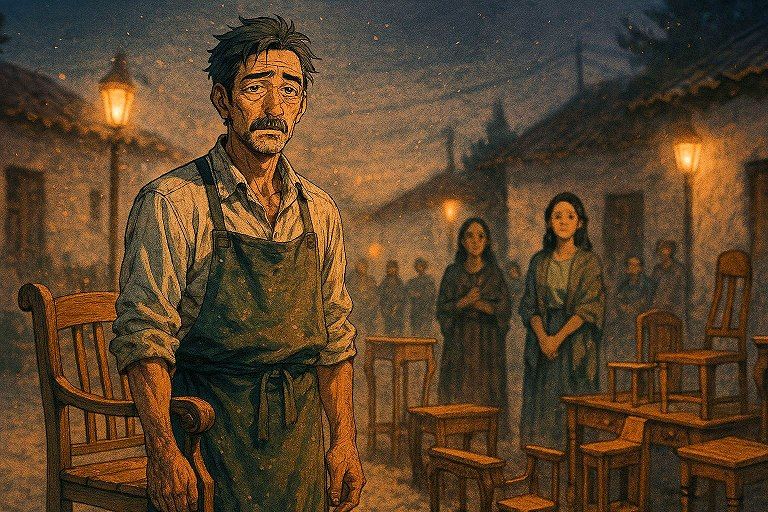
Luis Herrera was born and raised in a village whose name barely appears on maps: a place of low houses, dusty streets, and squares where time seemed measured in fallows and harvests. His childhood smelled of freshly cut wood and the murmur of tools: his father had been a carpenter and taught him to read the grain of wood as others learn to read faces. As a teenager he learned to repair chairs, straighten springs, and temper nails; skill with his hands gave him an early, simple dignity. The workshop where he spent much of his life was a refuge that smelled of sawdust, oil, and cigarette smoke; there, among splinters, Luis upheld his identity. Having work meant belonging. It meant buying bread, paying off a debt, covering Marta’s school, his younger sister’s, and leaving a few coins on the table on Sundays. When the workshop closed — an irrevocable measure taken by the main factory after orders fell off — the news was like a crack spreading through the house: first the foreman delivered the announcement in a low voice, then hands were left without work, and finally pride splintered. Unemployment moved in like an unwelcome tenant who paid no rent: days filled with unfinished coffees, aimless walks, and the sharp feeling that life was fraying. At first, alcohol came as a remedy: a few drinks with old coworkers, some beers in the evening to calm the anxiety of feeling useless. The line between casual drinking and dependence was thin, almost imperceptible. What began as a social balm became a folding of reality: alcohol dissolved shame momentarily and, in time, became the only place Luis could find oblivion. Nights lengthened; mornings came loaded with guilt and broken promises. Lack of money, unpaid bills, and the inability to find work worsened the spiral. Selling the old pickup truck to pay a debt was an act of humility that did not relieve him; it was a defeat. The family, which had once been his support, began to resent him. Doña Rosa, his mother, aged quickly under the strain of repeated disputes. Marta, who was then studying at night school, tried to stay firm; every time she saw her brother staggering, she felt she had to choose between leaving home or becoming the guardian of a man who no longer matched the memory of his childhood. Violence in that house was never extreme: there were no blows, but there were words that cut and looks that were daggers. Luis was proud and wounded; rage found its outlet in verbal anger and in the way he justified abuse with excuses. It was in one of those nights that an argument with Marta ended with broken plates and promises nobody could keep. Marta made a decision that hurt both of them: she refused to support him if he did not accept help. The door to the rehabilitation center opened because of Marta’s insistence. She called anyone she could and secured a place for Luis in a medium-term rehab program in a nearby town. Entering was an act of humiliation and hope. Humiliating because being admitted meant publicly admitting failure; hopeful because it offered a way out that didn’t mean death. The first weeks at the center were about adjustment. The rigid structure — schedules, shifts, daily meetings — contrasted with the disorderly freedom alcohol had given him. Volunteers, therapists, and fellow residents formed a minimal community that demanded truth and discipline. There, Luis faced his story: the loss of his job, petty crimes committed to sustain his drinking routine, nights when he skipped interviews. Individual therapy with Clara, the center’s psychologist, was a slow clearing of secrets. Clara was not indulgent; she was methodical and patient. “It’s not just about stopping drinking,” she told him one afternoon while rain tapped the window. “It’s about hearing what your body and memory have kept silent. Why do you do it? What space are you trying to fill?” Luis, who had learned when young to externalize rage but not to name pain, felt for the first time that he had to look that question in the face. He spoke of his father, absent for years; of the humiliations at the factory when staff were cut; of the feeling that the city, the country, had used and discarded him. He spoke of the guilt of not being there when his mother fell ill for a time. The words came haltingly, sometimes muffled by quiet sobs, but each sentence was a small rescue. In group sessions he heard testimonies that were broken mirrors. Antonio, a man with a rasping voice and hands marked by work, spoke with a tone of salt and resignation. “I lost my marriage,” he said. “I lost everything I thought mattered. I sat at the edge of the cliff and told myself: this is the end. But someone put a hand on my shoulder. I’m not here to give lessons; I’m here to say help sometimes comes late, but it comes.” His story resembled Luis’s and yet differed. The biggest difference was that Antonio spoke of perseverance: starting over each day, the humility of admitting relapse, and the necessity of small tasks that sustain sobriety. Those accounts altered Luis’s nights: he went from muted to listening with the focus of someone seeking a compass. At the rehab, besides therapy, there were community jobs that helped maintain the center. He found a modest craft there: restoring furniture, sanding tables, returning things to function. There was a symbolic value in it: he who had lost his trade returned to build structures for others. Over time he acquired a routine that seemed to temper his fury: rising early, working in the community workshop, attending sessions, cooking, talking. The money he earned there wasn’t much, but enough to ease the uselessness. One day he learned about a protected workshop in his town — a local project that gave employment to those in reintegration processes. Javier, the foreman, assessed him cautiously and put him to the test. “You didn’t come here for charity,” Javier told him. “You came to work. If you do it well, you’ll have weeks of contract. If you fail, there’ll be others.” The first contract was short, but for Luis it was his first proof of capacity to keep a rhythm. Manual work reminded him that his body still remembered what it had been born to do: to shape, measure, adjust. Spending hours on a concrete task was a balm for his mind, which no longer had to entertain the past or the anticipation of future catastrophes. Family did not reunite all at once. Doña Rosa remained cautious. She had received too many wounds to regain trust without safeguards. The first time Luis returned home, the scene was ritualistic: his hands still stained from labor, her face a mix of distrust and love. “Son,” she said in a low voice, “I can’t forget you, but I also can’t forget myself. Take things slow. I don’t want empty promises.” Marta, meanwhile, became the figure who maintained the boundary between support and demand. She learned to set limits that, though harsh, provided Luis a secure framework. She didn’t give him money to spend; she refused to tolerate lies; they spoke plainly. In that balance of firmness and affection, Luis began to rebuild trust day by day. Still, rehabilitation was not linear. Relapses were a cruel part of the process: nights when guilt and nostalgia for his old life were stronger; days when a missed call pushed him toward a drink; episodes that nearly cost him his new job. Each relapse left scars: sums of shame, setbacks in others’ trust, and relapse to psychological starting points. But the center and the community operated with a different logic: relapse was not an absolute end but a warning and—if the person reengaged—the chance to learn. Alcoholics Anonymous meetings were fundamental. There, in rooms of dim light and chairs arranged in circles, Luis listened and gradually spoke. At first his voice was timid, barely a confession among many. Over time he learned to narrate his fall without theatricality, with the raw honesty recovery requires. Sharing his experience freed him and made him accountable. His story did not seek to move hearts; it sought truth. “My name is Luis,” he said one night in the circle. “I thought alcohol was a bridge; it turned out to be the abyss. I lost jobs, affections, my mother’s trust. I’m not here to ask forgiveness with words—I’m here to work each day and prove it.” Those words had the quality of a public confession that made him human to others. People approached him, hugged him, offered work, or simply listened. Relationships beyond the recovery circle also began to mend. Carlos, his childhood friend, served as a bridge to his former life. Not all of Carlos’s visits were easy; sometimes he brought reminders of old habits: memories of afternoons drinking and laughing could sting. But Carlos learned to support him without celebrations that would entice relapse. He offered, above all, small tests: a coffee, a walk, a returned call. These small gestures accumulated and sustained a new routine. As months passed, the village witnessed a discreet change. Those who had known him since youth looked at him differently: some with skepticism, others with hope. AA meetings became more attended when locals began speaking about Luis’s story. His experience, far from being an exception, became a narrative others used to imagine their own exits. There was a turning point that was not dramatic: no epiphany, no cinematic scene. It was the accumulation of small victories: a whole month without relapses, repayment of an old debt, a dinner with his mother where they spoke without open recriminations, an afternoon when Marta looked at him without needing to hold back tears. In a meeting Antonio looked at him with pride. “You’ve endured,” he told him. “Not because you haven’t fallen, but because you’ve gotten up.” Luis learned to accept melancholy’s presence without letting it define him. Melancholy was often a companion in the process of remembering what had been lost. Remembering was not always pain; it could be a way of honoring what had been and building respectfully what could be. Rehabilitation also required bodily work: physical exercise, regular meals, restorative sleep. These small practices, once insignificant, now carried moral weight: caring for the body was caring for willpower. Clara worked with Luis on coping strategies: naming emotions, breathing exercises, routines to break crisis inertia. Having practical tools helped him face temptations and manage anxiety in risky scenarios. In a symbolic act of repair, Luis stayed after hours at the community workshop to restore a table for the village church and a bench for the square. Each piece handed back into public use was not only wood returned to life but evidence of his commitment to the community that had watched him fall. These small but consistent actions opened a daily relationship with people and the town that raised him. Over time, Luis’s public voice took on a testimonial tone: invited to share in meetings and sometimes at the parish, he spoke without dramatizing, with plain honesty. He recounted the unemployment that sparked his descent, the verbal violence he had exerted and now regarded as a moral debt. He said plainly that he wasn’t “cured,” only under constant vigilance and steady work. The attitude mattered: his humility and coherence made him believable. Some wondered why he remained so austere; others, why he sought no glory. The reality was that the redemption he found aspired not to grand gestures but to intimate transformation: repairing harm where possible, apologizing with deeds more than with words, and holding sobriety through small habits that, amassed, changed life. The village, initially reluctant, eventually saw in Luis not a pariah nor a hero, but a man willing to live with his history openly. His testimony inspired others to seek help; AA meetings increased in attendance, and a support network began to function as a communal lifeline. Clara continued to accompany him in periodic sessions; Javier kept offering work possibilities; Antonio became a patient sponsor in the circle. Years later, Luis’s figure was that of someone who had learned to walk with melancholy as a companion without letting it become a prison. There were gray days and bright days; life never promised the absence of setbacks. Moments of nostalgia still bit—a call from an old foreman about a new project, a festival where the smell of beer tempted him—but the accumulation of learnings, the family’s limits, therapy, and habits had built a fragile but real fortitude. In his intimate core, the relationship with his mother improved. Doña Rosa aged with a tender look; Marta consolidated her own path and, in turn, received recognition of a brother who showed up to life responsibly. Carlos remained a friend, now with the prudence of someone who knows companionship cannot excuse old failings. Luis’s redemption narrative never pretended to be an epic; at most it was a novel of daily survival. Death had circled his life, literally and figuratively — there were no explicit attempts, but the sense that the abyss was possible remained —. Failure was the first word of his fall; rehabilitation was the word of return, slow and contested. Money, though scarce, stopped being the obsession that drove him to drink; unemployment ceased to be his defining identity. Violence, once a way to hide pain, was named, understood, and, as far as possible, contained. Redemption he reached was not an endpoint but a process. It consisted of speaking his testimony aloud, recognizing the suffering other people carry, putting his hands back on wood as someone picking up fragments of a lost time, and allowing the community to ask effort rather than perfection. His life became more austere and also steadier: his reconstruction was a sum of small, repeated decisions. In a symbolic act that closed many wounds, Luis organized a small exhibition in the square with the furniture restored in the workshop: benches, tables, chairs, and frames that had once been broken. He invited his mother and sister; townspeople gathered. It was not a grand ceremony, just an afternoon with people speaking softly, drinking mate, and smiling. That day, seeing his work in others’ hands, Luis felt something of the past transform: destruction had at least partly served to build. He lived with no guarantees. He knew relapse could strike again, but he also knew help existed and that he had built networks that would not abandon him. His testimony, deeds, work, his family’s patience, and those who had supported him traced a possible map: one where redemption was not a myth but a daily task. Thus, amid traces of melancholy and flashes of relief, Luis Herrera continued his life with the faint, sublime certainty of someone who had learned to be reborn from the ashes. Source of the images. Image created with Bing.
No comments yet