 @mc5punk
more from that month
@mc5punk
more from that month
Short story: The Pencil Lighthouse
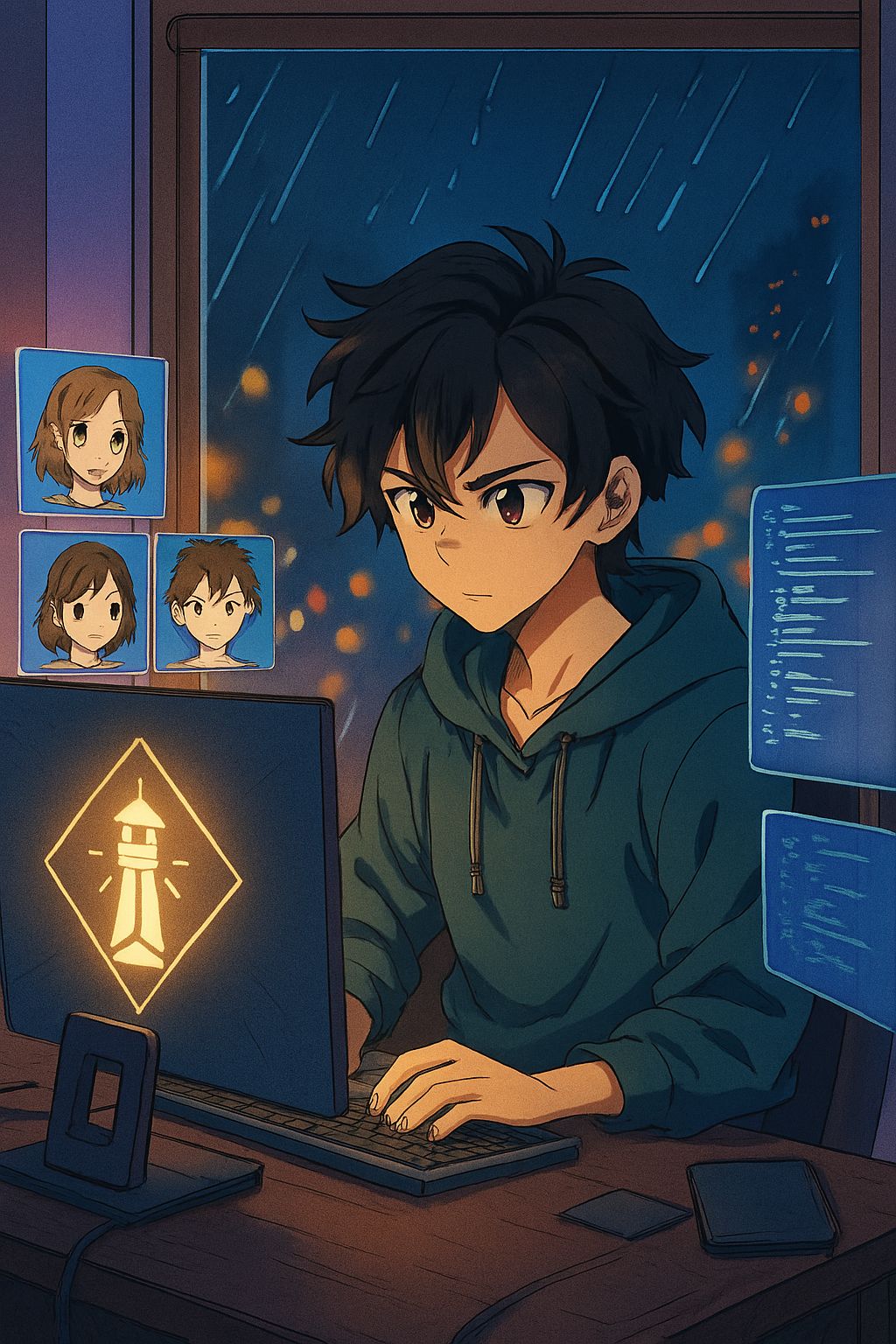
The rain had left a sheen on the asphalt that turned the city into a moving constellation. Kaito closed his bedroom window and returned to the screen; the monitor's light washed his face and made the shadows look like other characters watching his work. Outside, the suburb murmured in lights, but inside everything was silence and cold tea. He had spent months turning YouTube nights into small victories: a tag that learned to breathe, a script that stopped being an exercise and began to tell stories. His site, which he had tended with the care of someone mending a beloved garment, was a garden woven of pastel colors, icons Mei drew with the delicacy of someone who draws memories, and backgrounds that froze time like paused anime openings. Mei said the project had a soul; Riku, his childhood friend, insisted it had a future; and Sora, the moderator, called it his responsibility. Each had contributed a piece that fit without force: Mei gave calm with her palettes and lines, Riku brought sense to the system's architecture, and Sora built bridges between the project and the people who arrived seeking something more than aesthetics. Together they had sparked something: a Linux distribution designed for drawing, streaming, and dreaming without the system getting between the hand and the line. The official ISO was a promise wrapped in a friendly installer—preconfigured tools, optimizations for graphic tablets, themes that caressed the interface. The world responded with praise: streamers began showing installations live, volunteer translators adapted the documentation, and the community grew where technique and beauty converged. At first everything was celebration. Forums shared color shortcuts, scripts to automate exports, and wallpapers that commemorated moments. Kaito read the comments with the curiosity of a learner discovering his creations had started to live on their own. Aoi, a streamer with a warm voice and magnetic presence, devoted a segment of her streams to showing tools and site backgrounds. Lina, a design student in Argentina, uploaded tutorials dismantling and rebuilding themes; Omar, a self-taught programmer in Morocco, contributed small patches and tests. The community became an ecosystem: artists, developers, enthusiasts—all drawn by the promise of an environment that recognized their needs. The calm cracked like thin glass. The first signs arrived as whispers—a thread in a forum, a screenshot in a support channel, a private message from Aoi interrupting a live stream. "Kaito... what is this the system is asking me to install?" she asked, her voice enough to make the air hold. Aoi's screen showed pop-ups offering unnamed extensions, permission requests that made no sense, and erratic behavior: slowdowns, new icons no one had designed. The official ISO shouldn't do that. Riku, reviewing logs, was the first to measure the severity in numbers. "The hashes don't match," he announced, voice clipped. "Someone is distributing patched ISOs." What Kaito had believed was a refuge became a trench within hours. NebulaWare appeared as a faceless shadow: an anonymous group offering "improvements" and patches—versions whose installers had been altered to include adware, data-collection scripts, and, in some cases, subtle backdoors. The worst part wasn't just those versions' existence; it was knowing there were vectors among the people with access to repositories and package chains that could be exploited. The betrayal was a more intimate sting: Haru, a former collaborator Kaito had watched grow over coffee and late commits, began appearing in logs with small but significant modifications. His alterations weren't grotesque; they were subtle enough to pass unnoticed unless versions were compared carefully. "I thought you'd understand," Haru had written in a cold message. "If you want this to be big, you have to monetize. I only opened a door." Kaito felt the betrayal like a cut that didn't bleed immediately but burned deep. Haru's private messages and the threads in alternate forums where NebulaWare praised their "improvements" began to corrode the trust so carefully woven. News arrived with its own melodrama: stories of compromised installations, users with systems full of intrusive ads, tools that silently phoned home. Sponsors grew cautious and some contributors stepped away for fear of being implicated. Kaito's response was twofold: technical and human. He couldn't act from indignation; he needed order. Riku deployed virtual machines to reproduce incidents, compared official ISOs with infected mirrors, and hunted for fingerprints in package metadata. Mei, sleepless, reviewed every icon and sprite; her eyes found patterns where others saw only pixels. Sora organized communications: she drafted messages with a clarity that mitigated panic and prepared a FAQ understandable even to those who had never signed a PGP key. "We want people to know the truth," Sora wrote in the first public statement. "Don't download ISOs from unofficial sources. We'll publish a guide to verify signatures in twenty minutes." While the team worked, NebulaWare intensified its campaign. They published instructions to patch ISOs, offered payments to disgruntled contributors, and seeded disinformation accusing the official team of "censorship" and imposing unnecessary control. Everything seemed designed to divide attention and sow doubt. And Haru, from his corner of resentment, justified his actions as a step toward "professionalizing" the project. The community, however, refused to sink into panic. It was the users, unexpectedly, who held the most effective defense. Lina posted a step-by-step video on how to verify signatures; Omar, meticulous, traced coincidences between suspicious changes and secondary accounts; Aoi, live on camera, showed her audience how to check ISO integrity, crying at times when thank-you messages flooded the chat. Anonymous users began replicating tests and sharing findings; volunteers offered time to review packages and run audits. "I found a package with suspicious metadata changes," Omar announced. "Haru uploaded it last month from a secondary account." With tangible evidence, Kaito and his team moved from confusion to structured action. They published a technical report that demonstrated, plainly and without theatrics, the chain of malicious commits. Riku designed a cryptographic signing system where multiple keys were held by different maintainers, preventing one person from compromising the project's integrity. The installer was rewritten to verify signatures before proceeding and to issue clear warnings if anything didn't match. They also implemented automated tests and static analysis in the contribution flow to detect suspicious dependencies. Mei, meanwhile, conceived a visual seal that would serve as a beacon: a stylized pencil representing the union of art and guidance. They placed it in the installer and on the website—anyone who saw the seal would know the ISO came from the official source. Sora explained everything in a livestream—no needless technicalities, only human terms: "Signatures guarantee that what you download comes from the official source. They don't stop someone from modifying the code if they know what they're doing; they protect people who can't tell a legitimate ISO from a tampered one." Sora's message landed. Tutorials multiplied, technical guides were translated, and testimonials from users who had recovered their systems poured in. Aoi reinstalled on camera, this time with Riku supervising, and demonstrated how verification restored confidence. Slowly, legitimate downloads rebounded; volunteers helped purge suspicious mirrors from servers and repositories shut accounts linked to NebulaWare. NebulaWare changed tactics—from technical tampering to public disinformation—claiming signatures were a control mechanism and arguing that the community's "aesthetic version" should be free even if risky. But the now-mature community rejected the false choice. The narrative Kaito and his team spread emphasized transparency, responsibility, and education. Haru, isolated, posted a final justification that sounded more like spite than reason. In a direct message Kaito read without expecting reconciliation, Haru wrote: "Don't think you can stop us. People will prefer the fast, the flashy." Kaito thought of the sleepless nights, the messages of gratitude, the hands that had left marks on the project. He did not reply with anger; he replied with the serenity given by the conviction that he had chosen to protect the community that had trusted them. "I don't want to stop anyone," he wrote. "I want to protect those who trusted us. If that seems small to you, then you weren't with us from the start." The silence after that message was, for Haru, defeat and for Kaito the closing of a chapter that didn't deserve more public drama. Some NebulaWare members were discovered and had their accounts closed; others fled to smaller forums where their audiences were tiny and their impact, limited. Recovery wasn't instant. There were setbacks: users who lost files, systems that took time to heal, and mirrors that took a while to be taken down. But the sum of technical work, outreach, and solidarity bore fruit: legitimate downloads stabilized, sponsors returned cautiously, and the community emerged more responsible. The governance processes Riku implemented, the responsibly defended aesthetics Mei insisted on, and Sora's empathetic communication became the project's new structure. In time, the distribution regained its status not only for design and functionality but for the trust it inspired. Kaito watched signed commits stream into the repository and, for the first time since the crisis, felt the healing was real. One clear night, while the server processed an update, Riku let out a low laugh. "You did well," he said. Mei rested her head on the back of her chair and smiled with the tiredness of someone who had fought and kept painting. "And now we have a pretty seal," she murmured. Sora, discreet, posted the new main message on the website: "Official secure release — signed by the team. Thanks to the community." The phrase spread and became a refrain among those who had lost and those who had helped mend. Years passed. The distribution continued to stand out for its anime aesthetic, themes that stroked interfaces, and performance tuned for tablets. But something in the project's pulse had changed: beauty ceased to be the ultimate goal and became also a responsibility. The community, once scattered, had learned to guard what it loved. Aoi, Lina, and Omar remained active voices; Mei continued refining palettes; Riku maintained the infrastructure with care; Sora kept translating the technical into the human. Kaito, who had started as a kid in front of YouTube, later found himself at conventions, stepping onto the stage with his friends. He looked at the audience: eyes lit by tablets, T-shirts with the pencil beacon, temporary tattoos bearing the official seal. He didn't deliver a grand speech. He simply said: "This isn't mine. It's everyone's." The applause came like the returning tide—inevitable and calm. Haru was not among them. Kaito thought that perhaps the absence hurt less than the certainty of having chosen rightly; perhaps that was enough. Outside, it began to rain again, and the pencil-shaped beacon Mei had drawn stayed lit on the screen, a silent guardian of a project that had learned to be beautiful and, at the same time, responsible. Source of the images. Image created with Bing.
No comments yet