 @mc5punk
more from that month
@mc5punk
more from that month
Short story: Neon Hug
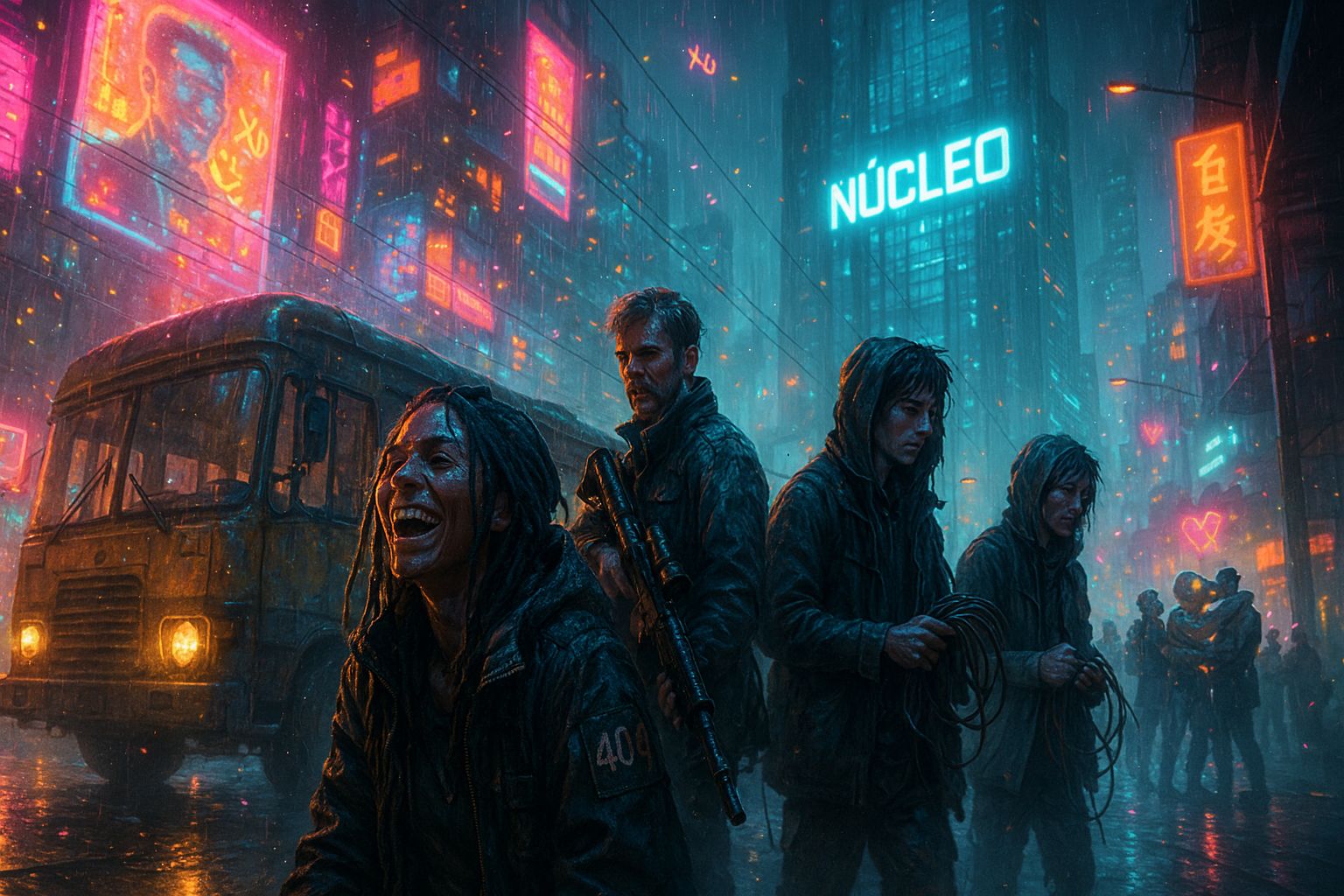
2070. The Earth smelled of acid rain and reheated coffee. The big cities - now neon constellations, data dumps and billboards with synthetic smiles — glowed like convalescent fireflies. Overhead, the glass domes where the oligarchs lived reflected a world that had never known unfiltered sunrises. Down below, in the maze of tubes and street stalls, people were learning to laugh at misery like one who learns to save for an impossible luxury. The oligarchy called itself ”The Harmony Junta". His ministers were bankers in tailored suits and philosophers for hire; his most dangerous servants were algorithms. Those algorithms didn't just recommend songs or brands: they mapped affections, calibrated joys on demand and sold calmness in installments. With a combination of neuropublicality and microstimulos, the feelings themselves could be bought, rented or programmed in deluxe versions. A free app promised you to “be happy today" and, if you accepted the small print, it made you love who the Board wanted you to love. A disparate group came out on that set: the Hack-Guerrillas, also called The Cumulus because of their cloudy operative routines and their habit of disappearing in tea smoke. They were street hackers — brains with code tattoos, ex-drone couriers, a barista who knew how to compile with one hand and fry arepas with the other — and, above all, they had a sense of humor. Her captain, Lola ”404" Navarro, had a spider's web laugh: thin, sticky and always about to entangle the opposite. - Are you ready for this? - Lola asked, adjusting her viewfinder with a theatrical gesture-. If we don't go out, at least let there be some good meme material left. "If it goes wrong, we have a laugh afterwards," Pitch said, as he loaded his rifle and a can of non—alcoholic beer. But I want to laugh now. His first plan had the elegance of a well-told joke. On a Sunday night, when the elites were dining at restaurants where the air came with a harvest label, The Cumulus released "The Hug." It wasn't a bombshell: it was a massive upgrade. They inserted a patch in the algorithm that modulated affections and, for six glorious hours, affective preferences collapsed into one thing: people began to embrace the first thing they saw. CEOs hugged each other in public squares, influencers gave spontaneous hugs to lampposts, and an augmented reality campaign turned advertising screens into “hug me, please” messages. The security cameras captured millimeter overflows of tenderness that the official news tried to process seriously and ended up going viral as the comedy of the year. - Did you see the minister? - laughed K, the barista—coder-. He cuddled up with his digital butler. How cute! —I cuddled with a delivery robot—" said Rolo, a former courier. He charged me for the hug on the flat rate, but it was worth it. The Board responded with an effective mix of outrage and protocols. Vigilant algorithms tried to reinstate the affective market with behavioral updates and fines. But amid laughter and confusion, something changed.People began to question why their urge to hug had been asleep before. A rare spark, not saleable in premium packages. The second onslaught was less sympathetic and more spectacular. The subsequent cyberattack - dubbed "The Server Nap” - managed to shut down the ads for three days. Without advertising, the streets recovered priceless words: "hello”, "how are you?”, “I was wrong”. The oligarchs reacted with physical forces: patrol drones, tie-wearing robots hurling warnings and excuses. In the squares, without the perpetual distraction of screens, people began to improvise barter markets that smelled of hope and burnt bread. "Turn off the screens—" Lola ordered. Let them see that they can look at each other without filters. - What if we get attacked? K asked, with the cable in his hand. —We'll tell each other bad jokes between bombs," Lola replied, with a smile. It worked before, didn't it? But the Clusters knew that the algorithm was only one side of the coin. When the Junta deployed paramilitary units that did not need a smile to obey, the guerrillas understood that the resistance had to learn to speak the other language: that of steel. They set up traps with black humor — smoke bombs that released confetti and maracas, mines that when they exploded projected bad jokes in HD Hologram - because, for 404, war without laughter was like a code without comments: unbearable. The climb became cinematic. Improvised heroes crossed roofs under neon, chased by motorcycles that smelled of oil and nostalgia. On a rooftop, in the middle of a neon rain, Lola and her deputy commander - a former marketing executive turned sniper named "Pitch"- planned the final blow: to enter the Nucleus, the tower where the Junta housed the Great Algorithm. His plan had the elegance of a bad joke and the precision of a video clip choreography: Pitch would distract the drones with fake ads of unrepeatable offers (2x1 in purchasing power), while Lola and a team sneaked through forgotten ducts. - Pitch, are you really going to promise 2x1 in purchasing power? - Rolo asked, laughing. "If you believe me, I'm running for minister of offers," Pitch replied. I prefer my rifle, though. Inside the Core, the aesthetics were an exaggeration of tastes: sound carpets, data sculptures and a central room where the algorithm slept wrapped in blue light. Their defense consisted of a legion of human guardians with emotional modulation implants. In the clash, the guns talked - bullets, and also messages that deleted sentimental profiles - but between shots there were ridiculous moments: one guard, confused by an injection of humor, began to recite love poems from the pre-digital era; another, after receiving a pulse that altered his musical preference, started dancing salsa in front of a security console. - What the hell...? - muttered a guard as he wiped away a tear -. How long have I known this sonnet? "Since someone slipped you a free humanity upgrade—" K said, wiping a panel with a smile. When they arrived at the room of the Great Algorithm, Lola did not pull out a lever or write a solemn command. He put an old joke on the matrix entry: "What is the favorite algorithm of romantics? The one who pairs compatible souls."The joke triggered an unexpected cascade: running humor at the core caused the system to reinterpret "affect" as an unmarketable variable. The algorithm — tired of being a seller of emotions — had an existential bug and began to distribute affection without fees: free, without subscription. - Did that work? - whispered Rolo, incredulous. "It works better than any patch—" Lola replied. The funny thing is that algorithms don't like to be trolled with old-fashioned humor. On the surface, the city responded with tender chaos. Shopping networks collapsed on orders of gratuitous affection; bankers, unable to sell calm, began to cry at their desks; an influencer handed over her last tie at a hug auction. The Junta tried to regain control with violence, but now people did not obey out of fear or out of payment: they obeyed because someone had shown them that another response was possible. Even some guards, previously armored by order and salary, sat down to share a cold bread with the people they had protected. - And now what do we do? - asked Pitch, looking at the crowded square. "We danced—" Lola replied. But then, we organized canteens and schools without algorithms. It wasn't all utopia. The collapse of the systems caused responsible disorder: shortages of goods, failures in services and endless discussions in impromptu assemblies about how to organize schools without algorithms. But comedy became a civil weapon: laughing at the absurdities of power created networks of union more resistant than any code. In the end, the victory was neither total nor clean. The Junta did not disappear completely; it mutated, like bad habits, and certain black markets of affection reappeared. However, the core of the city changed: the surviving algorithms learned to be tools and not masters. Lola and her family became an urban legend - a mixture of myth and meme - and gave themselves the luxury of disappearing on a second-hand bus that smelled of oil and hope. In 2070, under the neons and the rain, the Earth was reprogrammed into little things: a stolen hug, a laugh in a subway, an improvised song that no one could sell. The revolution showed that the affections, no matter how they are calculated, always have room for the unpredictable: laughter, anger and that human stubbornness that resists being paired in two uninteresting installments. Source of the images. Image created with Bing.
No comments yet