 @mc5punk
Short story: Echoes with Wi‑Fi and Nostalgia
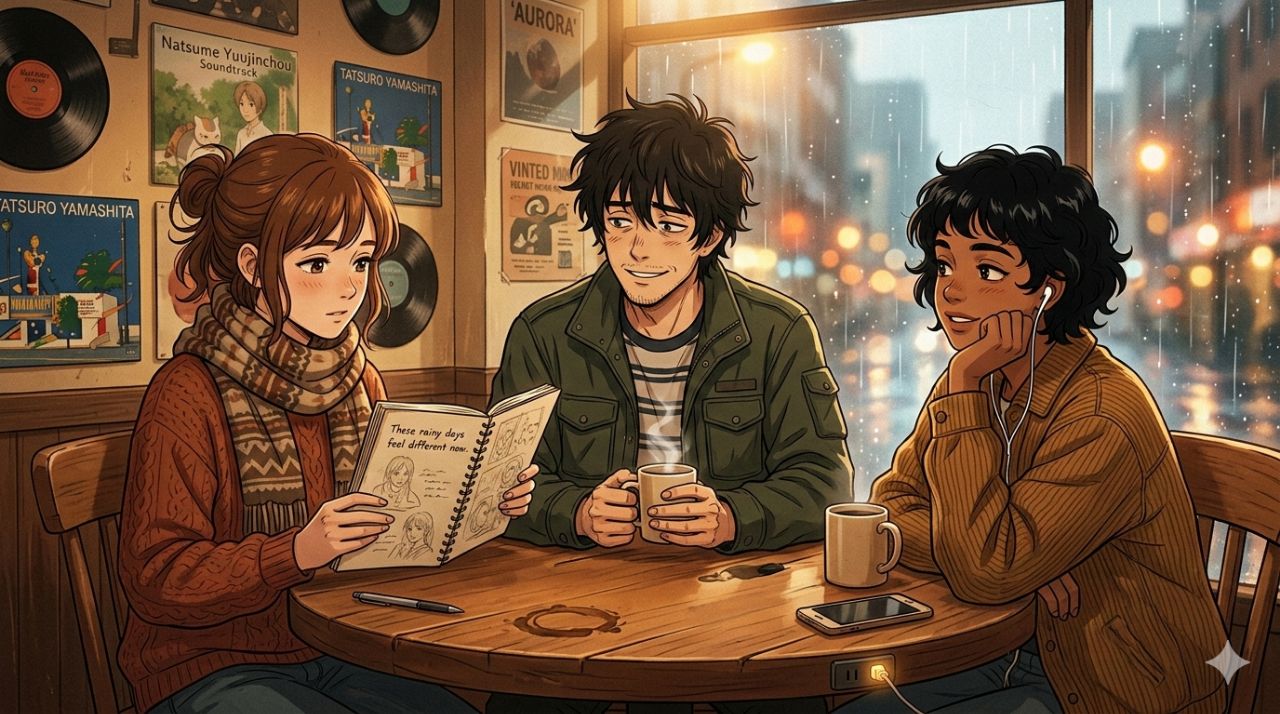
The café was called Aurora out of romantic habit rather than technological aptitude; its walls were covered in vinyl records and concert posters, and every table had, with ironic courtesy, an outlet waiting for whoever wanted to claim it. It was a refuge for those who still collected memories as objects and conversations. That autumn afternoon the rain traced uncertain writing on the glass. Clara, Miguel, and Sofía arrived separately and met at their usual table, the one with a little stain that, according to Miguel, “told stories of spilled coffees and half-made plans.” The three shared the age range of those the culture calls Millennials. They carried the same sentimental map in their pockets: the memory of corded phones, mixtapes recorded at dawn, the first time they connected to the internet with a dial-up chirp that sounded like a portal. On their screens, however, a constant buzz of notifications and apps promising efficiency and instant delivery accompanied them. “Remember when life’s drama was losing the walkman tape?” Miguel said with a smile that mixed melancholy and irony. “Today the drama is deciding which series to watch among four hundred titles and feeling existential guilt for finishing none of them.” “And the tapes,” Clara replied, holding her cup like a reliquary. “We would record songs off the radio with clumsy hands and the patience of archaeologists; each recording was a treasure. Now everything is streaming and gets lost in the sea of playlists. No archaeological risk whatsoever,” she added in a half-joke, half-lament. Sofía, wearing a scarf that gave her the air of a modern literature teacher, looked out the window and let the rain blur the horizon for a moment. “We were the glue between two eras,” she said softly. “We didn’t belong entirely to either. We had to cross centuries like someone changing a hairstyle in the middle of an identity crisis: simultaneously comic and necessary.” Miguel left the spoon in his glass with theatrical resignation and a small smile. “We’re the last generation that felt silence before the internet,” he murmured. “And the first to have to build careers, relationships, and reputations inside a window open twenty-four hours a day. An absurd training for adulthood, but perversely effective.” Sofía nodded; her voice grew small and precise. “Training with surprise obstacles,” she said. “We went through 9/11, the 2008 crisis, the pandemic. Promises of stability came in neat packages, but inside there was uncertainty. We learned to read life’s contracts with a magnifying glass that didn’t exist when we were kids.” Clara closed her eyes as if organizing memories on a shelf so they wouldn’t fall. “We adapted,” she said with determination tinged with nostalgia. “We learned to survive blows that didn’t come with instruction manuals. We started therapy before it was a rich-people trend for posting; we questioned customs that smelled of mold; we reinvented work to fit life. Then, with the calm of someone speaking from experience, she added: They call us the ‘fragile generation’ with the same tenderness with which a play hands the protagonist a handkerchief. It’s strange.” Miguel couldn’t contain his laugh, which burst like a bubble holding something bittersweet. “Fragile because we feel too much, or because for the first time in history we dare to talk about what hurts,” he said between laughs. “I’ll take that over the old ‘just tough it out’ version.” Sofía tapped the table with a finger as if marking the beat of a song only she heard. “Fragility is our secret superpower,” she said. “Asking for help, setting boundaries, saying ‘no’—these acts sound simple yet are subversive in contexts that haven’t learned to give up constant performance. We learned to live in chaos without losing the ability to remember silence. That mix makes us strangely dangerous and deeply human.” A shared silence filled the table; the café lights dimmed slightly and for a moment none of them checked their phones. Outside, the city sent notifications and traffic lights as if the world kept operating in push mode. Inside, the conversation resumed its thread with the softness of someone leafing through an album. “Remember the first text message that changed our lives?” Clara asked, with a smile that was more of a small beacon. “It was exciting and terrifying at once: the message opened new doors and old closets at the same time.” “It made us creative,” Miguel said. “We had to learn to build identity among memes, short bios, and CVs that sounded like pitches. Sometimes we lost our bearings in a ten-second story; other times we found jobs, love, or a clever explanation that got us out of a jam.” Sofía smiled softly, as if remembering a childhood song now played on a slightly out-of-tune piano. “We normalized therapy,” she said. “What was once a shameful secret is now shared in conversations and consultations. We questioned traditions that smelled like dust; we reshaped work to fit life; we made mental health a practical priority, not just a weekend hashtag. If that is fragility, I’d rather be that glass that reflects light better.” Clara took out her notebook, opened it, and picked up a pen. She wrote a brief line, like someone trying to catch a thought before it dissolved. “We’re not the generation of perfect family photos,” she said. “We didn’t get the stability promised by inherited narratives: a house that always stands, a job until retirement, a closed script. What we have is resilience that looks patched together—made of trials and errors, midnight healing hugs, and laughs slipping in between fears.” Miguel raised his cup as if making a toast to something both melancholy and festive. “To the generation that learned to dance in the technological rain,” he said. “With worn boots and a nostalgic playlist in our pocket.” Their cups touched and the sound was both fragile and firm. Outside, an older couple walked past the window with a phone with buttons, and the friends looked at each other with a mix of affectionate pity and envy: simplicity sometimes felt enviable. “We’re not fragile,” Sofía declared, putting her phone away with a deliberate gesture. “We’re resilient with a tendency toward nervous laughter and late-night introspection. And with a curious capacity to turn anguish into shared anecdote.” Clara closed her notebook with a gesture that felt definitive and proposed something that sounded like a gentle mission. “Let’s tell this,” she said. “Small stories of huge changes. For those who remember silence and for those who only know the buzz. So they understand we made it here exhausted, yes, but ready to keep building.” Miguel smiled and added, half as a joke, half as truth: “Don’t reduce us to a label. We’re the generation that learned not only to survive but to joke about our own therapy and turn discomfort into a way of being in the world.” Their conversation lengthened until afternoon became night. They spoke about jobs that had vanished like mist, about loves that arrived by chance in midnight chats, and about the new—and old—rituals that had survived the restructuring of daily life. Between laughs and silences they remembered anecdotes ranging from the comic to reinstalling operating systems to the melancholy of watching shops that once sold their first records disappear. When they said goodbye the rain had stopped and the streetlights left reflections in the puddles. Each left with the feeling of having been heard and of having listened with equal attention. The streets smelled of clean air and coffee smoke; the lampposts cast a mix of analog filters over the digital city. As they walked home, they thought about how much they’d had to learn: to set boundaries, to ask for help, to laugh at themselves. About what they had lost too: the patience to wait for a song recorded on tape, the absolute silence before notifications arrived, the certainty that a job would last decades. And what they had gained: the ability to hold uncertainty with humor, to turn fear into shared stories, to reinvent what’s possible. At home that night each turned on a different light: Clara a table lamp that mimicked the glow of an old room; Miguel a string of lights like frozen confetti; Sofía a candle and the screen intentionally off. From their windows the night looked like a great endless feed where stories scroll slowly, and at the center of it all the feeling of belonging to a generation that, despite labels, had built its own way forward. That night, while the city breathed halfway between analog and digital, the three knew with clarity that what defined them was not the fragility others attributed to them but the way they had learned to turn every blow into a story, every loss into a joke, and every silence into a map forward. Source of the images. Image created with Google Gemini.
No comments yet