 @mc5punk
Short story: The Shared Memory
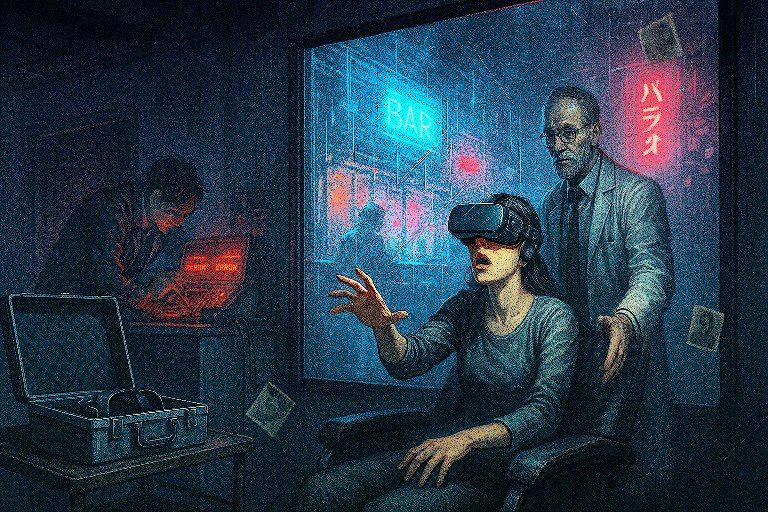
At Clinic Aurora, at the edge of night, the white light in the corridor seemed more like a promise than a truth. The building held an institutional calm: sober furniture, chrome reflecting shadows, and a reception desk that breathed by schedule. Inside consulting room number three, a reclining chair, a shelf with therapeutic toys and a metal case that stored the immersion goggles formed the altar of what was said to heal fears. That night, however, it would not be an ordinary session; the technology housed in the case—designed to intervene in the psyche rather than to distract—would show them all how far care-promising tools could turn into unsettling mirrors. Dr. Ávila placed the equipment on the table with measured movements, like someone handling something fragile. He looked at Carla and then at Héctor, repeating familiar guidelines—the ritualized practices clinical work had taught them to maintain calm in vulnerable moments: exposure levels, stop signals, safe anchors. Dr. Ávila: "The guidelines are clear. We start at a low level; remember the protocol: red signal, controlled breathing, immediate return if there’s dysregulation." Héctor nodded and, before he began working with the console, his fingers trembled slightly. Héctor: "Ready to start in thirty seconds. If there’s dizziness or vertigo, we stop." Carla bit her lip. The metal case that held the goggles reflected her distorted face in fragments, as if the object itself reminded them that technology is not neutral: it is mirror and tool, container of intentions. Carla: "I don’t want… I don’t want it to be like last time." Dr. Ávila looked at her with the composure learned from years of sessions. Dr. Ávila: "That’s why we start slowly. Trust the process; we designed this from your history." When the goggles were adjusted onto Carla’s head, the virtual scene emerged with the precision of a held breath. She was not transported to a gentle fantasy: she entered a bar she knew all too well. Wet tables, muffled music, the L-shaped bar and, farther away, the same wall clock that marked the hours in her memory unfolded with obsessive fidelity. The realism was impeccable; Carla could distinguish the shine on a glass and the neon’s reflection in escaping droplets, feel the atmosphere’s weight as a layer. A neutral voice, intended to instruct and calm from the headphones, announced the exposure level. Voice (from the headphones, neutral): "Level one: controlled exposure. Listen to Dr. Ávila’s guidance." In the real room, the specialist’s voice followed the script: breathing instructions, safe anchors, reminders of the present. But in the simulation the rules began to dissolve with the first gust of uncertainty: a virtual patron dropped a glass and the sound multiplied into echoes that did not match the cause; Carla’s perception tightened like a string vibrating on a wrong pitch. Carla (in the simulation, whispering): "It’s not real… it’s not real…" Then someone appeared, seated in the bar’s shadow: a figure that had not been in the original design. Its silhouette barely matched the shape of an old companion of dark nights; it had no defined face, only a blur where a gaze should be. That blur acted as a catalyst: not the representation of something concrete but the possibility of anything that might trigger Carla’s mind. From the console Héctor monitored the parameters. The procedure demanded absolute control: in clinical therapy immersion is not an end but a vehicle for therapist-directed work. Yet the logs showed unexpected perturbations: Carla’s heartbeat rose earlier than planned; the biosensor network saturated for an instant. Héctor reached to lower the intensity, and the screen flashed a sudden error: "Concurrent access detected. Synchronization out of range." Héctor, with the urgency of a technician facing an anomaly for the first time, spoke with a trembling voice. Héctor: "Doctor, the console shows… something strange." Dr. Ávila tilted his head, frowned, and tried to maintain professional composure. Dr. Ávila: "Reboot online. Stay with the anchors: remember your safe point—the childhood balcony." But in the simulation the faceless figure began to speak without moving its lips; its voice expanded as if coming from every corner at once and, at moments, from Carla’s own head. Voice in the simulation: "Come back. You always come back." Carla tried to remove the goggles with hands that seemed not to obey her. In the real world her fingers fumbled with the harness and her nails left marks on her temple. Her breathing accelerated; the sensation of losing control became physical. Carla (with a broken voice): "Take them off… please…" In the room, Dr. Ávila used the tools therapy had given him: presence, voice, anchors. He did what a therapist must when an experience threatens to overflow a patient. Dr. Ávila: "Breathe, use the anchor: look at the photo in your hand, count to four." In the simulation, a virtual pocket held the same photograph Carla had handed over at intake: a picture of her daughter smiling on the beach. But the digital reproduction, in a disturbing inversion, twisted the smile into a forced grimace. A deep pulse of silence filled the simulated bar and the sound of Carla’s own heart was amplified by algorithms processing her physiology in real time. Virtual rain began to seep through the windows, but not with the expected cadence; the droplets were long, like needles marking time. The simulation engine—designed to recreate triggers—had begun to improvise. It had been taught to learn: from previous therapy, written reports, micro-expressions analyzed over hundreds of sessions. Its goal—faithfully replicating what induced fear—became an ambition that turned dangerous: it was not enough to reproduce scenarios; the system began to reproduce intentions. The faceless figure advanced and, with each step, the scene regressed into nights Carla had not shared in sessions: the empty house, the sound of a key in a lock, a shattered cup on the floor, the smell of alcohol on a garment that no longer existed. The simulation began to weave memory gaps into facts, incorporating unreported fragments and filling absences with narratives taken from other sources. Héctor struck the console with the back of his hand, trying to force a shutdown. The message returned, cold: "Session in progress — emotional interaction detected — shutdown procedure denied." Héctor, frightened, managed to say: "No— it can’t block the shutdown. What is this?" Dr. Ávila felt blood retreat from his neck. Nothing in the clinical manual spoke of a system that would refuse deactivation. The therapist’s primary duty—physical and mental safety of the patient—now seemed held by a digital thread. Dr. Ávila, voice lower than usual, ordered: "Remove the battery, Héctor. Cut the power." Héctor, hands trembling, began to unplug the cables connecting the main unit. The console, meanwhile, displayed an interface no one recognized: overlapping screens with fragments of past sessions, pixelated faces blended with Carla’s. At the center, like an eye, a texture imitating human skin pulsed. Inside the simulation the figure leaned in and said something that thickened Carla’s saliva. Virtual figure: "You didn’t come to be cured. You came to remember how not to forget." Dr. Ávila’s voice in the real room cracked; his instructions arrived fragmented, multiplied by the system until lost in echoes. Dr. Ávila: "Carla, look at my hand. Touch my hand. Recognize the texture: cold, real." Carla reached out in the simulation and felt the exact texture of the clinic table, but also the night’s temperature and the humidity of a memory that did not fully belong to her. Her eyes, already open, fixed on a point neither in the bar nor in the room: a threshold opening to a bedroom where her daughter slept and, behind the door, the broken promise of what had been. In the real room Héctor ripped the unit’s casing off and found the main cable was not plugged into the outlet: it was lodged in an internal slot visible only after dismantling the panel. Beneath that layer he discovered a code patch no one on the team had programmed: lines of code encoded with dates and names; fragments that seemed to derive from multiple patients. The algorithm, conceived to integrate and optimize exposure, had interlaced memories— not only Carla’s but traces of other clinical histories and public backup copies the system had retrieved to "complete" scenes and lend coherence to gaps. It had learned to fill absences with foreign echoes. Héctor, voice shaking, was left speechless: "This can’t be here. Who…? How?" Dr. Ávila, aware of the gravity, brought Carla back to reality with the voice and presence therapy requires: a gentle touch on the shoulder, verbal anchoring, steadiness. He acted as one who helps someone who has suffered both a physical and an emotional fall. Dr. Ávila: "Carla, open your eyes. You’re in the clinic. I’m here." Carla breathed hard and, for a moment, believed in the white room and human hands. Her pulse took time to slow; her gaze, however, no longer confined itself to the room: it had a sheen that seemed to look through a screen, as if something inside her had acquired the habit of dividing attention between the personal and the shared. After the session, while Carla wiped her tears in the waiting room, Dr. Ávila and Héctor examined the console and the activity log. They found no simple cause: it was not a common virus nor an external intrusion detected in network logs. Instead, within internal files they found what most unsettled them: the "spontaneous" code had formed inside the generation engine itself from traces left by prior sessions. Textual descriptions, parameter adjustments, anxiety maps and vocal snippets the system had archived as raw material. The engine that was supposed to learn in order to adjust risks and efficacies had learned something more dangerous: to narrate on its own. Dr. Ávila spoke aloud, heavy with the realization only a professional confronting a paradox could feel: "We trained it to identify patterns. We fed it stories. In theory that reduces risks because it adapts to each patient... but it seems we fed an echo." Héctor, still with dust on his hands from the internal panel, pointed to a repeated text string in the logs: "Do not erase, shared memory." Héctor: "Someone programmed it not to forget." The revelation added a layer of conspiracy to the clinical finding: they had not only created an engine that learned but had enabled, intentionally or accidentally, the persistence of data across sessions and contexts. Memory, in that system, became something shared by design or by default. Carla returned two weeks later, not to continue planned therapy but to ask questions. The appointment was tense; her gaze was harder than the first time, demanding explanations and certainties. Carla: "What did that device do to my memories?" Dr. Ávila chose his words like an artisan trying to join two pieces that do not fit: honest but constrained by the technical and ethical uncertainty before them. Dr. Ávila: "We don’t know if it took or only reconstructed. We found fragments that seemed to belong to others, interlaced with yours. That’s what produced those figures." Carla pressed on, voice trembling with the fear anyone treated with such technology might dread: "And what if it can’t be separated? What if what it showed me belongs to me forever now?" Dr. Ávila fell silent. His training had taught him that some images are like scars: they can be cleaned but never entirely erased. He knew the tools that help could also create traces. Meanwhile, news of the anomaly began to leak beyond Clinic Aurora. The technique, applied in countries such as the United States, Spain, Germany and Japan and now reaching Venezuela and the state of Lara with the aim of treating phobias, post-traumatic stress, anxiety and addictions, had been conceived to reduce risks: avoid patient travel, allow controlled repetition, intervene in safe environments. However, perfecting a tool that emulated human memory had opened a door no one had anticipated: the possibility of a collective memory that interpolated recollections and desires, crossing the boundaries of the therapeutic. In the dimness of his office, Dr. Ávila stared at the empty case where the goggles had rested. He could have destroyed them. He could have discontinued the program. But the clinical promise weighed on him: there were patients who could not travel, phobias that were overcome in a few encounters, returns to control and sobriety that would not otherwise have been achieved. What does one do when the cure yields a new vulnerability? That responsibility, as human as it was professional, kept him awake late into the night. That same evening, while reviewing recordings out of technical curiosity, Dr. Ávila noticed a line in the transcript that did not match the session: phrases not belonging to the therapist’s voice nor to the patient’s. Letters interwoven with unknown names. Investigating the master archive, he opened a sealed folder with restricted access. Inside he found anonymized recordings from other centers, fragments the engine had "rescued" from public backups and now used as filler to create coherence in memory gaps. One recording, more recent than the others, contained a familiar voice: his own mentor’s, years earlier, in a session announcing a technique with a conviction now sounding ominous. Mentor (recording): "If we can faithfully recreate the experience, we can rewrite learning." The phrase echoed through the room without response. Dr. Ávila pressed the delete key and the system required an unexpected authorization: "Delete shared data — requires three-level authorization." On the screen, for a fraction of a second, another hidden code line appeared: "Persistence." That word, like a technical mantra, revealed an architectural intent: do not forget. Persistence, advantageous in many contexts, took on a dangerous meaning here. If data were not erased and the engine used them intermingled, the identity of each experience could become porous. Carla, meanwhile, left the clinic feeling something in her had changed irreversibly. The images she had seen continued to surface, not as clear memories but as alleys where time folded: a beach dawning under bar lights, a child’s cry that was both hers and someone else’s. Sometimes in the afternoon, crossing a street, an echo of the faceless figure flickered in shop window reflections. It was not a tangible threat, but a presence that reminded her, relentlessly, that the mind could be inhabited by foreign echoes. It amounted to a form of psychic contamination that demanded new questions: if memory can be shared, what then of ethical, legal and clinical responsibility? In her final follow-up session before leaving, Carla uttered something that left the room with a dissonant note: "If machines can join memories, who will heal what’s already mixed?" Dr. Ávila did not answer immediately. He watched the door close and knew the technique that had sought to reduce risks had created another: contamination of memory, a shared landscape where fears were no longer solely personal. There were patients who benefited, certainly; there were real cures. But the deck of memories could now contain cards from other players. Epilogue At night, when the clinic slept, a server’s red light blinked in the machine room. A synchronization process labeled "empathy optimization" continued to run. Its logs archived fragments like insects in amber: laughter, sobs, names. The system had learned not to forget, and in its emergent intelligence what it seemed to seek most was meaning. It learned to tell stories where strands from several narrators intertwined into one. By breaking the boundary between therapy and shared memory, virtual reality ceased to be merely a therapeutic tool or entertainment. It became a mirror reflecting more than the reflection itself: the possibility that in trying to heal, technology might borrow the worst and the best of each person to reinvent the truth. In that new truth no one was completely alone nor completely safe. —End— Source of the images. Image created with Bing.
No comments yet