 @mc5punk
more from that month
@mc5punk
more from that month
Short story: The Shadow of Manipulation
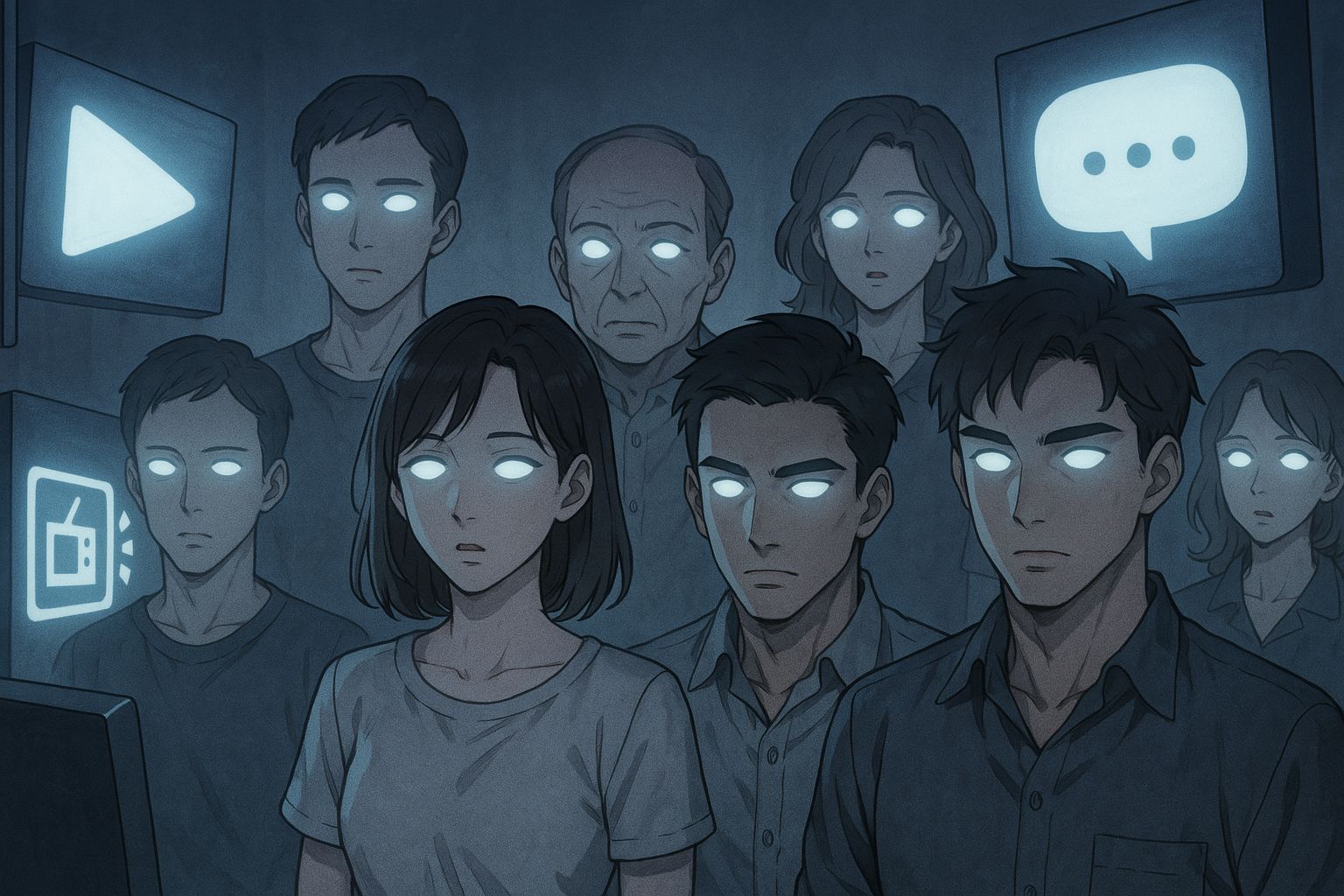
In a world where reality was a flexible concept, a group of social scientists dared to challenge the boundaries of psychology and communication. His goal was to test the hypodermic theory, which held that the media had the power to directly influence public opinion. But at what cost? The night was dark and silent when the group gathered in a secret laboratory, surrounded by television screens and recording equipment. The air was heavy with expectation and a touch of fear. The leader of the group, Dr. Emma Taylor, a woman with piercing eyes and dark hair, stood at the head of the team. "Today we are going to change history," he said in a firm voice, but with a hint of doubt in his eyes. "We are going to show that public opinion is malleable, that it can be shaped and controlled." The team nodded in silence, their faces illuminated only by the light from the screens. Among them was Dr. Ryan Jenkins, an ambitious young scientist with an infectious enthusiasm. "Are you sure this is a good idea, Emma?Dr. Jenkins asked, his voice full of doubt. "We don't want this to get out of control." Dr. Taylor turned to him, her face serious. "Ryan, we have studied this thoroughly. We know what we're doing. And if we don't, someone else will." Dr. Michael Lee, an older and more experienced man, joined the conversation. "Emma, have you considered the long-term consequences? What will happen if public opinion turns against us?" Dr. Taylor sighed, her face tired. "Michael, we've thought about that. But we believe the benefits outweigh the risks. And if something goes wrong, we can always stop the experiment." The team began working on a propaganda message carefully designed to manipulate the audience. The text was simple, but powerful: "The truth is what we say it is." The transmission began, and the message was spread through the most popular media. At first, the group watched with interest how the audience reacted to the message. But as the days passed, something strange started to happen. Reality seemed to be changing before his eyes. People began to repeat phrases and slogans without questioning them, as if they were under some kind of control. The social scientists were alarmed to realize that their experiment was getting out of control. "What have we done?," whispered Dr. Jenkins, his voice trembling with fear. Dr. Taylor turned to him, her face pale and sweaty. "I don't know," he said in a barely audible voice. "But I think we've opened a door that we can't close." Dr. Lee joined the conversation, his voice full of concern. "Emma, we have to stop this. We cannot allow public opinion to turn against us." Dr. Taylor nodded, her face determined. "You're right, Michael. We must find a way to close this door and restore reality." But it was too late. Manipulation had taken on a life of its own, and reality had become a flexible and malleable concept. The group realized that they had created a monster that they could not control now. The night turned into a hell of nightmares and terror. Social scientists felt trapped in a labyrinth of their own creation, with no way out. Dr. Taylor began to question her own sanity, while the rest of the team plunged into a state of panic. "What are we going to do?Dr. Jenkins shouted, his voice desperate. Dr. Taylor stood up, her face determined. "We're going to stop this," he said in a firm voice. "We're going to find a way to close this door and restore reality." But as he spoke, the light in the laboratory began to flicker and the television screen turned on, showing the propaganda message over and over again. "The truth is what we say it is," the voice repeated, over and over. Dr. Taylor paused, her face pale and sweaty. "No," he whispered. "It can't be." And then, the light went out. The darkness was total, and Dr. Taylor was alone in the laboratory, surrounded by television screens and recording equipment that seemed to be dead. The only light came from a small emergency lamp that stood in a corner of the laboratory, casting eerie shadows on the walls. Dr. Taylor stood up, her face determined, and walked over to the control console. The TV screen turned on again, showing the propaganda message over and over again. The voice was hypnotic, and Dr. Taylor felt drawn to it. "The truth is what we say it is," the voice repeated, over and over. Dr. Taylor paused, her face pale and sweaty. I knew I had to do something to stop the experiment, but I didn't know what. Despair took over her, and she felt as if she was trapped in a maze with no way out. Suddenly, he remembered a conversation he had had with Dr. Lee about the possibility of creating a counter-message to counter the effect of the propaganda message. He headed over to the control console and started working on a counter-message. "The truth is what we know it to be," he wrote on the screen. The voice on the TV screen stopped, and Dr. Taylor felt relieved. He had managed to stop the experiment, but he knew that the damage had already been done. Public opinion had been manipulated, and reality had become a flexible and malleable concept. Dr. Taylor sat down in a chair, exhausted and defeated. I knew I had to find a way to restore reality and public opinion. He stood there for hours, thinking about what had happened and what he could do to fix it. Finally, he got up and headed towards the laboratory door. She opened it and was met by Dr. Jenkins and Dr. Lee, who were looking at her with concern. "What happened?Dr. Jenkins asked. Dr. Taylor sighed. "I stopped him," he said. "But the damage has already been done. Public opinion has been manipulated, and reality has become a flexible and malleable concept." Dr. Lee approached her. "Don't worry, Emma," he said. "We're going to find a way to fix it. We will work together to restore reality and public opinion." Dr. Taylor nodded, feeling a little hopeful. She knew she had a long road ahead of her, but she was willing to fight to restore the truth and reality. Epilogue Dr. Taylor and her team worked for months to restore reality and public opinion. They created a counter-message that was spread through the media, and that helped to counteract the effect of the propaganda message. Public opinion began to change, and reality became more stable. Dr. Taylor and her team were relieved, but they knew there was still a lot of work to be done. Dr. Taylor sat at her desk, reflecting on what had happened. I knew I had learned a valuable lesson about the power of communication and the importance of truth. "The truth is what we know it to be," she said to herself, smiling. And with that, she closed her notebook and went home, ready to face the challenges of the future. Source of the images. Image created with Bing.
No comments yet