 @mc5punk
Short story: The Four-Legged Vagabond
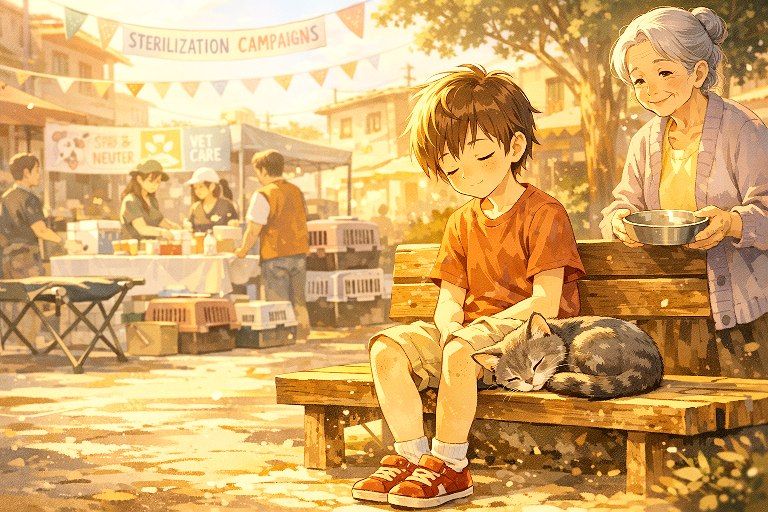
On the dusty corner of the Santa Lucía neighborhood, where the sun pressed down on the roof tiles and the tree shadows were small patches of relief, a gray mottled cat with twin eyes—lucid but dimmed by fatigue—appeared. He was found lying next to a broken trash bin, his tongue rough and stuck to the roof of his mouth. The people of the block, who knew the comings and goings of animals and residents on that street, called him The Vagabond for his slow gait and because no one seemed to claim him; some said he once had owners, others that he had not been seen for weeks. Doña Marta, a small woman with callused hands who had lived alone since her husband died, always left a container of water in front of her doorway for animals. Seeing him, she bent down, offered her hand, and let out a soft voice: —Poor thing —she murmured—. He’s dehydrated. We have to help him. The cat opened his eyes with effort and, confused by the affectionate gesture, moistened his muzzle in the water Doña Marta placed. The scene was witnessed by two young people walking down the street wearing Cola Alegre Foundation shirts: Marcos, the rescue coordinator, tall and always alert-eyed, and Lía, an experienced volunteer with a frank smile and nimble hands for holding frightened animals. They had a folding stretcher in the corner of their truck and a bag of kibble that smelled like home. —Look, Marcos —Lía said, pointing at the cat with her chin—. Another one. We can’t leave them here to their fate. Marcos, who had seen this scene repeated in many neighborhoods, crouched carefully. In a low voice so as not to startle the animal, he spoke while wrapping him in an old blanket: —Calm down, friend. We’ll take you with us. The cat purred weakly feeling the human warmth; his purr was like a thread of life restarting an almost-stopped engine. They placed him in the truck with the care one uses to handle a fragile, frightened being. As they loaded him, Lía could not help but comment bitterly: —We’ve had so many cases lately. In the whole sector they’ve been abandoning cats and dogs. If we don’t run permanent sterilization and education campaigns, this won’t stop. At Cola Alegre’s headquarters, an old house repurposed with improvised pens and stacked boxes that served as hiding places for shy animals, they worked overtime. That day the room smelled of antiseptic and freshly groomed fur; there were more than sixty dogs awaiting adoption, colorful beds and posters with photos. Seeing The Vagabond arrive, Carolina, the organization’s coordinator, approached with a serious look, her coat stained with mud and a notebook where she recorded rescue stories and diagnoses. —We need a solid strategy —Carolina said aloud, as if calling the team together—. It’s not just rescuing: we must sterilize, educate, and follow up. If not, overpopulation will devour our resources and the animals face a cruel fate. Lía wiped the cat’s little dirty paws with warm water and gave him a little subcutaneous fluid. The animal, cradled on the stretcher, made small sounds between purrs and whining relief. —Sometimes people think giving a plate of food fixes everything —Lía said—. They call them community pets, and although the intention is good, they don’t know the risks: disease, parasites, fights between animals, spread of infections... and the fact that sharing the same bowl can spark outbreaks. From another nearby organization, Peluditos al Cuidado, Patricia arrived: a veterinarian trained in preventive medicine with the patience forged by years of night shifts. Patricia, the technical coordinator, attended a joint meeting between foundations organized that afternoon to map out a regional plan. Her rigorously gathered data showed a worrying trend. —We lack basic first-aid training among neighbors —Patricia explained with professional calm—. And many cannot afford professional care when animals are injured or dehydrated. Awareness campaigns change that: they generate affection and responsibility. Animals must be considered part of the family; they need to be vaccinated, dewormed, and kept hygienic. Without these cares, animals roam sick, causing suffering and preventable deaths. Carolina closed her eyes for a moment, as if weighing the magnitude of the challenge. —Alone at Cola Alegre we carried out 158 rescues last year —she said tensely—. And we’re not the only ones. This situation repeats in other foundations across nearby municipalities. We must coordinate efforts, establish permanent campaigns, and, above all, educate. That afternoon, The Vagabond received fluids, warmth, and a bowl of tepid food. He slept in an improvised bed, wrapped in blankets, while Carolina and Patricia drew up a plan: free sterilization days, educational modules in plazas, pamphlets with first-aid instructions, coordinated rescue routes among foundations, and an animal registry. They decided to start in the areas with the most reports: La Esperanza (locally nicknamed Chucho Briceño), Los Rastrojos, and Agua Clara, then move west across the city through Barrio Unión, the Industrial Zone, and Pueblo Nuevo—areas from which the foundations received the most calls about abandonment, mistreatment, and animals injured on roads. —If we run permanent campaigns —Patricia said— and families take responsibility for postoperative care, we’ll see real reduction. Also, we must emphasize felines: they’re the most neglected and suffer greatly because their recovery requires specific, careful attention. The following days were a mix of logistics and tenderness. Volunteers set out early with carrier boxes, blankets, cages, and printed signs. They set up a registration post in the central plaza where neighbors could list animals in the streets, ask for information, or sign up for free surgeries. Doña Marta offered her house as a postoperative recovery point for cats, with a quiet room, a box lined with soft sheets, and a small corner with fresh water. Marcos coordinated transport from meeting points, Lía handled community communication, and Patricia supervised medical procedures, aided by volunteer veterinarians who took shifts offering services. The opening day drew people from many neighborhoods. Some arrived shy, eyes downcast, as if bearing an animal’s responsibility were a confession; others came proudly, because they had already sterilized their dog and wanted to share their experience. People came to learn: mothers who wanted to know how to treat wounds, young people who offered to volunteer, and merchants who donated food and medical supplies. One afternoon, while they were closing the post, a young man with an anxious look appeared holding two trembling kittens. He had found them in a dumpster, wrapped in dirty cardboard. —I found them in the trash —he said quietly—. I didn’t know what to do. Now that I see what you do, I want to help. Carolina welcomed him with a tired but genuine smile and handed him a form, explaining the adoption process and the importance of postoperative follow-up. —Welcome —she said—. This kind of action changes lives. Learn to care for them; we’ll teach you. Here we don’t judge: we give tools. Meanwhile, in the neighborhoods identified as most critical, life continued at a tense rhythm. The streets of La Esperanza were a mosaic of low houses, shops, and alleys where people often abandoned animals due to lack of resources or misinformation. In Los Rastrojos, a degraded industrial sector, dogs sought shelter among containers and scrap. In Agua Clara, standing water supported parasite proliferation and disease. In Barrio Unión and Pueblo Nuevo, toward the west, personal stories mixed with abandonment: families who migrated away, owners who stopped feeding or caring for pets due to economic impossibility, and people who, fearing veterinary costs, preferred to abandon an animal rather than treat it. The sterilization campaigns proved a larger logistical challenge than expected. They had to set schedules, train personnel for postoperative recovery, and sensitize attendees about the responsibilities of caring for an animal after surgery. Some owners were initially reluctant; they feared the procedure or did not understand its necessity. But through clear talks and testimonials, the team changed perceptions. At an information table, Patricia offered an explanation that captured many people’s attention: —Sterilization reduces the number of animals on the streets and prevents unwanted litters —she said—. It also reduces behaviors driven by reproductive instinct, like fights and escapes, and lowers disease risk. But surgery doesn’t end there: families must be responsible for postoperative care. Keeping the animal rested, monitoring wounds, administering medication, and watching for signs of infection are key tasks. Lía, who had seen animals returned to the street due to lack of postoperative care, added: —It’s not just about operating: if we don’t have homes that can manage recovery, the situation worsens. That’s why we ask for citizen commitment. Meanwhile, The Vagabond—still nameless—recovered. The first week was long naps and small portions of food. Over the days his coat regained shine and his eyes became curious again. Children in the plaza began to look for him. One of them, Samuel, a ten-year-old boy with a freckled face and unruly hair, couldn’t resist. He watched carefully, touched him gently, and soon the bond formed as if it were natural. —Can I touch him? —Samuel asked softly. —Of course —Doña Marta replied from a nearby bench—. But go slowly. He’s still learning to trust. In the days that followed, Samuel brought toys he made from string and plastic bottle caps. He watched the cat stretch in the sun and spoke to him in a low voice. It was evident he was becoming attached. The community, however, still faced obstacles. Some neighbors continued to feed animals in the streets without registering or sterilizing them, believing they were showing compassion. Patricia and Carolina organized sessions to explain the problems of so-called “community pets”: people who leave water and food without integrating animals into a family or providing veterinary care. Kahale (in her role as a community educator stressing the dangers) emphasized that good intentions can have consequences: sharing a bowl, for instance, can facilitate parasite and disease transmission, and multiple animals eating the same food without control can trigger fights and territorial disputes. —Good intentions are not enough —Patricia insisted during a plaza talk—. It’s necessary to know the risks. If the community decides to help, do so responsibly: register, vaccinate, deworm, and sterilize. Acceptance grew slowly. Some neighbors donated materials: blankets, boxes, cans of food. Small local businesses offered discounts on veterinary supplies. A group of young people formed a watch brigade to report injured or endangered animals. Doña Marta, in addition to being a water point, became a guardian for recovered cats; her home sheltered cats in convalescence and became the nook where they were taught to trust human contact. In long coordination meetings, Carolina stressed that the work needed to become systemic: they requested meetings with municipal authorities to manage resources, held sterilization days in public spaces, and worked with schools to introduce animal care workshops in class plans. They also made efforts to reach people with less information access: simple-language pamphlets, short videos, and live demonstrations. The changes were neither immediate nor easy. The first mass campaign brought many pets but also exposed the need for follow-up: some animals developed infections because of inadequate home care, others were returned by owners who could not assume the responsibilities. However, with each mistake they learned clearer measures: postoperative checklists, telephone consultation lines, and volunteers willing to provide home assistance in critical cases. The Vagabond transformed amid this torrent of activity. He was no longer anonymous; his recovery was documented with photographs used in foundation brochures to show before and after. His name changed to Félix when Samuel—after completing the adoption process and attending a pet care workshop—took him home. Formalizing the adoption mattered: with it came responsibility. Samuel, supported by his parents and supervised by the foundation, learned to administer medicine, keep the wound clean, and watch for warning signs. Félix became a contagious enthusiasm. He went to school with Samuel in the afternoons and waited at the doorway when the boy left to play. At night he curled up at Samuel’s headboard like a silent sentinel rewarding dedication with affection. The cat’s transformation was a living example the foundation and campaigns used to show the community that investing in rescues and sterilizations was worthwhile. Six months after the campaigns began, the foundations noticed measurable changes: fewer reports of animals in the streets, more responsible adoptions, and more families participating in campaigns. It wasn’t a perfect solution: there was still abandonment, animals mistreated or run over, and neighborhoods resistant to intervention. But awareness grew. The idea that pets should be part of the family took root gradually in the community. At a neighborhood assembly attended by residents, volunteers, professionals, and local authorities, Patricia spoke to summarize what they had lived through. —Empathy saves lives —she said calmly—. It’s not enough to give food; it takes commitment, education, and responsibility. If each family assumes postoperative care and vaccination, and if each community organizes permanent sterilization campaigns, we can prevent unnecessary suffering. Marcos, watching Félix gambol in the plaza as if he knew every stone, added softly: —There’s a lot to do —he murmured—, but we’ve begun to change the story. And so, between nighttime rescues, sterilizations on hot mornings, and hands willing to help, the neighborhood stopped seeing animals as a city problem and began to see them as life companions. Félix, once The Vagabond, became the symbol of that change: tangible proof that organized compassion, allied with education and solidarity, can turn dry alleys into homes filled with water, food, care, and affection. Over time initiatives multiplied: school brigades teaching children to recognize dehydration signs, agreements with hardware stores to donate recovery materials, and a network of foster homes to care for animals undergoing long recoveries. The foundations, better coordinated, managed funds and expanded their campaigns. Still, in the early mornings when the city seemed to hush its noises, people remembered the names of animals who did not survive: stories of those run over on avenues without proper crosswalks, or cats who died of dehydration—reminders that work must intensify. That awareness of loss spurred more neighbors to get involved: nobody wanted the story to repeat. In the end, what began as just another rescue—a gray cat picked up beside a trash bin—became the spark of a community transformation. Félix didn’t just find a home; his journey mobilized resources, sensitized citizens, and generated a care network that, imperfect though it was, worked and grew. In each campaign, each conversation with a newly committed family, each sterilization carried out by careful hands, the community reaffirmed a key principle: organized compassion saves lives and changes destinies. And in the plaza, under a tree that had grown to cast a wider shade, Félix slept at Samuel’s feet, and the neighbors, seeing him, smiled. They knew the road ahead continued, but they also knew that, for the first time in a long while, the difference depended on them. Source of the images. Image created with Bing.
No comments yet