 @mc5punk
Short story: The Club of Borrowed Dreams
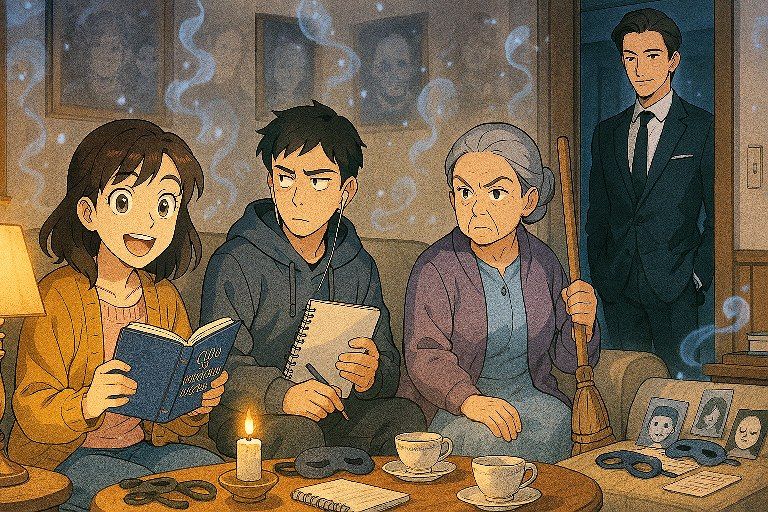
María had always been the sort of person who turned an anecdote into an epic. That afternoon, returning from the library with a volume that seemed to contain more imagination than words, she planted herself in the living room with bright eyes and the book under her arm. She had read about the viral theory that claimed "the human brain cannot create new faces in dreams" and presented it to her companions with the solemnity of someone announcing an archaeological discovery. "Guys, did you hear that viral theory? They say the human brain cannot create new faces in dreams. All the strangers you see are real faces or ghosts watching you while you sleep!" María exclaimed, waving the page at Javier as if the paper could prove the rumor true. Javier, a daytime programmer and a skeptic by vocation, barely looked up from his wireless earbuds. His smile was slight, ironic. "Sounds like clickbait. My brain is more like a Spotify mixer: it puts an actor's eyes, the barista's nose, and a philosophy professor's smile together. Nothing supernatural," he replied, settling into the couch like someone who doesn’t believe in conspiracies but does believe in good remixes. Doña Eufemia, the neighbor from the first floor, watched from the balcony railing with the attention of someone who never lets a rumor pass without adding a pinch of drama. "I once saw a face in a dream that stared at me. Since then I sleep with the lamp on and a broom under my pillow. Just in case," she said, as if the broom were an infallible talisman against the unknown. María paused, as if her imagination needed a moment to unfold even further. "Then we're surrounded by recycled faces! What if one of those faces is a professional ghost watching us and leaving reviews on our pillow?" she suggested, and in that exaggeration slipped the possibility of a joke that everyone found delightful. Javier let out a short laugh. "If ghosts leave reviews, at least I hope they give me five stars for my posture," he joked. That night the collective spirit of curiosity led them to a singular decision: they would stage a home experiment. The "Club of Borrowed Dreams" was born amid laughter and supplies: sleep masks, tea, a notepad, and a hand-lettered sign proclaiming the name with the pomp of a secret society. They agreed that if anyone dreamed of a face none of them recognized, they would draw it and bring it to the group upon waking. Doña Eufemia, cautious as ever, insisted on keeping her broom close at hand. "If someone new appears, we draw them," María whispered when they turned off the light. "And I'll catch them with the broom!" Doña Eufemia declared resolutely. "Okay. If I see a ghost, I'll program it," Javier said, adjusting his earbuds with the confidence of someone who believed nothing could surprise him. The house surrendered to silence: the steady hum of the refrigerator, the whisper of passing streets, and eventually sleep. The next morning they returned to the living room squinting but feeling like amateur detectives. María, pen still trembling, flipped her sheet. "I dreamed of someone with a postman's mustache and influencer eyes. I called him 'Mr. Mashup,'" she said, describing the features with the passion of someone unveiling a theatrical character. Javier’s drawing, by contrast, was sober and almost minimalist, no less descriptive. "A guy appeared in a band T‑shirt I've never seen and with my boss's eyebrows. I called him 'Beta‑Test,'" he declared, his tone carrying the irony of someone who spends too many hours in front of screens. Doña Eufemia, triumphant, held up her own paper as if it were a trophy. "I caught a ghost! He had the face of… of…" she murmured before revealing that her sketch matched the face of the neighbor on the second floor—"an exact likeness to the second‑floor neighbor!" she exclaimed, shaking the broom for moral support. There were laughs and speculations. Yet one discovery interrupted the joke: on one of the sofa’s pillows lay a small, impeccably professional photo cutout. A man in a suit, a neutral expression practiced for the camera. It wasn't an amateur collage; it looked like a portfolio image. "I didn't see him," Javier admitted. "But I found this taped to the pillow: a small cutout with a professional photo of a serious man in a suit and a look that said 'I'm famous in another life.'" Curiosity drove them to investigate. They took the photo to Dr. Vargas, the neighborhood neurologist known for his patience and his perpetually warm eleven‑o'clock tea. The doctor examined the image with a mix of scientific skepticism and amusement. "Interesting," he said, resting his glasses on the tip of his nose. "Our brain tends to recombine familiar features to fabricate dream faces. This shows a high potential for neural remix. But…," he lifted his gaze, "you said you found a real photo attached to a pillow?" María nodded vigorously. "Yes. Isn't it odd? It's too professional to be a collage." The doctor smiled without losing composure. "It would be odder if a ghost hired a photographer," he replied calmly, the sort of humor that explains the inexplicable. Javier, unable to resist the tech‑conspiracy streak, ventured a hypothesis. "Or it's an ad campaign for 'customized dreams,'" he suggested. Doña Eufemia bristled as if the slight were personal. "We'll investigate! Who is that man?" she demanded with the determination of someone convinced there is a warrant behind every stranger. They searched the photo online. Nothing. No names, agencies, or image bank matches. The next clue emerged at the post office, where an unattended envelope held several more cutouts: the same face in different outfits and poses, always that same slightly enigmatic expression. It looked like a portfolio deliberately sent. "It's like he's sending us his dream portfolio," María murmured, barely holding back a nervous laugh. "Maybe he wants to be hired for a show: 'Tasteful Ghosts,'" Javier quipped. Doña Eufemia wasn't amused. "Or he wants to marry my neighbor from the second floor!" she shot back, as though the offer required an exclusivity clause. Deciding—between the charm of absurdity and the expectation of mystery—to summon the man, they prepared a late‑night "interview": an empty chair by the window, a flashlight for signaling, a courtesy cup of tea, and a notebook for notes. The house was theatrically set, candlelight flickering in the background. "If you're a ghost, answer us with a flash," María said, a bit nervous and a bit dramatic. "If you're a brain montage, at least give me credit as the editor," Javier added, pointing his phone to document any eventuality. "And if you're my neighbor's husband, I'll introduce you to my wedding broom!" Doña Eufemia threatened, broom in hand. For a while nothing happened but the wind pushing the window open and bringing cold air. Then, as if the stagecraft demanded a climax, a sheet of paper fell onto the chair: a handwritten letter. María took it, hands betraying the tremor of the possible. "Dear nightly observers: thank you for choosing my face for your dreams. My name is Eduardo. I work as an actor, model, and—yes—I sometimes charge to appear at private events. If you want my rates, let me know. Sincerely, Eduardo. P.S.: I'm not a ghost; I'm a very persistent professional," she read aloud, the words hovering between disbelief and laughter. Javier ran his eyes over the handwriting, searching for a trick. "An actor who self‑promotes by appearing in other people's dreams? That's… marketing on another level," he muttered. Doña Eufemia flushed at the moral outrage. "Charlatan! Traitor to the broom kingdom!" she declared, though her voice carried more amusement than fury. María kept returning to the central question: if the scientific explanation was true, how did the physical portfolio end up on their pillows? Before more sophisticated theories could form, the doorbell rang. On the doorstep stood a man in a suit—the very same polished look from the cutouts—holding a folder and smiling as if he had rehearsed this entrance. "Good afternoon. Sorry to intrude. My name is Eduardo. I saw your Club of Borrowed Dreams sign online. I offer 'directed dreams' services: I appear as a character in clients' dreams. It's a form of oneiric networking. Interested in a demonstration?" he asked, with the casual frankness of someone introducing a new product. María struggled to process it. "You charge for... appearing in people's dreams?" she asked, astonished and amused. Eduardo shrugged with elegant composure. "Standard rate: basic nocturnal appearance—50 euros. Includes a remix version and a feedback session on awakening," he said with the same seriousness any professional listing packages might use. Javier, half‑fascinated and half‑dubious, arched an eyebrow. "Told you: marketing. And damn effective," he observed, scanning his phone as if decoding the algorithm behind the phenomenon. Doña Eufemia, finally appeased, wielded the broom like a prop in a courtroom. "If you charge for bothering me in my sleep, I'll bill you…and sweep the square," she warned, the notion of a business that invoiced the intimacy of the night suddenly very real. Eduardo laughed, warm and businesslike. "Deal. I can offer a neighbor‑friendly pack: 'Dreams without Brooms,'" he proposed, and the offer closed the loop between absurdity and plausibility. But that was not the end. Eduardo produced his phone, opened an app called "Oniric PR" with a clean interface and a list of services. A notification popped up: "Reservation confirmed: Club of Borrowed Dreams — 3 slots. Signed: The Committee for Sleep Research." The three of them stared at the message with a mix of pride and astonishment. "Were we... hired?" María asked, unsure whether the confirmation was a mistake or the improbable culmination of their experiment. Javier read the notification aloud. "It seems so. And the package includes… a cameo by the Model Ghost," he said, and the room slowly filled—not with phantoms but with people: curious neighbors, a couple of extra actors who recognized a work opportunity, the barista who once served them coffee, even Javier's boss wearing a T‑shirt that read "I Dreamed of Eduardo." María looked around, unable to hide her amazement. "In the end, the brain didn't create new faces; it created a franchise," she murmured, and the line drew shared laughter. Doña Eufemia, satisfied, set the broom in a corner but not before affixing a small sign: "Authorized by the Club: Only contracted ghosts accepted." Eduardo bowed with the theatrical courtesy of an entrepreneur who had just closed a sale. "Thank you for your time. I promise the dreams will be unforgettable. And if anyone needs to sleep with the light on, I can offer a 10% discount," he said with a wink, as if selling tickets to a performance yet to happen. The meeting wound down with handshakes, informal agreements, and nervous chuckles. In the quiet that followed—cups stacked, daylight streaming through the windows—María reflected softly: perhaps the scientific explanation was true, perhaps the brain was a library and a talented editor, but she had also learned that the world was willing to embrace the absurd so long as it came with theater and unexpected invoices. Javier, pragmatically smiling, was already calculating how the app might work and what data would need protection. Doña Eufemia, for her part, had gained a new stairwell anecdote: she could now say that if anyone watched her at night, it was because they owed a tip to an actor. And so, between science and stratagem, between neurological explanation and entrepreneurial ingenuity, the Club of Borrowed Dreams found its balance: there were no ghosts keeping watch from beyond, but there was a world inventive enough to turn a viral rumor into a small business of nocturnal entertainment. The house calmed, the pillows regained their shape, and the broom—with its new sign—stood proudly in the corner, ready to defend the neighborhood’s honor should another uncontracted actor dare to cross their dreams. The End. Source of the images. Image created with Bing.
No comments yet