 @mc5punk
more from that month
@mc5punk
more from that month
Short story: Market roots
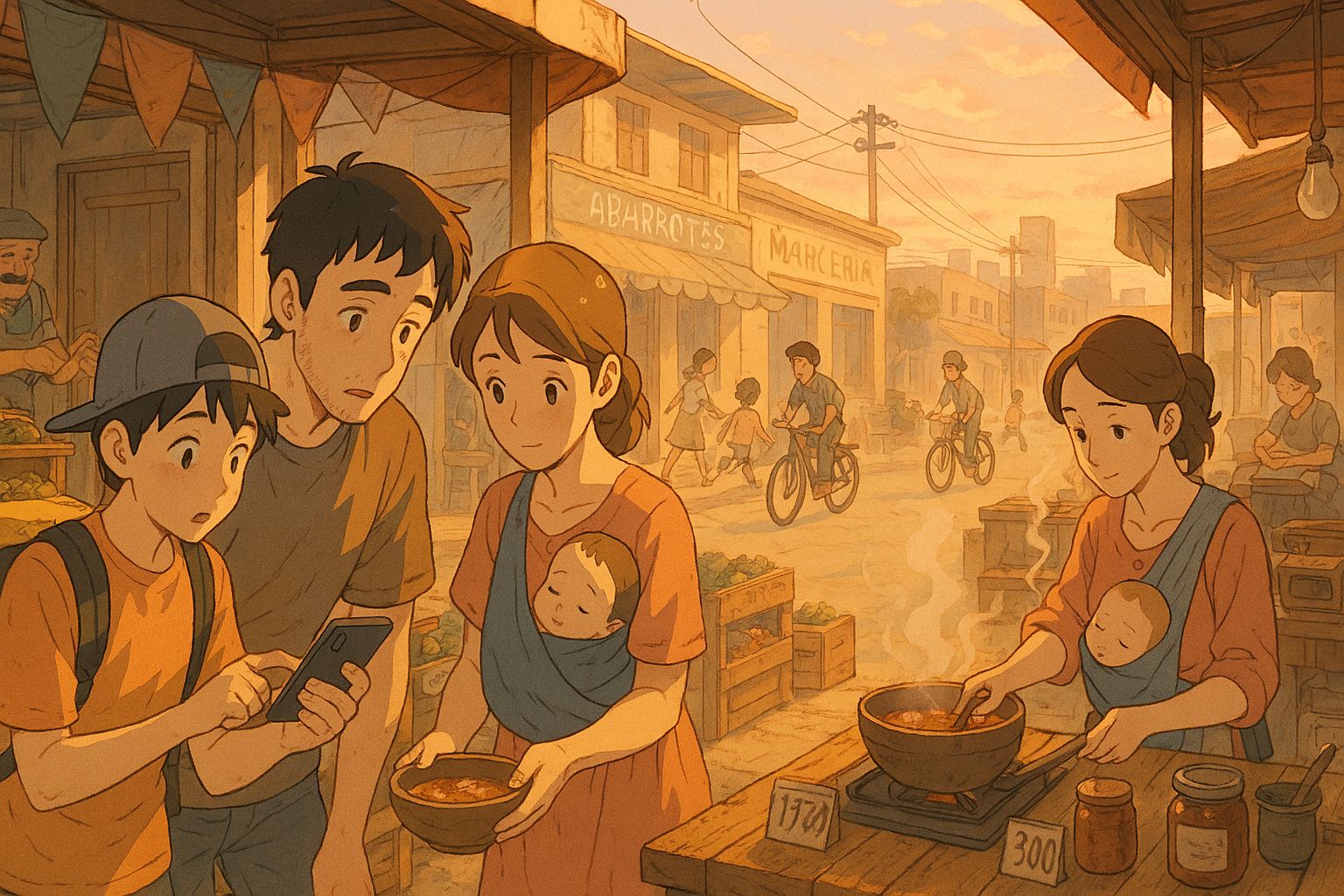
The city wore the pale face of someone who has worked hard and received very little in return. Empty shop windows and "clearance — bankruptcy" signs repeated like a fulfilled prophecy; beside the major avenues, people rummaged through trash searching for what others had discarded. Prices kept rising without mercy each week. In that landscape, the neighborhood where José and Clara lived seemed like an island of resistance: faded-painted façades, dogs marking their territory, and Don Raúl’s grocery — a wooden-and-tin place that smelled of coffee and conversation — serving as a meeting point. José had been a salesman for years at a company that had announced its permanent closure months earlier. Losing his job was a blow that unsettled more than his finances: it shook the identity of a man accustomed to contributing and feeling recognized. About to become a father, he and Clara carried not only expectations about a name and a crib but the heavy burden of an uncertain future. Clara, for her part, had worked as a cook in different places and always had the gift of turning modest ingredients into meals that brought family together. A tireless worker, she had learned to see usefulness in what others threw away, and that practical outlook would soon become a collective engine. That week, the atmosphere in their rented home was thick. An old table held the piled bills: electricity, rent, and the light they feared would be cut off. Clara stirred a pot with the calm of someone who knows dinner serves not only to feed but also to anchor a conversation with some sense. “I don’t know what else to say,” José muttered in a dry voice. “If we sell what little we have and take a loan, maybe we last one more month.” “One month isn’t enough,” Clara replied without taking her eyes off the pot. “But not everything is about borrowing. If we organize the neighbors, if we do something with what we know how to do, we could get by without mortgaging the baby before he’s even born.” José looked at her with a half-incredulous, half-nostalgic expression. Memories that burned like images from another life came to him: dinners at restaurants, shopping bags full of brand-name items, trips with photos that smelled of salt and airports. Those days seemed both near and foreign, as if they belonged to someone else. The phone vibrated on the table; a message from Elena lit the screen. She had been his coworker, the woman with whom he had dallied between stacks of folders and shared coffee. The connection had not been merely professional: their complicity had turned into secret encounters that once seemed like a relief valve. Now Elena lived abroad and occasionally opened windows from afar: offers, promises, the possibility of escape that smelled of both risk and relief. “Is that from Elena?” Clara asked, already guessing the answer. José stared at the text: "I’m back for a short while. If you want, I can help you get out of this. There’s work here and someone who can give you a push." The proposal landed like a blade in his mind; the idea of taking a flight, starting in another city, leaving anguish behind, was seductive. But behind the desire there was something else: the responsibility of someone about to become a father. At Don Raúl’s grocery they spoke openly and at length. Clara had knocked on doors and now it was time to join hands. That shop, hardened by years of napkins and post-meal debates, became a meeting hall: Marta arrived with a box of fabric scraps; Lucho, a teenager with dark circles from little sleep and big dreams about a screen, carried handmade flyers; Ana, a grower from the outskirts, showed up with a net bag full of still-dirty vegetables. “We can set up a cooperative market,” Clara proposed, her voice practiced beforehand. “Barter the first week, sales the second. I’ll cook, Marta will repair clothing, Lucho will do deliveries, José will negotiate with suppliers and manage the common fund.” Don Raúl, hands stained with coffee, nodded. “I can lend the place for meetings and open earlier. If we work seriously, we’ll get something out of it,” he said. “I’ll give you 10% of the space to gather and decide.” The idea took hold, not without hesitation. Trust had eroded in the neighborhood, but necessity brought people together. The first decisions were to organize cooking and selling meals by weight; to allocate a space for clothing repairs and household fixes; and to turn planters and patios into community gardens to reduce dependence on the market. While the project sprouted, a darker piece of news increased the strain: Marta confessed that because of the urgent need to pay for her daughter Lucía’s tooth treatment, she had accepted money from a local loan shark. The terms were usurious; the debt grew in a way that threatened to leave her homeless. The revelation shook the cooperative: the possibility that one of their members would fall prey to exploitation forced them to act beyond mere economics. “He gave me the money in five installments, and on the last one he demanded things I couldn’t pay for,” Marta said in a thin voice. “He doesn’t show his face, he sends messages. I’m scared.” The situation forced a reordering of priorities: the communal fund now aimed to cover Marta’s debt to avoid a human catastrophe. Lucho, handy and connected in the neighborhood, managed to locate a place where the loan shark supposedly operated. José, who was still tempted by Elena’s offer, felt the weight of the choice. It was Don Raúl who, with a stern but fair tone, posed the crossroads to him. “If you leave now, you’ll take away the comfort of your nostalgia, but people here need you,” he said. “Besides, what future do you offer your child from afar? Staying isn’t cowardice; it’s taking up the fight.” The following weeks were almost militaristic work: the cooperative organized shifts, installed a mobile stall to circulate through markets and street corners, and set a calendar of themed fairs to attract customers. José, whose sales experience seemed dormant, returned to the trade with a mix of pride and confused hope: negotiating with suppliers, calculating margins, convincing a farm owner to accept payment by volume. Lucho built an improvised delivery network with bikes; Marta taught sewing classes; Clara put together a menu of popular dishes sold by portions that slowly earned regular customers. Comisaria Torres, a municipal official known for strict enforcement of regulations, showed up one morning with papers and warned about sanitary permits and licenses. The threat of shutdown put the project at a critical point. That’s when Micaela, a midwife and activist, and other neighbors organized a campaign to make the market visible: meetings with the commissioner, presentations of hygiene protocols, and a promise to take on community inspections. The official, initially inflexible, began to show a more human side as she saw the organization and the people’s capacity to take responsibility. Meanwhile, Elena intensified her messages: “Come, I assure you there’s work. You won’t have to struggle as much.” The offer was a siren song that tempted José during his weakest nights. They had conversations—calls that dropped, promises hanging like clouds in the air. On one occasion Elena traveled to see him in person. She walked down the main street like a tourist with intent, and her presence created a stir: some regarded her with disdain, others with curiosity. “We could go tomorrow,” she whispered this time, with the certainty of someone backed by the outside. “There you don’t have to beg for chance; you start over.” José looked at her and for a moment the logistics of escape lined up: tickets, suitcases, distance. But an image returned: Marta’s shaking hands as she described the debt; Lucía smiling when she received her first bowl of soup; Don Raúl buying half a dozen empanadas for his workers. At that crossroads José realized the decision wasn’t just his; it was collective. He took Clara’s hand in front of Elena. “I can’t,” he said, his voice tight. “There’s something here that deserves care.” The reply was a tense, definitive silence. Elena left; her car receded down the avenue with the dull sound of someone finding a closed door. Negotiating with the loan shark was another tense episode: the cooperative went to his place together. It wasn’t a violent confrontation but a pressure tactic: they offered to pay part of the debt through community labor and a payment schedule with witnesses and a legal commitment. The loan shark, who expected lone, easy targets, calculated the reputational risk and—faced with the neighborhood’s visibility and the possibility of police or press attention—accepted restructuring the debt on less draconian terms. No one came out unscathed, but Marta regained something worth more than money: her dignity. With pressure eased, the market gained customers. Local press arrived one Sunday morning and documented images of people buying in bulk, mothers chatting at a communal table, children darting between crates of produce while the breeze carried the scent of freshly made dough. Ana, the rural producer, found in the cooperative a bridge that allowed her to sell more with fairer conditions. Young people found microjobs; Lucho, who began by delivering empanadas, learned to coordinate routes and charge for service. The first real income that entered the common fund bought a refrigerator to preserve food and paid Marta the initial installment. The baby was born in a public hospital. The labor, with contractions that mixed fear and hope, had the calm of those who know they have forged a safety net. Micaela accompanied the birth with the knowledge of someone familiar with bodies and secrets. When the newborn’s cry filled the room, it was as if the whole neighborhood breathed. José, eyes red-rimmed, held Clara’s hand and for the first time in a long while didn’t see an abyss between past and future: he saw a path with people by his side. The epilogue offered no promise of restored luxuries. They did not return to boutique shopping or extravagant dinners. Instead, the cooperative formalized as a civic association; Comisaria Torres, convinced by evidence of community work, helped speed up permits. Don Raúl expanded his grocery and offered a permanent space to the market. Marta began paying off the restructured loan and took Lucía to a public dental clinic for a preventive plan. Lucho enrolled in a logistics course; Ana bought improved seeds for her crops. There were afternoons when old fears returned: inflation struck again and some orders were delayed. But now the neighborhood had a common fund and agreements: an emergency reserve, solidarity shifts to care for the baby if Clara had to work, and a legal support network for permit issues. The cooperative also launched a training program teaching everything from basic entrepreneurship to health and safety standards; young and old trained to face a market in flux. Elena called one last time with news from the city where she lived: “It’s tough, but you get by.” José returned the call with gratitude and certainty. “We get by here too,” he told her. “Not with the same luxuries, but with dignity.” The final scene bathed the story in early Sunday light. The market opened with neatly arranged tables: vegetables, eggs, jars of preserves, and a row of steaming dishes ready to take away. Children ran between stalls; a radio played popular music; neighbors haggled over prices with smiles and the kind of trust born of routine. José taught Lucho how to speak to a supplier on the phone, gently correcting a phrase. Clara carried the baby in a sling while serving a portion of stew. Marta smiled, relieved to see her daughter’s teeth improving. Don Raúl fixed an old door at the grocery. Comisaria Torres stopped by to check paperwork she had signed. Raíces de mercado did not close as a story of absolute success: it ended as the story of a community that learned to sustain itself, to turn lack into work and uncertainty into cooperation. The real wealth never returned as ostentation; it became the ability to pool resources, protect the vulnerable, and build together a possible future. Source of the images. Image created with Bing.
No comments yet