 @mc5punk
more from that month
@mc5punk
more from that month
Short story: The Night of the Charger
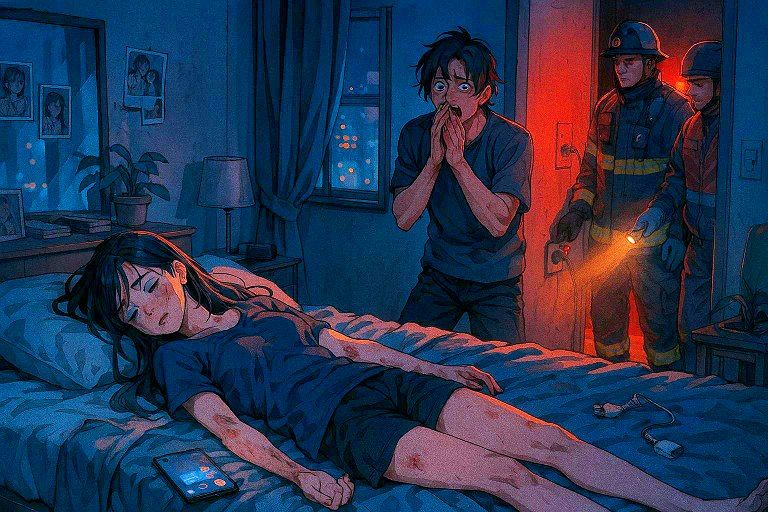
Viviana had spent twenty-eight years moving through the city with a mix of steadiness and disorder that made her endearing to those who knew her: she arrived late to gatherings, forgot appointments, but always brought a smile and an encouraging message for anyone who needed one. She lived in a mid-rise apartment in a neighborhood that breathed the life of cafés and small shops; her home was a modest refuge, with books piled on shelves, a plant pleading for water, and photographs taped to the mirror’s frame. There she hid from haste: there she returned, again and again, to read messages and listen to playlists that seemed to confirm moods. That afternoon had been a string of small pushes: a client who delayed a delivery, an email asking for last-minute corrections, the sticky feeling of fatigue that no coffee could shake. Back at home she collapsed onto the bed without changing, turned on her phone, and began to scroll through a mix of news, voice notes, and viral videos. The charger remained plugged into the outlet beside the nightstand, an everyday object that rarely deserved attention: a white cable, an adapter she had bought at an electronics store the previous week. The city lights filtered through the window, casting shadows across the walls; for a while the company of notifications was enough. “Still awake?” Laura, her longtime friend, messaged with a coffee emoji—the kind of message meant to erase loneliness. “Yeah, a bit longer,” Viviana replied. “Watching some stuff, talk later.” Their conversation flowed in fragments: stickers, audios, photos of trivial things that, together, ordered the day. Viviana allowed herself to stay a little longer. Her body, already tired, began to give in; her eyes, blurred by exhaustion, fought to stay open. At some point during the night, sleep took her without asking. Her partner returned from work around ten-thirty. It was a usual hour for him: a bus ride, a quick stop for dinner, the key turning in the lock. The apartment struck him as strange in its silence, an absence that did not match Viviana’s presence. He noticed her phone still lit on the bed, its screen spilling light over the pillow. He called softly, expecting a sleepy “I’m up” or a grunt. “Viviana, you there?” he said as he opened the door. No reply disturbed his routine; instead, he found a scene no one wants to own: her lying motionless, skin marked by darkened patches and small burns that told the story of violent contact with electricity, and the charger deformed at its end, melted as if consumed by a force that had worked quietly. He said her name again, attempting to conjure the miracle of waking, but his voice broke into nothing. Panic set in with the speed of an unwelcome guest. He fumbled for the phone and dialed emergency services with hands that barely remembered how to press the buttons. His voice, when giving details to the operator, was a tangled thread of words: “My partner… I think she was electrocuted. She’s unconscious.” There were instructions, footsteps, the promise of help. The minutes between the call and the arrival of the teams felt suspended, as if time had held its breath. When the sirens sliced the air, the apartment filled with measured movement: firefighters in gloves, paramedics unfolding stretchers, police taping the door with yellow ribbon. One of the firefighters, voice steady, asserted technical authority almost immediately: “Don’t touch anything else, sir. We need to make sure there’s no live current.” He inspected the charger carefully—the plastic deformed, the wire charred—and the wall outlet, which bore signs of overheating that suggested an electrical fault. The paramedics examined Viviana with the efficiency practice provides: feeling for a pulse, searching for signs of life. Finally, with a gravity that leaves no room for half-measures, they confirmed the inevitable. A policeman approached her partner and, trying to keep some humanity amid the cruelty, said: “I’m very sorry. We’ll open an investigation and we’ll need your help with information about the charger and what happened tonight.” From that moment, daily life turned into procedural duty and raw memory. The investigation unfolded in technical steps: the charger was packaged and sent for testing; an electrician inspected the apartment’s wiring and noted signs that could indicate overheating—a loose connection, old wiring that hadn’t been checked in years. Statements were taken at the station, records drawn up, and a forensic report prepared to establish the precise timeline of death. Specialists spoke of short circuits, of failures in low-quality adapters, of the danger of leaving devices charging for hours on soft surfaces that retain heat. Outside the institutional accounting, the drama had another face: a stream of friends’ visits, unanswered messages, gatherings where anecdotes felt, by necessity, insufficient. Laura arrived at the wake with a small bouquet and a photo clutched between trembling fingers. She sat near the coffin and began to tell what might seem small but, together, made up the person they had lost. “She always answered me with a silly sticker when I was stressed,” Laura said, her voice breaking into restrained sobs. “It was like a reset button—one stupid joke and I could breathe again.” Her partner, ruined by guilt that sticks to details, repeated he could have prevented it if he’d arrived five minutes earlier, if he’d unplugged the charger, if he’d noticed the fault. Friends and neighbors tried to console him with words that rang hollow against reality: electricity makes no bargains, and accidents do not understand human blame. In the following weeks the investigation acted as a mechanism that, necessary as it was, could not soothe the pain. The forensic report concluded that the probable cause was an electric shock from a short circuit originating in the charger, possibly worsened by prolonged exposure of the cable and deficient electrical conditions. The lab found signs of extreme heat on the adapter and traces confirming a strong current passed through the outlet. Technically, the explanation closed the circle: the ordinary object became the agent of tragedy. But the technical explanation did not fill the space where memories lived. Viviana persisted in commuters’ conversations, in social comments, in stories spun as if to reintroduce her into daily life. Friends organized meetings to remember her, to share old photos and voice notes, to reconstruct the person through small gestures: the way she folded napkins, the tone in which she gave advice, the playlists she recommended without asking for anything in return. There was also a public ripple: municipal bulletins reminded citizens to check their electrical systems, advisories about using certified chargers, and warnings against leaving devices plugged in on heat-retaining surfaces. In forums and social media, Viviana’s story became a conversation about home safety—a wake-up call for many who had minimized the risk. Grief, of course, followed its own capricious and silent pace. In the first months, friends gathered to talk about her until conversation faded into an echo. Her partner returned to routine, but with a constant presence of absence in the apartment: the pillow no longer shaped by her, the charger removed and replaced by the memory of what had happened. Laura began writing messages to a closed group of friends to keep her memory alive and, over time, as a kind of ritual, organized a small memorial plaque on the shelf where Viviana kept her favorite books. The city continued, prone to absorbing tragedies into its vastness, but in small affected circles the story of that night remained an indelible mark. Beyond the forensic report and technical talk, Viviana endured in anecdotes that restored her voice: the GIF she sent to celebrate a birthday, the recipe that worked for whoever tried it, the phone call that solved a minor problem. Those moments, nearly impossible to summarize, became the most human way to remember—not the cause, which science painstakingly detailed, but the manner in which her presence had woven companionship. Authorities closed the case with the usual technical conclusions: domestic accident by electric shock, recommendations for electrical inspections, and a call for caution with uncertified chargers and adapters. For those who loved her, there was no official closure to soothe the wound. Memory, instead, found ways to hold her: an annual message on her birthday, a playlist circulated among friends, a favored corner in a café where a cup is now shared in her honor. In short, the night of the charger was not merely a technical incident; it was the intrusion of fragility into the everyday of a life presumed continuous. The accident reminded those left behind of the impossibility of controlling everything and the need to attend to small details—checking the objects around us, untangling domestic hazards, not dulling fatigue with seemingly harmless distractions. But above all, the story left a more humane lesson: people do not disappear completely when they stop answering a message. They remain in the voices that recall their gestures, in the small things repeated to prolong their presence, and in the obligation to let memory become a form of care for those who remain. Source of the images. Image created with Bing.
No comments yet