 @mc5punk
more from that month
@mc5punk
more from that month
Short story: The Tower of Ash
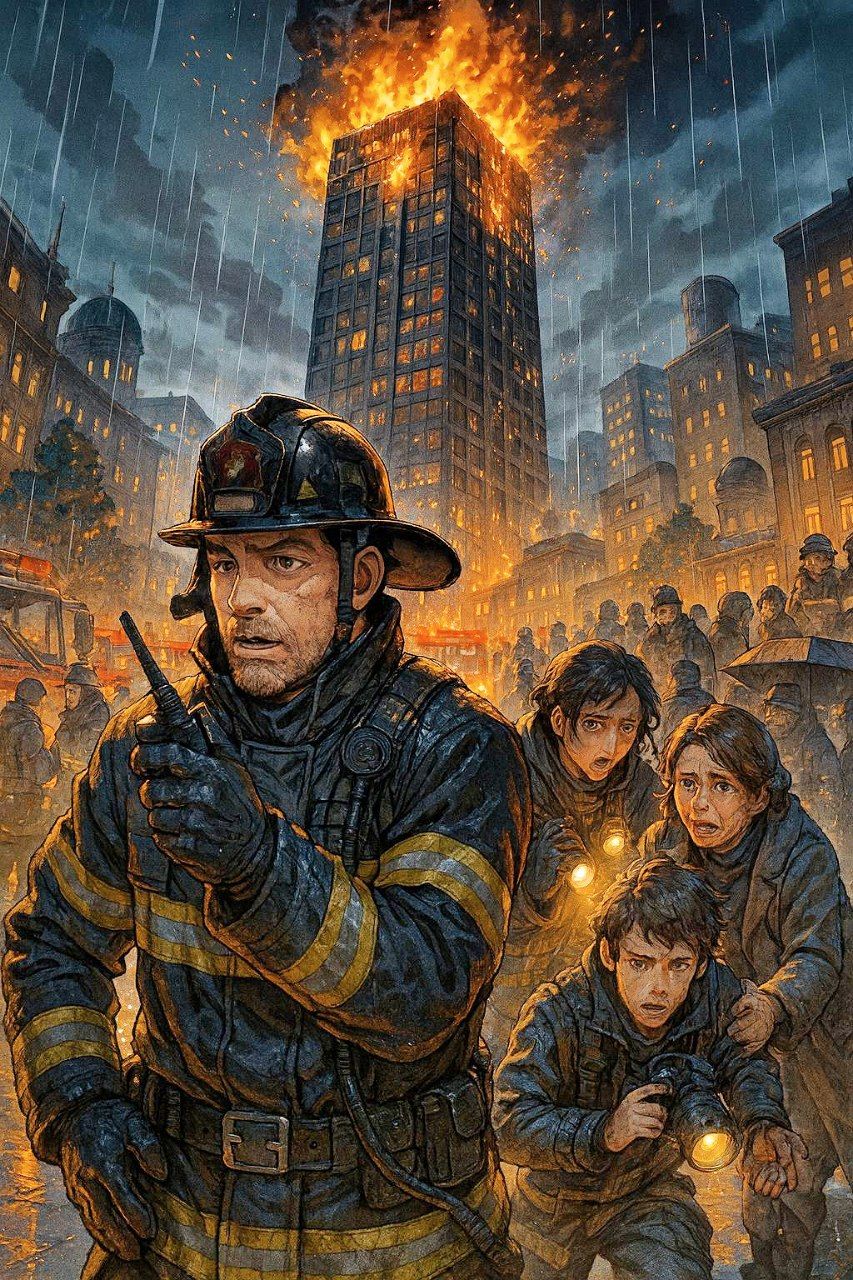
The rain had begun to threaten since the afternoon, heavy and slow, as if the sky wanted to postpone the inevitable. Valdaria, the city leaning on memories and façades, felt November in its bones: streets polished by the season, umbrellas painting dark spots on the main avenue, and the Solenne Tower standing in the center, watching with its profile of glass and concrete. For many it was merely a building; for others, an open book of printing presses, newsrooms, and voices that for decades had shaped the city's pulse. That night, however, the Tower became something else: a source of light and slow death that would set fire to the collective memory. Shortly before midnight, a distant burst broke the night’s routine. At first it was curiosity: windows shining brighter than usual, the top silhouette bathed in an orange glow. In less than twenty minutes, the glow became a column of fire licking façades and throwing sparks into the wind. The fire, as the investigation would later say, started near the top where renovation work had gathered materials, tools, and a provisional electrical network. That combination was, unfortunately, perfect fuel. Mateo Radic was not a man of many words; his mettle had been forged over years of putting out fires that stayed written on skin and memory. When the alert came, he left the night behind and rushed to the tower. Upon arrival, the sight hit him hard: the upper part of the building was already a body lit by flaming wounds. He ordered perimeters and coordinated crews with almost choreographic precision. His voice—firm, sharp—traced routes, set priorities, and executed evacuations, because in his chest he firmly believed structures could be lost, but people had to be saved first. “Perimeter secured! Two water lines on the north face, stair B clear, evacuate through the south exit. No one goes back up until I say so,” he shouted upon arrival. Iris Novak, a young firefighter newly out of the academy, climbed with him. Her training that night faced the real school of fire: corridors warped by heat, smoke that blinded and dragged. With her flashlight and radio as the only allies, Iris forced her way to the eighth floor where she found jammed doors, overturned desks, and an employee who refused to abandon his archive. “I can’t lose this,” the man said, voice broken. “You can’t stay. Come down with me now or I’ll get you out the window!” Iris said, gripping his arm with a low, hard voice. After several minutes of effort she freed him. The rescue was quiet, full of tiny gestures—a shoulder that pushes, a hand that points to the stairs—but each gesture mattered. Lena Vuk, a veteran journalist who had spent much of her working life in the Solenne Tower, experienced the conflagration as if her past were burning. That night she hadn’t come for work; she had gone to check boxes of clippings before the renovation shuffled everything. She found Hugo Marin in the corridors, the young reporter who had begun documenting the night with his camera and who, trapped by a stuck door and coughing, hesitated between saving negatives or exiting by the stairs. “Hugo!” Lena called when she saw him. “What are you doing there? Are you waiting for the smoke to take it?” Hugo coughed and held the camera like a wounded animal. “The photos… they’re everything,” he stammered. “If I lose them, the Tower is lost forever.” Lena gave him a look that mixed anger and tenderness, snatched the camera from him, and slung it over her shoulder. “Photos can be recovered. You can’t. Move—now, reporter!” Hugo looked at her, humiliated and relieved, and let himself be pushed toward the stairs. Tomislav Rena, the janitor and guardian of the building’s secrets, seemed to know the Tower in an almost intimate way: shortcuts, closets that hid meters, doors that never really closed. He guided print shop workers and veteran editors to secondary exits, opening locks only his hand could find. “Through here,” Tomislav whispered to Lena. “There’s a stair that goes down to the engine room. If we keep calm, we get out fine.” “Thank you, Tomislav,” Lena replied. “I don’t know what we’d do without your memory of this place.” The street filled with spectators who were more than curious eyes: they were people with history in the Tower. Ana Kolar, a neighbor facing the complex, improvised a reception point with blankets, steaming thermoses, and an unexpected calm. “Bring blankets, coffee, and water,” she ordered in a voice meant to comfort. “Get people to sit down and breathe.” There, with trembling hands and voices trying to restore normal rhythm, a human network formed: volunteers attending minor burns, makeshift counselors listening to stories, photographers documenting devastation. Among them appeared Sofía Lema, heir to a magazine that had once had its headquarters in the Tower. Clutching a folder to her chest, Sofía looked like a living relic. “These are the most important covers,” Sofía told Ana, showing clippings. “I can’t imagine the Tower without these things.” “Keep them here,” Ana replied. “We’ll look after them. No one’s burning them today.” Coordination between services became a tense pulse. Mayor Iván Petrov and Deputy Minister Marko Jovan planted themselves at the scene, needing to respond while uncertainty stuck to their shoe soles. “How bad is it?” the mayor asked, voice measured but with the strain of one who must decide. “The upper floors are compromised,” Marko said. “If we control the hot spots and prevent spread to the main columns, the base holds. But we must be cautious: a change in wind and it all changes.” “Do whatever it takes,” Petrov ordered. “Protect yourselves and the people.” Inspector Pavle Simic began the formalities with meticulousness. His notebooks filled with strokes and notes: testimonies, photos, possible ignition points. “Did anyone see anything before the burst?” Pavle asked aloud, pen poised. “Even the smallest detail can be key.” A shaken construction worker offered: “I saw sparks near the temporary rooftop wiring… I didn’t think it would go this far.” “Write your name and number,” Pavle commanded. “Explain everything calmly at the station.” The night stretched and, with it, the fight against time. The fire was not uniform: some sections burned fiercely, others were embers that could flare up again. Firefighters worked as gears in a human machine—coordinating hoses, climbing temporary scaffolding, carrying out impossible rescues. At one critical moment a beam gave way; a deep crack ran through the structure like a verdict. Mateo, seeing the deformation, issued the inevitable order: evacuate the north perimeter. “Evacuate north now!” he said over the radio. “If anyone is inside, leave by the central stair immediately.” The tension between technical and sentimental became palpable in a scene many remembered: Sofía, folder of clippings in hand, confronting Branko Bacic, a high official sent to assess the damage. “Are you really considering demolishing it?” Sofía asked, eyes wet. “You can’t just tear it down.” “I don’t decide with my heart,” Bacic replied, bearing the seriousness of ministerial responsibility. “If the structure poses a risk to citizens we must consider controlled demolition. But I understand: there is heritage and memory at stake. We will evaluate it carefully.” “Evaluate it—but don’t destroy it out of bureaucratic haste,” Sofía pleaded. Marko listened; for a moment political calculus mixed with human emotion. “We will conduct public assessments,” Marko announced. “Full transparency. No one will decide in the dark.” Inside the building, the work of saving mingled with small acts of humanity that eased the harshness of the flames. Hugo helped an older archivist who refused to leave his desk; Lena used the authority forged by years in the newsroom to convince people to prioritize life over belongings. “What will you do if you stay?” Lena asked the archivist, gripping his arm. “I can’t bear to leave—this is my life,” he replied. “Your life is worth more than a desk,” Lena said. “Get out now and I promise to do everything to recover what we can.” Iris, smoke plastered to her skin, found new strength to get a young woman down the stairs. “Take my hand,” Iris ordered. “Look ahead and come down with me. Don’t think about anything else.” The young woman nodded through tears and descended step by step into the light. Small victories in a night when losses seemed inevitable. At dawn the Solenne Tower looked like an amputated apparition: upper floors gone, black beams outlined against a pale background, windows reduced to empty eyes. The flames that had roared with pride yielded to water, foam, and human effort. When the blaze began to subside, there was less celebration than a sharp relief: no lives had been lost. That certainty—no deaths—was the only possible celebration for many. Extinguishing work took hours more, teams checking every corner to douse embers and secure stability. Dr. Emile Horvat, an architect consultant called in at first light, sketched the geometry of what remained. With trembling hands and pencil he began calculations that would later become reports: residual stiffness, collapse risk, restoration feasibility. “If columns show buckling beyond twenty percent,” Emile told Marko while pointing at plans, “we can’t guarantee safety without deep intervention.” “How long would such intervention take?” Marko asked, exhausted. “Months, perhaps years,” Emile replied. “And considerable funds.” In the early morning the main scene became the human appraisal of damage. Marko and Branko led improvised meetings with engineers, architects, and emergency services. Possibilities ranged from complex, costly restoration to precautious demolition if peritages judged the structure irreparably unsafe. The city ceased being a spectator and began weighing the cost of preserving the Tower as living heritage versus the risk of leaving it standing. Mateo stayed until the end, hands black with soot and eyes tired. When he allowed himself a breath, he approached Lena, who had survived the night as both journalist and witness. “We didn’t lose lives,” Mateo said, voice meant to console and affirm. “That matters. That counts.” “And those stories must be well told,” Lena replied. “We cannot let memory be buried in technical reports.” At the station Pavle compiled testimonies; his notebook filled with hypotheses. Some spoke of a short circuit, others of a spark from the work area, someone mentioned a cigarette stub carelessly extinguished. “Every clue matters,” Pavle murmured. “We won’t rule anything out until we have conclusive proof.” The investigation promised to be thorough because the need for answers was urgent: a city wants to know why something that formed part of its essence nearly disappeared. Pavle, aware of the weight of his duty, ordered rooms that could contain evidence to be secured and coordinated forensics to produce a technical ruling. Reactions across the city were intense. Neighborhood forums demanded preservation of the Tower, urban archaeologists and former workers organized committees to propose turning the remnants into a commemorative space. Social media filled with night photos and digitized old covers showing the Tower in its heyday. Political opponents seized the event to question urban management; heritage defenders saw a call to action. Amid the noise, a minimal consensus emerged: the decision could not be solely technical; citizen voices had to be included. Sofía’s presence was crucial in those early days. She did not limit herself to safeguarding clippings: she organized a campaign to gather testimonies and objects related to the publications once housed in the Tower. “The Tower cannot fall silent,” Sofía said at a community meeting. “If the city decides to erase it, it will erase voices that deserve remembrance.” “We need concrete proposals,” Marko replied. “If you want to conserve part of the building, present technical alternatives and budgets.” “We will,” Sofía assured. “We don’t ask for the impossible; we ask for our voice to be heard.” The following days became a mosaic of peritages, public declarations, and proposals. Marko issued statements promising transparency and cautiously opened the door to various outcomes: restoration if feasible; otherwise, reconstruction preserving the façade; and, as last resort, controlled demolition. For some citizens, even mentioning demolition felt like a wound; for others, public safety had to come first. The technical assessment process produced reports mixing mathematical calculations with risk appraisals: column strength analyses, beam inspections, metal fatigue tests. Dr. Horvat and his team worked from old plans, comparing the pre-fire tower to what remained. Simultaneously, urban historians and conservationists drafted memoranda asking that the Tower be listed for protection, at least partially, for its cultural value. The tension between technical function and affective value found a partial resolution in public roundtables where citizens like Ana and journalists like Lena provided testimony that gave faces and voices to the reports. “We cannot decide in solitude,” Lena said at one public meeting. “This tower is part of Valdaria’s identity.” “Then the decision will be collective,” Petrov responded. “We’ll convene commissions and public debates. No one will impose their view without listening.” Days turned into weeks. The city that had watched the blaze as a spectacle now actively participated in its aftermath. Workshops for symbolic reconstruction were organized; former print workers brought machine parts and memorabilia from the editorial complex. In a symbolic act the community collected fragments of stone and glass, cataloged them, and stored them for a potential museum of the fire and its memory. Politically, responsibility was not only Marko’s or Mayor Petrov’s; the issue surpassed the local administration. Pressure, consultations, and budget debates became visible. Talks of restoration funds, assistance for displaced workers, and the need to strengthen renovation safety regulations to prevent temporary installations from becoming lethal risks filled the agenda. Pavle’s investigation produced preliminary results: indications that the origin lay on the roof zone where the works had concentrated flammable material. It was not a final conclusion but it marked a path. As forensics continued, rumors of negligence and protocol failures grew, along with calls for administrative and corporate accountability. Moral reconstruction proved as heavy as the physical. The Solenne Tower had been a living archive; the printers had left their scent on the walls and the journalists their words. The city understood that any intervention on the structure demanded a project that preserved memory. Proposals varied: restore the façade and convert the upper floors into a cultural center; preserve a section intact as a printing museum; create a memorial plaza commemorating those who worked there. At a public event with dust still hanging in the air and the black beams in the background, Sofía gave a brief but piercing speech. “If they tear this tower down, they won’t only lose concrete,” she said. “They will lose voices, papers, stories. I ask you to hear us.” Branko, serious but not unfeeling, replied: “We will listen. I can’t promise an immediate yes, but I promise a clear and participatory process.” The remark resonated. Citizens, politicians, and experts began to lay out a roadmap: deadlines for technical reports, regular public tables, and a provisional fund to preserve recovered materials. Discussions were long and bitter, but also carried an odd comfort: the city would not bury its past without dialogue. In the following weeks a fragile, deliberate intermediate decision took shape. The base and façade of the Solenne Tower would be reinforced, irrecoverable sections would be demolished in a controlled manner, and the new upper floors would house a cultural center and an archive of journalism and graphic arts. The project was signed by technicians who had worked alongside historians and neighborhood representatives; funding combined public funds, private donations, and citizen campaigns. Not everyone was satisfied, but the proposal recognized both safety and memory. In a cold symbolic ceremony Mateo, Lena, Sofía, Tomislav, Iris, and Hugo gathered before the main scaffold. On a table lay preserved covers, soot-stained photographs, and a plaque bearing the names of those who risked their lives that night. “No one does this alone,” Mateo said, voice grave. “The city does it.” Sofía set the folder on the table and looked around with a mixture of fatigue and pride. “We promised not to keep it silent,” she murmured. “Here is our first word.” Lena raised her camera, searching for the angle that would tell the scene: the partially rebuilt tower in the background, faces hardened and hands full of ash in the foreground. “I will write all of this someday,” she said. “It won’t be an epitaph; it will be a logbook.” Hugo, now understanding how life outranked the shot, placed his camera beside the other items and smiled sadly. “There will be new photos,” he said. “And old ones that will say how we almost lost it.” During the months of reconstruction Valdaria lived small ceremonies: opening a temporary archive, exhibitions of rescued presses, workshops for young people on urban memory, and publication of testimonies gathered by Lena and Sofía. former printing workers taught students the craft of setting type by hand; veteran journalists gave talks on professional ethics. The Tower, half rebuilt, began to beat again—not exactly as before, but with a different awareness. There were visible scars—smoked façades, reinforced beams—and invisible ones etched into café conversations and Sunday chronicles. The final investigation assigned administrative responsibilities for failures in managing the renovation and recommended stricter safety protocols for urban refurbishments. There were sanctions, regulatory changes, and mandatory inspections. For some, justice arrived slowly; for others, it brought relief and the possibility of moving forward with some equity. Years later, the picture was no longer unresolved. Technical assessments found parts of the structure retained sufficient resistance while other sections had to be demolished for safety. A mixed commission of engineers, historians, residents’ representatives, and authorities decided on an intermediate route: conserve and reinforce the base and façade, demolish unsalvageable parts in a controlled manner, and dedicate the new upper floors to a cultural center focused on graphic arts and journalism. The decision satisfied many, angered some, but offered a concrete path forward. The Tower Solenne was reborn, not as an exact replica of its past but as a reconfigured version where the new coexisted with what the city chose to preserve. Plaques were placed honoring the night and the emergency teams. A small memorial in the ground floor bore names, dates, and recovered objects. A discreet inscription read: “Here we burned, here we learned to speak again.” Mateo remained with the fire corps, telling rookies the story of how coordination and decisive action saved lives the night the Tower burned. Iris later taught at the academy, repeating to cadets the lesson of calmness and empathy. Lena published chronicles and a book collecting testimonies and essays on the relationship between urban memory and heritage. Sofía promoted the permanent archive and founded a small press dedicated to rescuing local stories. Tomislav stayed on as the janitor who kept closing old doors and opening new ones. Valdaria, like any surviving city, learned to live with repaired ruins and with the stories they still told. The Solenne Tower, among smoke, stone, and paper, ceased to be only a building and became a collective symbol: of fragility, of resilience, and of the debt a city owes to its own memory. On a November night, years later, a group of children climbed to the viewpoint of the cultural center and one of them, pointing to the black marks still visible on a restored beam, asked: - Why is that there? A guide, who had heard the stories countless times, smiled and replied: - To remind you that what is lost can be recovered if we do not forget. And that there is always someone willing to take care of what matters. The boy looked at the city spread out at his feet and, without knowing it, took the first lesson that Valdaria had paid for with ashes: memory is rebuilt with living hands. Source of the images. Image created with Bing.
No comments yet