 @mc5punk
more from that month
@mc5punk
more from that month
Short story: The tide chest of drawers
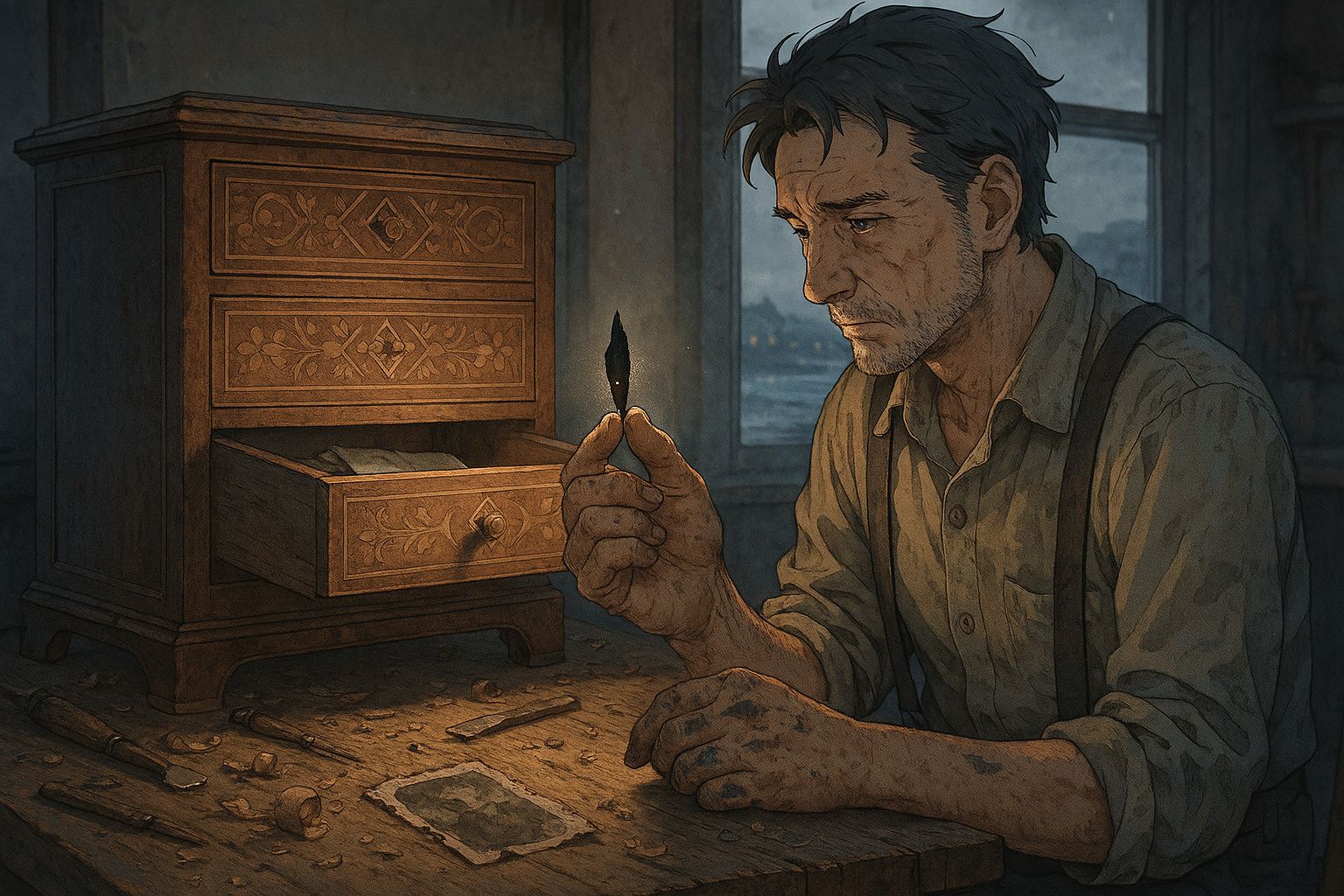
The boards of the chest of drawers retained, under the cracked lacquer, an ancient rumor: the vein seemed to have learned to keep tides. He arrived at Mateo's hands one early morning when the port was still breathing sleep and diesel. The sea, that presence that marked the days in the village, beat the walls with a slow clock; the seagulls had not yet decided their first claims. Mateo had been restoring furniture and objects for years, a job inherited from his father and a trade that restored a dignity to things that others discarded. He knew how to read wood with the patience of one who deciphers maps: a knot said boats, a poorly made gluing counted hurry, a sunburned patina spoke of open windows on the salt. The woman who left the dresser in his workshop spoke little. She had the face of time, that skin that no longer stretches to hide gestures. She came with the piece wrapped in a faded blanket and with the eyes of someone who had decided to leave a memory in someone else's hands. —It doesn't weigh much," she said as she set the blanket down on the table. But it brings weight. Mateo replied with habitual modesty and a certain curiosity that he did not pretend: he lowered the price and promised to take care of her. The woman nodded, rested her palm on the wood as if she wanted to understand its temperature, and left without looking back. The chest of drawers was, from the first inspection, a puzzle. His drawers opened with an ancient resistance; beneath the varnish were layers of procedures imposed by different hands. When he lifted the top lid Mateo discovered a cavity that did not correspond to the design: a series of small inlays, pieces carved with obsessive patience, lined up like truncated syllables. They fit with each other, but they did not end up forming a recognizable image. Inside the lid there was also paper; small ink plans that, due to the weakness of the stroke, seemed written by a hand that trembled at the same rate as the heart. That night the workshop lasted until insomnia. Mateo left the lamp low, the radio without volume, and began to classify the pieces: walnut with cedar, calabo with black tones that he could not name. When he assembled the first pair of inlays the air changed. It wasn't an apparition; it was the distinct feeling that someone had peeked in from the edge of his consciousness. - Is anyone there? - he asked without waiting for an answer, the sound of his voice strangely large in the gloom. There was no response in words, but a presence settled behind her eyelids. Mateo, a practical man, tried to attribute it to sleep or excessive coffee. Even so, on the surface of the table appeared, as if someone had placed it, a new splinter and a paper with old calligraphy: the same hand that had signed the note that accompanied the chest of drawers. The ink, however, seemed to have dried up decades ago. In the village the news of the dresser ran like the waves: slow, with whom it whispers. Mateo went to the tavern keeper to ask about the woman who left her. - Do you know her? - he asked. The innkeeper looked up from his rag and looked at him with the distance of one who hears names often. "There was a woman like that—" he said. She is barely remembered. She lived alone, they said. One day he left and the house was closed. Old stuff, you know. At the mayor's office, rummaging through files, Mateo found a yellowed note with the woman's name on it. Next to it, a sketch with directions to villages on the coast, ink marks that seemed to indicate finds of similar pieces. The annotations suggested that the chest of drawers was not an isolated case, but part of something larger: a chain of objects repaired by different hands that, without reaching completion, had left a trail of fragments. From then on, Mateo's life was fragmenting with the rhythm of the pieces that fit together. He started with minor objects: a small music box that, after his intervention, stopped playing the melody that the owner remembered so fondly; a rocking chair whose balance became strange as if oscillating between two beats; a clock whose pendulum marked moments that the villagers no longer knew they had lived. Every repair seemed to demand something that was not paid for with money. Some owners noticed gaps: a word that no longer fit into a sentence, a grandmother's name that dissolved like ink in water. The repairman became a custodian of losses that he had not asked for. One night, exhausted and with a piece in his hand, Mateo dreamed of a craftsman. The dream was almost a memory: the man was working at a long table with veins reminiscent of waves, an open window through which salt entered. He spoke in the voice of one who knows the subject. - Why did you leave the play half finished? - Mateo asked inside the dream. "Because sometimes completion is what breaks—" the craftsman replied. And because finishing forces you to pay in another way. The phrase stuck in his memory like a splinter. He began to understand that there was something that the pieces demanded: it was not only the technique, there was a price measured in memories. With every object that was returned to its owner, there was an invisible exchange: small intimacies, names, fraying fragments of stories. Some people received relief in a certain sadness; others, a calm that sounded like an amputation. - What do I do with this? - asked an older woman at the antique market, holding Mateo's hands. Since you took my jewelry box I can't remember the smell of my mother cooking. Is that what you charged? Mateo had no consolation prepared. His job, until that moment, had given people back their past in a tangible way, but he soon realized that now what he was delivering had an unapologetic cost. His travels began to become more frequent. He was gathering pieces by markets and villages; he talked with other artisans who had also come across objects that they “asked” to finish. Some denied having paid any price; others, in a low voice, admitted that one day a lover's name or a wedding date had been erased from them. Notes appeared that talked about apprentices and a craftsman who left an unfinished work: the worker who ordered a certain piece of furniture to be a “key” between times. The figure of the craftsman ceased to be a nocturnal spectre and began to seep into daytime encounters. Mateo found notes in a neighboring city that referred to his name, sketches that spoke of an “intermediary” piece — neither furniture nor object— but something that, placed in its place, had to adjust invisible tensions. In his dreams the craftsman became more human: he talked about debts, about broken promises, about a work that he dared not finish for fear of the consequences. Every time Matthew consulted him in a dream: - What does the play ask for? - inquiring. "What is missing—" replied the craftsman. What someone kept wrong. Which he refused. Mateo understood that the job did not just involve finding rare inlays and glues; it involved calibrating losses. He began to write down more rigorously: which memories had been lost after each repair, who had smiled with an emptiness, which gestures no longer had their origin. He became a sort of cartographer of absences. One afternoon he found, in an antiques stall, a black splinter carved with symbols that did not correspond to anything in his catalog. It was the piece that, according to his notes, was missing for the chest of drawers. He bought it without thinking; when he held it he felt a different cold, like the premonition of a door that opens. "If you put it up, everything will change," someone at the stall, a man with overly attentive eyes, told him. It is not just any object. - What's he missing? Mateo asked. The man just shrugged his shoulders. There was a mingled respect and fear in his gesture, as if talking too much might hasten the inevitable. He returned to the village with the splinter in his pocket and with fingers that could not stop tracing the outlines of the symbols. Before making his decision he went back to the house of the woman who had brought the chest. He found it empty, furniture draped, and a cascading sadness: photographs with singed edges, papers that spoke in broken voices. On a back cover he found a note linking the woman’s surname with the craftsman’s. It was the last piece of information he needed, the one that gathered the loose thread. “Who were you to her?” he asked aloud in the dimness of the house. The house answered with the murmur of the tide against the window; there were no dry answers, only the impression that many stories had been cut off before they could be told. That night, in the workshop, with the black splinter resting like a promise on the table, Mateo felt the weight of accumulated decisions. He had seen what the work did: it closed wounds but opened gaps. He had seen relief bought with oblivions, peace that oozed absence. He had also seen faces recover some fragment of their past and others, in exchange, lose names that had served as anchors. It was clear the work would be a key: completing it was not simply finishing a restoration, it was altering the very fabric of what people remembered. “I can’t keep adding losses,” he whispered. “But I can’t let this keep undoing lives either.” In his dreams the craftsman approached him with eyes like the woman who had brought the chest. “Finish it,” the craftsman said in a low voice. “It’s what the piece asks. It’s what the line asks.” “And what will become of us?” Mateo asked honestly. “There will always be a price,” the craftsman replied. “The work restores a different balance. Sometimes people prefer the cut to the infection. Other times… not.” The clarity the craftsman offered was not consolation but responsibility. Mateo began the task. The splinter fitted with a resistance that explained, by itself, the work of centuries: it was not a noise nor a click, it was the feeling that something closed its circuit. The chest exhaled, if one can say so, as if it had held its breath for a long time. An absolute silence settled in the workshop. The sensation that filled him was neither light nor shadow: something interstitial, a space that watched. Life outside the workshop continued on, but with slight alterations no one could name precisely. A child stopped remembering his teacher’s name; a couple no longer knew why they had stopped arguing about a date; an elderly woman forgot the exact feel of her kitchen when she was young. The losses were small, almost microscopic, but they were knots in the stories of those who suffered them. Mateo looked at the open chest; in the lacquer, like a mirror, he thought he saw a face: the woman who had brought it smiled with an expression that was neither full nor repentant. “I did it,” he said, without true relief. “But I don’t know if it was right.” “Sometimes what is right and what is irrevocable resemble each other,” the woman answered with a voice that seemed to rise from the varnish. “Other times they are confused.” The craftsman, who until then had been shadow and dream, stayed for a few moments in the workshop’s gloom. His hands were stained with shavings and dust; his gaze, with gratitude and guilt. “You are finished,” he murmured. “Now the consequences will come.” Mateo closed the lid carefully. The wood answered with a small sigh, as if a joint had found its place again. But there was no relief, only a new weight: the sense that something had been lost forever, and that something else had opened. The next day the village woke with a strange calm. Conversations flowed with less friction; people seemed to accept forgettings with a serenity that sounded like resignation. Some were frightened to notice the absence of a word, a date, a face. Others felt a certain relief, as if a burden had gone. Mateo walked among them and watched their gestures with a distance he had not felt before. He felt his own chest hold new furrows: fragments of his childhood with his brother, the tune of a song his father used to hum, certainties from a summer that no longer fit into words. He understood that he himself had become part of the price the work demanded. The innkeeper saw him pass and, with a cloth over his shoulder, asked him with curiosity mixed with fear: —Will it come back? —I don’t know, Mateo answered. Maybe the work never leaves. Maybe it keeps changing hands. Days later, on the beach where the tide eats what the light leaves, someone let a black splinter fall onto the sand. The tide covered it and returned it, again and again. No one there knew for certain whether the piece belonged to what had closed or to what was about to open. The splinter seemed to wait, as things wait when they know they still have work to do. Mateo returned to his workshop several times. He looked at the chest as one contemplates a doorway whose threshold he had already crossed. He tried to measure the damage and balance the accounts: how many forgettings it had taken, how many reliefs it had sown. The numbers didn’t add up; the losses could not be inventoried. He watched how people made do with absences, with the lightness of those who learn to live with a hollow. Weeks passed and the rumor in the village turned into caution. Some craftsmen closed their workshops to others’ pieces; others, in secret, continued the chain begun decades before. Someone said that in the neighboring town a man had begun dreaming of the craftsman again and that, on his workbench, he left a note: “Don’t finish without knowing what it costs.” Mateo, however, had made a choice that no longer entirely belonged to him. He had done what he believed necessary and, in the process, had altered the fabric of lives. At night, when the moon leaned toward the chest’s lacquer, he still heard a murmur that was not his: as if something inside asked him for a word capable of recomposing what had been lost. He thought of reopening the lid, of looking for another splinter, of trying to mend the gaps left after the repair. The idea of reversing it chilled his blood: how do you return memories to someone who no longer recognizes them as their own? How do you reweave cut threads without breaking others? The craftsman stopped appearing with the clarity he once had. In Mateo’s dreams there were now only fragments: sanding hands, an expression of weariness, a phrase—“what was missing”—that echoed like a sentence. Mateo understood that he had taken part in something larger than his trade, something that moved collective memory like a network of underground tides. One of those nights, sitting before the chest, he turned off the lamp and looked at the grain of the wood. The lacquer, under the low light, returned a reflection that was not exactly his. —Was it worth it? he murmured to the wood. There was no answer. Only the murmur of the tide, and the sense that somewhere, something waited. The black splinter remained on the beach, at the mercy of the waves. They covered it, revealed it, covered it again. It might be picked up by new hands or swallowed and polished until nothing remained of its symbol. It might lie latent, awaiting the impulse that would place it again. No one could say whether the work had ended or whether, newly made, it was waiting for its next owner. One afternoon Mateo closed the workshop and went for a walk without direction. The village carried on; people lived with holes they could not name. Sometimes a man hummed a song he could not quite remember; sometimes a woman kissed with a memory she could not name; sometimes a child laughed and did not remember why. They were small fractures no one seemed eager to heal all at once. The chest remained in the dark, steady and calm, like a coffer that awaits its own story. The air around it held the possibility of a new movement: another hand to open it, another missing splinter, another key to seek. One uneven certainty remained: Mateo had chosen, and that choice altered the map of the village. There was no evidence the decision was final forever. Perhaps the work had been completed; perhaps it had only changed hands. Perhaps some memories slept forever and others, silently, awaited reclamation. What was clear was that the tide kept doing what it did: covering, uncovering, erasing and returning in a cycle without judgment. The tale ends with the wood and the sand, with the possibility of new hands and new losses. Mateo’s workshop closed its door that night with the echo of shavings on the table. On the beach, the black splinter slid among the waves, and the horizon remained a line no one could fully cross. The story stayed suspended: there was no conclusive closure nor a moral verdict painted in large letters. What remained was the whisper of the tide, the grain of the chest, and the doubt that accompanies every act that rearranges other people’s lives. Source of the images. Image created with Bing.
No comments yet