 @mc5punk
more from that month
@mc5punk
more from that month
Short story: Shadows in the Feed
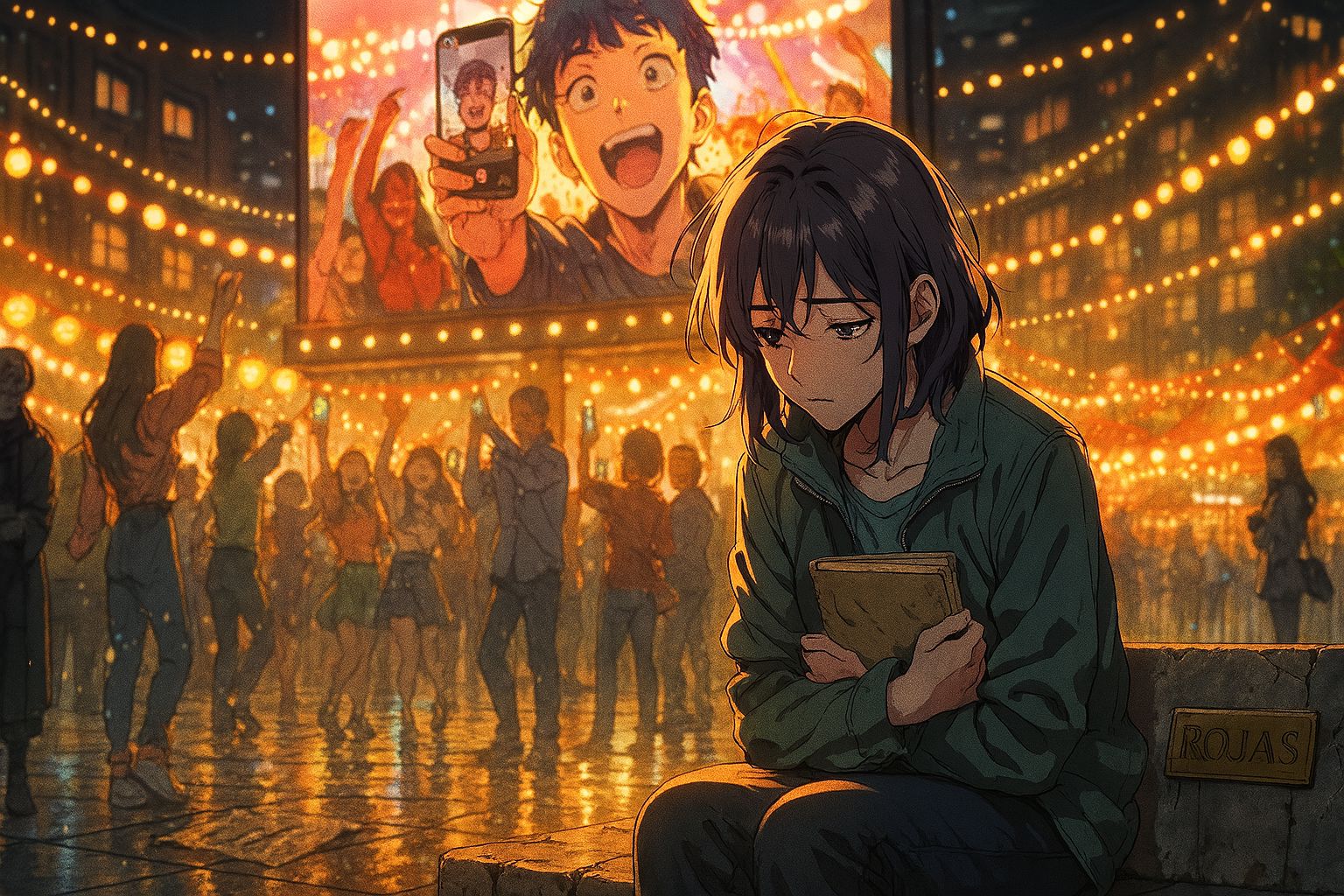
The city breathed with the quickened rhythm of digital times: at night it lit up with screens and fed on fast consumption. Malls sat beside small shops that still resisted, plazas held broken benches, and parks the rain turned into puddles because of badly done works. In that setting a generation grew up that sought the instant beat—the like—before the patience of a process. Some derisively called them "the dumb generation"; others, with pity. But the label did not explain the web of negligence, distrust, and surrender that would come to shape the social landscape. Aitana had been born into cream-colored walls, a nurse mother, and a father who did odd maintenance jobs. From childhood she learned to observe: the kitchen conversations, the forgotten letters from city hall, the rumors about projects that never happened. At twenty-four she worked as a barista in a café that doubled in the afternoons as a small studio for neighborhood podcasts. She wasn't an activist by birth; she was someone who grew weary of injustice and looked for practical ways to fight it. That is why she gathered signatures, helped organize neighborhood cleanups, and patiently attended to neighbors’ complaints between paper cups. Marcos, her childhood friend, was the other side of the coin. A skilled content creator with an eye for editing and aesthetics, he had turned his taste for images into a small profession: local brands hired him, and his videos gained followers quickly. He lacked an elaborate political ideology; he mostly moved by instinct: what generated interaction he pursued, what didn't he discarded. His pragmatism and charm kept him close to the social scene but always at a distance from prolonged commitments. Doña Carmen kept the neighborhood's memory in a notebook: dates of unkept promises, photocopied invoices, names of companies that repeatedly appeared in questionable contracts. At sixty-two she had been an activist in an era when demanding streetlights or potable water required marches and enormous patience. She didn't rejoice in digital trends; she trusted presence and daily follow-up. Juli was the youngest: a university student, idealistic and convinced that networks could catalyze mobilization. Laura, the independent journalist, read details with a magnifying glass and understood that contracts could be read as maps of power: names, dates, companies, invoices that left traces if someone did the work of following them. Councilman Rojas arrived as politicians who read the language of spectacle always do: with a polished smile, a short speech, and the ability to offer images. Filmed ribbon-cuttings, smiling children, gleaming plaques—those gestures, translated into videos, fulfilled the basic function of effective media politics. Behind that friendly screen, contracts were awarded quickly and discreetly; favored companies were always known within the inner circle of power. The park's drainage was not installed correctly, but the ribbon-cutting and applause on camera were enough for the week's consumption. A city used to short-term solutions accepted the images with relative ease. The feed acted like a faint memory: what wasn't repeated didn't endure. In that context, Rojas’s campaign found fertile ground. While one office moved papers and redistributed inflated contracts, another crafted jingles, photos, and ads to be shared. Rojas avoided technical questions in the plazas; he preferred the gesture and the photo. "We build for our children," he proclaimed, and the camera helped him erase the rest. Aitana and her allies tried to ignite another logic. Laura published investigations that showed discrepancies between declared costs and materials actually delivered. Doña Carmen organized signature tables; Juli called a university day to explain how to read municipal budgets. Marcos collaborated at first—some reels, a shot in the plaza—but his relationship to the cause was ambivalent. He felt sympathy for Aitana but also pressure from sponsors and the certainty that the content that "worked" showed joy, not long denunciations. The balance became dangerous. Institutional responses were not decisive. The prosecutor's office opened an investigation reluctantly; officials and offices changed hands with ritual passivity. In the outlets that could investigate independently, Laura found doors open but with fewer resources than needed. Her pieces sparked reactions: first institutional silence, then an opened file that made no progress, and later smear campaigns designed to confuse. They orchestrated montages portraying activists as destabilizers. Tactics were simple and effective: mocking filters, messages turning the complaint into eccentricity, and a public relations machine ready to legitimize gestures over results. Polarization settled over the plaza like a blinding fog. A citizens' assembly meant to deliberate and organize concrete actions degenerated into physical confrontation when groups of youths—some recruited by manipulated videos—burst in to "defend" the inaugurations. What began as shoving ended with broken banners, insults, and blows. The police arrived late and intervened with the same coldness reserved for extinguishing fires rather than investigating their source. In that moment something more than a demand was lost: the possibility of dialogue. Laura bore the weight of the information attack. She received anonymous threats; her column was pulled from a site that suffered economic pressures and nearly cost her livelihood. Doña Carmen found a note at her door that didn’t threaten with explicit words but with the threat of social isolation: you'll stop being counted on if you insist. Juli, exhausted and disillusioned, withdrew from public spaces out of fear and fatigue. Marcos ultimately chose to protect what he had—his work, contracts, and audience. He uploaded a measured video calling for "dialogue" and toned down his activism. The community read his posture as betrayal. The coalition that sought oversight fractured. Those who remained found fewer resources, less support, and the constant threat of wear. Investigations dissolved into paperwork; audits, when they came, took so long that the chance of real sanction evaporated. Rojas consolidated his position not for brilliance but for the exhaustion of his opposition: time and resources faded in a battle that became symbolic. The city, meanwhile, paid concrete prices: schools with reduced budgets, less efficient public services, constructions that crumbled from lack of maintenance. The quietness of the deterioration made it more devastating. There was no final coup, no spectacular scandal that would ignite mass outrage; there were hundreds of small renunciations and a normalization of disregard for transparency. The corrupt strategy used spectacle to divert attention, to fragment society, and to erode trust between neighbors: if no one fully trusts another, it's easier to impose agendas without scrutiny. In that void, the "dumb generation" played an ambivalent role: many chose immediate consumption and amusement over sustained vigilance; others were bought, intimidated, or simply worn out. Aitana was left with the bitter sense of having tried everything and still being insufficient. She remembered nights handing out flyers in the rain, signature tables at the church doors, conversations with neighbors who spoke with breaking voices about how resource leakage affected their children. She thought of every voice she had listened to, the documents Laura had shown her, Doña Carmen’s hands wrinkled from so much writing. All of that mattered to her memory. In practice, however, the plaza gleamed with a new plaque: Rojas's name in polished metal. The benches were new, yes, but soon began to show cracks; the work had been poorly done, but for urban consumption the inauguration sufficed for the photo. The city continued its ritual of distraction. Festivals, fairs, and events that went viral drew crowds and diluted attention. Protest banners became forgotten accessories tucked into corners. Social networks that could have mobilized instead amplified indifference: when a topic stopped producing immediate reactions, it died. The algorithm rewarded the fleeting. Aitana, capable of sustaining rage through constant work, ended up feeling fatigue as a physical weight. She tried to continue—organizing talks, teaching how to read budgets, asking questions at open sessions—but subtle repression and the wear of her allies diminished the available energy. She watched Juli distance himself, Laura change her tone out of caution, and Doña Carmen make fewer rounds for fear of losing the little peace left. She also saw Marcos, from his broadcasts, celebrating the plaza and gaining followers. He had not imposed defeat maliciously; he had simply chosen the easier option. One summer night, when temperatures coaxed people outside, Aitana walked to the plaza. The lights were intense and the music enveloping. The inauguration months earlier had become an event: children playing, people taking photos, vendors selling. Tucked at one end, almost hidden among commercial signs, a crumpled banner demanded justice for poorly made works. Nobody looked. The city surrendered to shine and comfort. Neighbors preferred smiling for the camera rather than fighting to fix the drainage that would flood the streets in the rainy season. Aitana sat on a cracked bench and watched. She felt a type of failure that makes no sound but seeps slowly: the loss of trust between neighbors, the disappearance of spaces for deliberation, the habit of treating politics as spectacle rather than public matter. She turned on her phone by habit; she saw Marcos's livestream celebrating the event, received an applause emoji in the comments, and turned the phone off without sharing anything. She knew some people continued to work quietly; resilience wasn't extinguished. But the prevailing feeling was an acute defeat: not one that fixes with a march or a report, but one that settles into routine. Without constant vigilance and the capacity to sustain action beyond a gesture, societies grow more vulnerable to manipulation. The last image that remained with Aitana was the illuminated plaza, the giant screen replaying the viral video of the party, and Rojas's name on the plaque gleaming under artificial light. Around her the crowd danced; the music covered the questions; each face blended into the celebrating multitude that no longer demanded accountability. Aitana picked up Doña Carmen’s notebook: a handful of signatures, voices once raised now reduced to ink on paper nobody read. She rose, walked down streets that no longer recognized collective claims as everyone's business, and understood that the struggle for transparency and dignity is long and painful; that without watching closely, and without sustaining action, the price of not paying attention is the silent loss of the possibility of living in a just place. The defeat was not spectacular; it was ordinary. And that ordinariness, more than any public scandal, would leave scars hard to heal. The city maintained its consumption and entertainment rhythms, and the generation once called "dumb" largely continued to favor distraction. Among the few who had not given up remained the bitter certainty that sometimes the cost of not looking closely is the slow disappearance of the chance to live in a fair society. Source of the images. Image created with Bing.
No comments yet