 @mc5punk
more from that month
@mc5punk
more from that month
Short story: The Smoke That Reveals
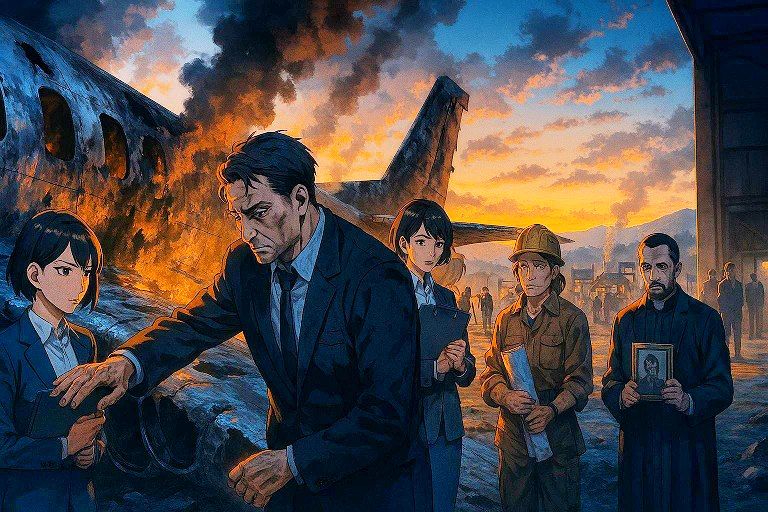
The smoke arrived like a presage: a damp shadow stretching over the fuselage, promising disorder. Marcelin Kambale noticed it before anyone else—not by ministerial instinct, but by the habit of someone who had spent nights in offices where other people's fates are decided—; his hand sought the seatback as if in that gesture he could grasp something concrete amid the vertigo. Twenty-one souls were aboard that craft: ministers and advisers, technicians with mine-cracked hands, a journalist biting her notebook with anxiety, a priest who carried a baptism photo in his pocket. Among them, Aline Bemba kept her composure as if she were a wall others leaned against; Jonas Mbala, with his plans always rolled, watched the gauges for a numerical explanation of fear; Kofi and Mireille murmured names of parts and protocols under their breath. Outside, toward where they flew, Katombé appeared on the maps as a point destined to certify culprits and hand down judgments: the next stop of a visit that could calm or ignite an entire region. "Do you see it?" Jonas whispered, his fingers glued to the panel's screen. "Pressure in engine line two is out of range." Mireille, who had breathed mine dust since she was fifteen, looked out the window and pressed her lips until the skin turned pale. "That smell isn't normal," she said. "It smells like burning oil and... something else." The explosion sounded dry and brief, and then came the fire: a tongue of flame on one of the engines, an ear of the sky burning. Masks, life vests, the automatic instructions; the scene unfolded with the precision of contained tragedy. Marcelin saw Adela Nsimba, the journalist, swallow her voice so as not to turn the panic into live news. He saw Father Okumu's hands tremble over a rosary. He also saw the impassive face of Victor Ngoyi, who traveled with the delegation not as a guest but as a guardian of secrets, his smile now a fold of calculation. "Everyone, stay calm," Aline ordered in a firm voice. "Vests on, masks ready. Jonas, coordinate with the crew." "Marcelin, what do we do?" Kofi asked, anxiety in his voice. "What we always do," he replied, and his voice surprised them with its calm. "Keep a clear head. Evacuate in order." They landed as if cutting a rope: abruptly, with a sound that was both relief and the promise that, this time, fortune had favored the living. There were wounded; stretchers raced and questions were shouted with the urgency of those who need immediate answers. No one died. That single truth fell on them like both a blessing and a threat: the possibility that the worst had not happened, but that the political and personal consequences could be just as devastating. While forensic teams examined the blackened engine and took notes, the delegation gathered strength. Katombé waited. Mwana shouted for justice: five miners buried in galleries that breathed dust and silence. The families still had no names for the guilty; the word "accident" hung from mouths like a coin no one dared touch. The official mission—to inspect, verify, sanction if necessary—needed to be more than gestures. In the makeshift room where they regrouped, the walls seemed to absorb the murmurs. Marcelin, jacket still stained with soot, let the silence grow heavy before he spoke. "We must act with transparency," he said. "Not just for us, but for the families of Mwana." Aline nodded, her eyes lingering on the paper she held. "I've requested external auditors," she announced. "Nothing leaves here without protocol. No one manipulates evidence." Jonas spread out photographs of corroded supports; Kofi presented records that contradicted official certificates. Mireille, her throat still raw from the smoke, recounted stories missing from the minutes: explosives stored without control, entrances sealed by other hands. "In one shaft I saw supports worn down halfway," Mireille said. "It wasn't a collapse by chance. Something gave way because it wasn't reinforced in time." Adela, who had shifted from observer to uncomfortable chronicler, tapped her notebook with a pen. "People want names," she said. "If responsible parties are protected, they'll know. And they won't forget." But in the theater of politics, truths are not always welcome. Victor Ngoyi soon showed his true face: courtesy outside, stratagem within. His movements were precise, his language conciliatory; his interests were sharp as knives. Beside him, Pascal Lunda pulled invisible strings: contracts, permits, informal shafts where extraction knew no rules. For them, the Mwana tragedy was an economic risk and a lit match too close to their stores of power. If the investigation was thorough, it could cost them dearly; if not, it would be another line in their ledgers. Victor requested the floor with that measured smile he used at public events. "Minister," he said, "I would ask that we refrain from premature judgments. We've always cooperated with authorities; any hasty measure could affect jobs." Marcelin looked at him with a hardness he had not shown before. "This isn't about attacking companies," he replied. "It's about saving lives. If there's negligence, there must be consequences." Victor inclined his head; the smile didn't change but the gesture felt less spontaneous. "Of course. But stability must be the priority." Meanwhile, Pascal sought anyone who would hear him in the dark halls of power. "There are ways to handle this without making it a spectacle," he whispered to an official. "A communications effort, fix perceptions. Nobody wants economic problems." Aline perceived the move as a shadow and did not remain silent. "We will not trade safety for stability," she said quietly but loud enough for those around to understand. Adela Nsimba began publishing reports; the local radio broadcast fragments of interviews with families and surviving miners. Conversations that sparked on networks turned into public demands. Opinion sharpened day by day. Victor and Pascal did not sit still. Discreet calls to officials, meetings in windowless offices, veiled offers of "collaboration" that smelled like bought silence. Leaked "technical" reports tried to rewrite the version of events. They resorted to mud tactics: muddying evidence, discrediting testimonies, seeding doubts about the impartiality of experts. When the room's door closed, a low murmur of strategy could be heard: "delay, divide, neutralize." "If they publish all this evidence, we will lose contracts and employment," Pascal said to Victor in a private office. Victor rolled a cigarette, though he had claimed months ago he did not smoke. "I'll handle the conversations," he said. "You talk to logistics. If we delay inspections for a few weeks, much will cool down." But the net closed from the other side. Jonas and Kofi, stubborn as those who know truth hides in badly filed papers, recovered contracts from offices that should not have kept them. Among the documents was an invoice dated and numbered that linked one of Pascal's subcontractors to an uncontrolled supply of dynamite. Aline, with the discipline of a prosecutor, sealed the evidence and requested independent forensic analysis. The engine smoke was no longer the only black mark: stains appeared now in accounts and permits. "This changes everything," Jonas murmured when he saw the invoice. "It's not just technical negligence. There are purchase records that don't add up." Kofi gripped the document as if he feared it would evaporate. "If this comes out, people will go to jail," he said. "There are names." Tension rose as the delegation advanced toward Mwana. Vigils multiplied. Father Okumu organized services and forums where families could raise their voices. The community demanded names, not euphemisms. The minister's presence—his face still marked by the plane fire—stopped being merely ceremonial and became a public summons. Marcelin spoke harshly in the central square and promised "zero impunity." His words bore the cadence of someone trying to regain credibility, but also the fragility of someone who knows hollow promises do not fill graves. "You will not be left in the dark," Marcelin said before the families. "Not while I am here. But I need your help to move things in order." A woman, her face hardened by grief, answered him: "Words don't bring our children back," she shouted. "We want to see the culprits, and we want change now." On the dawn the documents were handed to external auditors, the conspiracy tightened. Jonas received threatening phone calls; Mireille's car had a tire slashed. Adela got anonymous messages—photos of her house. Victor smiled in closed meetings, but his smile was different now: rubbed by the fear of accountability. Pascal used his influence in the courts to file motions aimed at blocking inspections. "They won't stop us with intimidation," Aline said when she learned of the threats. "They're testing us," Mireille replied. "They want to wear us down." Jonas stared out the window as if the sky might yield another answer. "They have power, yes," he admitted. "But we have evidence." Public pressure pushed the investigation toward results that could no longer be hidden. The pieces fell into place like a puzzle: negligent reinforcements, uncertified material purchases, payments that didn't add up. Victor tried to slow the fall by invoking technicalities; Pascal appealed to institutional memory. Their tricks worked only partially. The press, tireless, and the community, relentless, tightened the noose. On the morning the first indictments were announced, Marcelin walked the hangar alone where the damaged plane still smelled of tar. He stopped in front of the blackened fuselage and touched with his fingertip a coal-black streak. He thought of human fragility and how, sometimes, the threads that bind corruption to tragedy are as invisible as the combustion that ignited that engine. "Sometimes I think all this started in an office," he murmured to himself. "Not in the mine." The victory was partial and costly. Victor Ngoyi and Pascal Lunda did not vanish: they remained shadows on the prowl, seeking legal holes, opportunities to reweave networks. But the community had changed; voices that once begged in silence now demanded loudly. Jonas and Kofi returned to their mine measurements, more careful and vigilant; Mireille pushed training and safety programs; Aline coordinated transparency for the files; Father Okumu accompanied funerals and memorials. Adela continued to write, turning pain into narrative, and each article nudged justice forward. There were trials, public hearings, tears and rage; there were also small advances in regulations and rescue equipment. Not everything was fixed instantly: rebuilding galleries and repairing trust were years-long labors. The novel was thus marked by fire and earth: a plane fire that reminded people of their vulnerability, and a collapse that exposed negligence in the shafts. In between, conspiracies revealed themselves as taut networks that sought to shield interests. When Marcelin finally climbed into the vehicle taking him back to the capital, the hangar's low lights faded behind him and, in memory, the engine's blast echoed. He knew the battle had only begun. Outside, dawn opened like an enigma: promises, threats, fulfilled or frustrated, cautious celebrations for small victories. The country watched. And in every village, in every mine, there remained the hope that that fire had not been in vain. Source of the images. Image created with Bing.
No comments yet