 @mc5punk
Short story: The Orchard of Memory
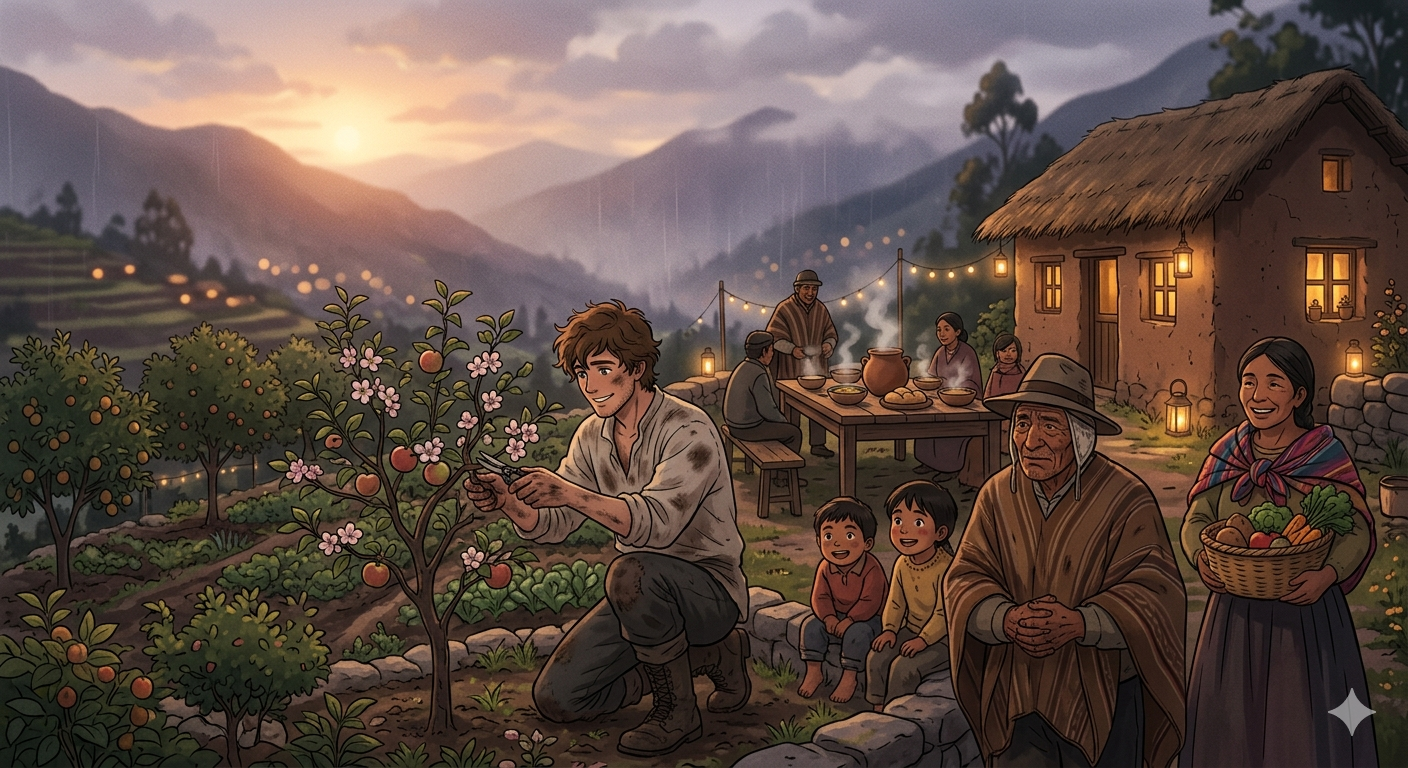
The move was quieter than Emil had imagined. That late June morning, the city still breathed smoke and haste; he, however, packed with the slowness of someone measuring each object as if deciding which part of his life deserved to remain. He closed the apartment door without ceremony. On the threshold he left a ceramic mug, a cookbook, and an envelope with letters he would not open. He paused, pressed his forehead to the cool wood, and whispered, “Goodbye, old noise.” Then he left. The journey to the hamlet was a succession of landscapes that spoke to him in another language: highways that ended in dirt roads, telephone poles giving way to trees that rose unapologetically. He arrived while the sun was still sluggish. The house he had rented was small, with adobe walls and a tile roof that held memories of ancient rains. A man with large hands greeted him with a frank smile. “Welcome, brother,” the man said, extending his hand. “I’m Don Álvaro. Are you coming from far away?” “Very far,” Emil replied in Spanish still rough from the trip. “I came looking for… something I didn’t have in the city.” Don Álvaro looked at him with the soft eyes of someone who has seen many departures and returns. “Here the land is good, but it demands dialogue,” he said. “It’s not for those who want orders, but for those who know how to listen.” The first weeks were a lesson in patience. Emil learned to walk slowly, to bend his back without complaint, to recognize the sound of rain on a guadua leaf. His hands, which had once operated keyboards and contracts, filled with calluses and soil. Every task had a depth that manuals did not show: how to sow a seed without suffocating its urge to grow; the exact moment to transplant without wounding; the gesture to protect a young sprout from a curious animal. One night, when the moon was nearly full and the house felt like a whisper, Emil sat with Don Álvaro at the small kitchen table. The conversation arose like corn is planted: with respect and postponements. “Why did you leave?” Álvaro asked, wiping the frost from his coffee cup. Emil looked at the man’s hands, hardened by years of work. “I was looking for freedom,” he said at last. “Not the freedom in headlines, nor the romantic idea of wandering without a destination. I wanted to do something with my hands, to understand time, to be responsible for something that has no price in markets.” “The freedom we seek here is different,” Álvaro replied. “It’s knowing when to cut and when to let grow. Here decisions are made with the land, not against it.” Soon Emil began designing what he would call his edible forest. It wasn’t just a technical project; it was an answer to a nostalgia that stretched back to his childhood in Europe: memories of grandparents cooking with what their hands had gathered, the sense of belonging to a landscape that responded with patience. He sketched maps on the kitchen table, mixing names of species he was learning with terms he carried from his native tongue. He wanted fruit trees, legumes, and herbs to coexist like in ancient forests—each layer supporting the other, each root conversing with another. He worked with the neighbors. At first they watched him cautiously—a foreigner who spoke slowly, who brought ideas from elsewhere—but his willingness to learn broke the distance. He spent mornings alongside the village women who knew soils and harvests without certificates; he learned to sow by the lunar calendar according to local customs and discovered there was wisdom in that blend of observation and faith. He gave up plots, asked for advice, and received stories. People told him about seasons of hunger and abundance, about home remedies and planting rituals. Emil listened as if each tale were a botany lesson books couldn’t offer. “I don’t want this to be a museum,” he said at an impromptu meeting under a guamo tree. “I want food to be a bond again, not just a product. I want kids to know where tomatoes come from, for grandparents to see the plants they knew in their youth.” A woman named Carmen, who tended a garden by the road, replied in a voice that seemed to flow from the furrows themselves. “Then work with us, son. Let this belong to everyone. We have nothing left to hide.” Emil agreed. They started working together: building raised beds, creating polyculture systems, planting fruit trees that would offer shade and fruit in different cycles. There were mistakes. Seeds that never germinated, pests that devoured an entire planting, a rain that came too early and swept away hope. Each failure hurt and fed doubt: Had he done the right thing in leaving a “settled” future? One afternoon, after losing nearly an entire batch of cassava to pests, Emil sat on the edge of the garden with his hands over his face. “I thought it would be easier,” he murmured. “I had the illusion that will alone would be enough.” Don Álvaro sat beside him, put a hand on his shoulder, and looked toward the mountains. “The land teaches humility,” he said. “What’s missing is not strength but time. And here the times are different.” Social media, which had known him in Europe as just another technician, began to take an interest in his story. A friend still living in the city had asked him to share photos. Emil hesitated at first; he didn’t want his work to become a spectacle. But he gave in and sent images showing muddied hands, shy shoots, a communal table where they distributed the season’s first tomatoes. The photos traveled like breadcrumbs: people were moved by the transformation; others criticized the choice to forgo security. Emil didn’t seek approval; he simply wanted to document the honesty of the work. One morning, while watering the new plantings, he heard children laughing near the path. They came with small bags and curious eyes. “Mister, is that tomato really sweet?” one asked, tearing off a still-timid fruit. Emil smiled and handed one over. “Try it,” he said. “If you like it, plant the seed at home.” The girl returned with her face lit up. “It’s sweet!” she cried. “My grandmother says it tastes like childhood.” Moments like that anchored him. They were small instances that wove a new fabric: food as memory, land as a library of flavors. Over time, the edible forest became something alive beyond his original project. Grandmothers taught the young how to make preserves; migrants who had once left for the city returned to relearn sowing; children made the garden their playground of discovery. Emil, who had initially sought freedom, discovered he had found a community that returned identity to him. Seasons cut the story with invisible shears. There were years of plenty and years of scarcity. A harsh winter accentuated his nostalgia; one night Emil lit a fire and spoke to Carmen. “Sometimes I feel nostalgia eats me alive,” he confessed. “I miss the constant sound of the city, the ease of going anywhere.” Carmen looked at him with compassion. “Nostalgia is a bridge, not a prison,” she said. “It connects you to who you were and helps you choose who you will be. Also, here nostalgia becomes flavor: look at the bread we made with your wheat.” Overwhelmed with gratitude, Emil let nostalgia become a motor rather than a burden. He began to write more often: letters to his sister in Germany, posts for a blog where he recounted routines, losses, and small miracles. One entry read: “I didn’t come to run away; I came to learn how to care.” The phrase became an accidental motto among those who followed his work. One rainy afternoon, when the world seemed confined to the sound of water on roofs, a group of young volunteers from the city arrived. They came with new boots and different energies. Emil received them with the simple instruction to get their hands dirty and listen. “What are we looking for here?” one asked, trying to understand if their presence would be useful. “To learn how to wait,” Emil replied. “The land does not hurry.” The volunteers soon learned that plants did not obey idealistic speeches. They learned to repair the irrigation system, make compost, identify pests without panic. In return, they offered new techniques, ideas, and a capacity to tell the story that broadened the forest’s reach. Over time, one of those volunteers stayed and formed a partnership with a local woman; others returned regularly to help in key seasons. Nighttime conversations around the fire became rituals. There, between laughter and silence, Emil began to recount his former life without excessive dramatics but with an unexpected tenderness. “Before, I had everything planned,” he said one night. “A house in the city, a salaried job, plans for vacations. I wasn’t unhappy, but there was a hole. It was like having all the pieces of a puzzle… except the one that makes the picture make sense.” “And here, did you find it?” Don Álvaro asked. Emil watched the flames and nodded. “I found it in small gestures: seeing a tree bear fruit year after year, the gratitude of someone who receives food you knew how to care for. It’s not absence of pain: I’ve suffered losses, failed harvests, cold nights. But pain carries a different weight; it doesn’t drag me under. It reminds me I’m alive.” Years later, the edible forest had grown into a green corridor on the hillside. Trees mixed with seasonal crops, and shared meals were frequent. Visitors came not just out of curiosity but out of a need to touch earth with insistence. Praise on social media was replaced by tangible visits: agronomy students, chefs interested in original flavors, communities wanting to replicate the model. One afternoon, while pruning a branch that stubbornly refused to bear fruit, Emil felt a familiar shift: the city, contracts, and promises of comfort passed like a film he no longer wanted to watch. As he cut carefully, he remembered the first night he vowed not to seek comfort but connection. “Do you regret what you left?” Carmen asked one afternoon, watching him work. Emil rested the tool on the bench and looked at her with tenderness. “No,” he said. “There are days when nostalgia calls loudly, but it’s not regret. It’s a sign something important was gained. The freedom I looked for wasn’t escape but belonging. Here I am part of a cycle that holds me.” When his hands gathered ripe fruit, he didn’t see only food; he saw stories: the seed given by an elder, the rain that saved a season, the child who planted his first tomato. Each fruit testified to renunciations and learnings. At the end of one of those years, during the flowering festival, the village square filled with tables sharing dishes made from the forest’s produce. Emil walked among the people, watched faces lit by candlelight, and remembered that his choice, though painful at first, had woven a new fabric. Someone asked him to speak. He climbed the improvised stage and, in his soft voice, said: “I came looking for freedom and found responsibilities that make me feel free. Here I learned that true freedom is being responsible for something you love.” Applause. A child handed him a small bouquet of leaves and wildflowers. Emil took it with trembling hands and, without pretension, let nostalgia turn into gratitude. The orchard of memory that had begun as a personal gesture was no longer just his. It belonged to everyone who had worked, laughed, and cried in its furrows. It became a school, a sanctuary, and a common table. And although the city still existed in the distance, it no longer occupied the center of his being. In silence, while the wind swayed the night’s last petals, Emil returned to the adobe house. He switched on the light and placed on the table the envelope of letters he had left behind when he departed. This time he opened them. There was a note from his sister: “I hope you find what you are looking for.” He smiled and wrote in his own hand: “I found it in the patience of a land that teaches you to remember.” He closed the letter, looked out the window where the moon bathed the forest, and felt that, for the first time in a long while, he could rest without having to run away. Source of the images. Image created with Google Gemini.
No comments yet