 @mc5punk
more from that month
@mc5punk
more from that month
Short story: The Village of Forgotten Leaves
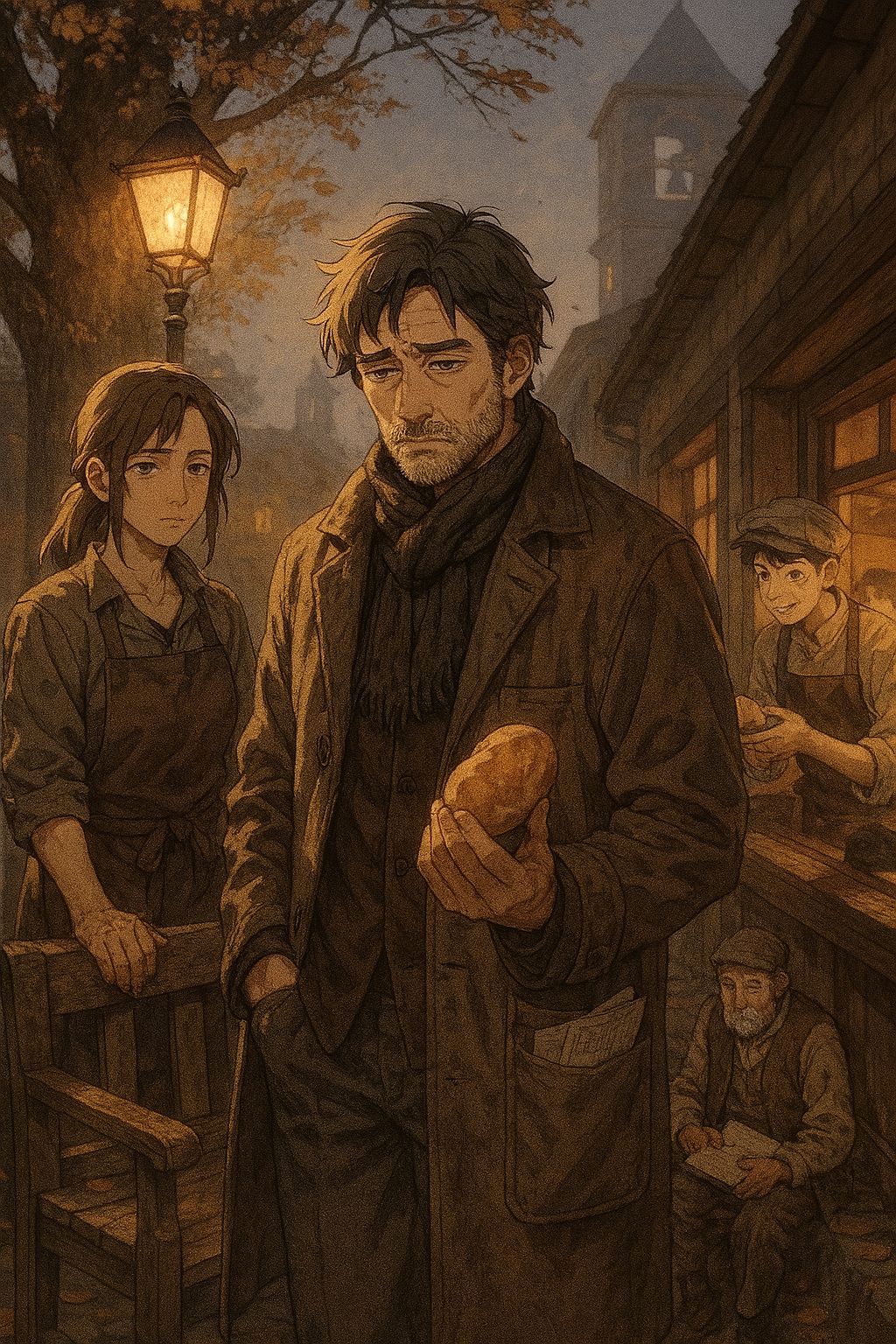
Every autumn, when the first leaf began to loosen from the old elm that watched the entrance, he returned to the village that did not appear on official maps. It was not a festive homecoming nor an escape sanctioned by routine: it was a return measured by the need to touch what had been left loose in his life, like cut threads that still pulsed beneath the skin. The village, wrapped in a light that seemed inherited from other seasons, did not offer spectacular wonders; its oddness lay in the patience with which it kept the small things the rest of the world discarded. The town's clocks did not mark hours with mechanical exactness; they answered to the tolling of the church bells—a sound deep and slow—and doors opened only for those who still knew how to tell a truth with steady hands. The facades, worn by years of honest labor, held lessons in their peeling paint and in the flowerpots a woman always tended with care. It was a place made of customs: people rose early to work and spoke slowly, as if each word had to be weighed before being launched. In the main square, on a bench that seemed older than any memory, Don Elías waited seated with his patched vest and a collection of folded maps. They were not maps of routes or rivers; they were maps of moments. Each sheet traced summers that had been, afternoons that had taken something away, and nights in which promises had been made susceptible to breaking. When he unfolded one, the lines did not guide the traveler to a topographical destination but to a date, a feeling, a loss to recover or accept. "This map is not for getting lost," Don Elías said in their first conversation, his voice rasping from having read too many goodbyes. "It is for finding yourself." The man who returned felt, immediately, that the phrase was not a light invitation: it carried a warning. He asked how to use it, and the old man explained with a patience grown rusty. "Each line remembers something you forgot. It is not always sweet. Not all memories embrace you; some cut. Are you willing to let them hurt you?" The question hung. He did not answer right away; the old man's words acted like a mirror that showed not only what had been but also what could still wound. Martina's workshop, attached to the square like a tamed scene, smelled of shavings and wood oil. Martina worked with strong, callused hands, and her gestures were precise as if every nail and every sanding were a rite. She did not smile for show: she smiled to keep the seam of the day intact. When he approached, she drove a piece of wood with the concentration of someone ordering chaos. "Don't buy maps out of curiosity," she said without fully raising her eyes. "Buy one if you want to learn how to return." Her words, simple, carried a different gravity: she did not speak of romantic journeys or exotic discoveries, but of the intimate return that demands courage, discipline, and time. Martina was not a dramatic apparition; she was the certainty of routine turned into refuge. With her, learning to return meant learning to take up again the cadence of small tasks that sustain life—lifting a table, repairing a chair, accepting that the wood has veins that cannot be changed. Tomás's bakery was always warm. Tomás, young with cheeks perpetually dusted in flour, kneaded with moderate haste and spoke slowly when trust allowed. He offered a roll, the sort of everyday gesture that in that village acted as medicine. "Maps open doors," Tomás said as he handed the roll into his hand. "Once a man came looking for his mother. He left with his grandmother's recipe and hands that learned to knead. With each loaf, he found pieces of himself." The anecdote had the texture of the tales the village cultivated: they were not epic stories but repairs. Bread, in that context, became tangible memory; kneading was remaking the thread of identity over and over until the dough answered and the oven's heat healed nostalgia. At the school, Ana taught the children to tell stories before they learned to read. Her classroom smelled of chalk and paper, and the walls were covered with cutouts, names, and dates. She showed a mural woven with local stories: weddings, farewells, births—a chorus of small narratives that offered comfort to anyone who wished to belong. "Here we teach how to tell stories before we teach how to read," Ana explained in a voice nourished by tenderness. "If you learn to tell, you learn to be." Her lessons were a form of transmission: narrative as social foundation. For him, the notion that belonging was earned by telling and listening was a subtle, disarming revelation. In a world where many forms of belonging are bought and sold, this village guarded its own as one guards a cracked plate: with patience and careful repairs. Neighbor Rosa, the seamstress, worked in a room lit by a lamp that always burned on cold nights. Her hands seemed to move by their own memory; the needle plunged and emerged with the regularity of a heartbeat. She stitched not only fabric but memories. Under her needle, scraps of different pieces became blankets that not only warmed the body but preserved whole circumstances: weddings, funerals, rainy afternoons. "Each stitch is a story that refuses to die," Rosa murmured as he watched almost in silence. "Sewing is a way of saying this matters." Rosa's house smelled of lavender and thread, and in a corner, a mended blanket seemed to contain a catalog of emotions: patches dulled by loss and others vibrant with joy. The act of sewing was an act of resistance against forgetting; memory was held together with threads that wrested time from its selfishness. As the days passed, he moved among these small and sensitive events: the opening of a door, a child's whistled tune, chimney smoke. Each encounter seemed arranged to show him another way back: not triumphant, not spectacular, but made of repeated gestures that, added together, rebuilt what had worn thin. Sometimes, at the bakery table, at the carpentry bench, or in the school chair, he allowed himself to remember loose fragments of his own life: a laugh he no longer found, a confession he never made, an absence he had learned to bear. The night he was to leave, Martina walked him to the village's edge. The sky was clear and the stars, though few, seemed placed with the precision of wise hands. The air smelled of wood smoke and bread: everyday scents—perhaps the most dangerously beautiful—reminded him that true belonging is built slowly. "Will you come back?" Martina asked without drama, as one who poses a question that is also an offering. He looked at her. The weight of his travels, the tiredness of silences, and the possibility of recomposing passed through his chest. He answered with a voice that tried to be both firm and humble. "Yes. Not for vague promises, but because I learned to care for small things." Martina squeezed the hand he offered with the naturalness of someone confirming an everyday pact: it was not a solemn vow but an agreement of presence. In that gesture there was acceptance of the world's limits and a wager on the perseverance of affections. When he rounded the corner, Don Elías reappeared, sentenced to the same patient watchfulness as always. He handed him back the map, now folded, with a movement that seemed to repeat an ancestral liturgy. "Keep the map in the pocket where you can feel its fold," he said, and his voice, softer than before, became a recommendation to be honored. He tucked the map into that pocket, feeling the paper's crease like someone who keeps a scar that speaks. He left with the warm roll in his hand—tangible symbol of what remained—and with the certainty that returning did not mean recovering exactly what was lost but restoring a fabric the years had frayed. The journey back was long and quiet. He thought of the stories he had heard, of the hands that gave him work and those that offered consolation. He understood that the village was not a utopian refuge but a laboratory of small repairs: there no one promised miracles; they promised routines and fidelities. People did not offer recipes for happiness; they taught how to hold everyday life so that, over time, it would not come undone. Arriving in the city, the map stayed in his pocket as a discreet reminder. Sometimes, amid the noise, he would take the paper out and run his finger along the crease. Remembering then required discipline: making time, speaking the truth aloud, mending what could be mended. He realized that his return to the village was not an act of escape but a practical decision: to learn to care for the small so as not to lose himself when the great things vanished. Over the months, the lessons became routine. He repaired tables that were clean outwardly but empty within; he left messages for friends with the exactness of someone who tends to constancies; he cooked with the calm Tomás had taught him; and he sewed blankets with the patience he'd learned from Rosa. In that new discipline there was a humble remedy: everyday life turned into care. And yet melancholy did not vanish: it remained like a familiar furrow, a companion that did not bother and sometimes taught. What changed was how he inhabited that melancholy: he stopped seeing it as a sentence and began to understand it as raw material. He learned to turn it into story, into bread, into stitches. He did not rewrite the past, but he learned to hold it better. Seasons passed. He returned each autumn, not out of festive superstition but because the village's discipline demanded it: to check the map, to speak with Don Elías, to take a roll at the bakery, to pass by Martina's workshop, and to make time to sew the stitches life required. Each visit left a gentler trace: not spectacular triumphs, but minimal restorations that accumulated. Sometimes, sitting on the square bench and unfolding the map, he would see Don Elías's bent figure, Martina's workshop with its smell of wood, and the window where Rosa sewed. He felt the weight of what he'd learned: belonging is a daily act, and fidelity to the small sustains the large. And when he folded the map to put it away, he did so with the assurance of someone who understands that return does not erase losses but shelters them with simple tools: willing hands, honest words, inherited recipes, and blankets that capture memory. Thus, the Village of Forgotten Leaves continued to exist—not as a static refuge but as a margin where stories were recomposed through patience. And he, returning every autumn, found himself again in that fabric of bread, stitches, and tales, convinced now that salvation, if it exists, keeps the rhythm of small things. Source of the images. Image created with Bing.
No comments yet