 @mc5punk
more from that month
@mc5punk
more from that month
Short story: Beacon of Salt and Shadows
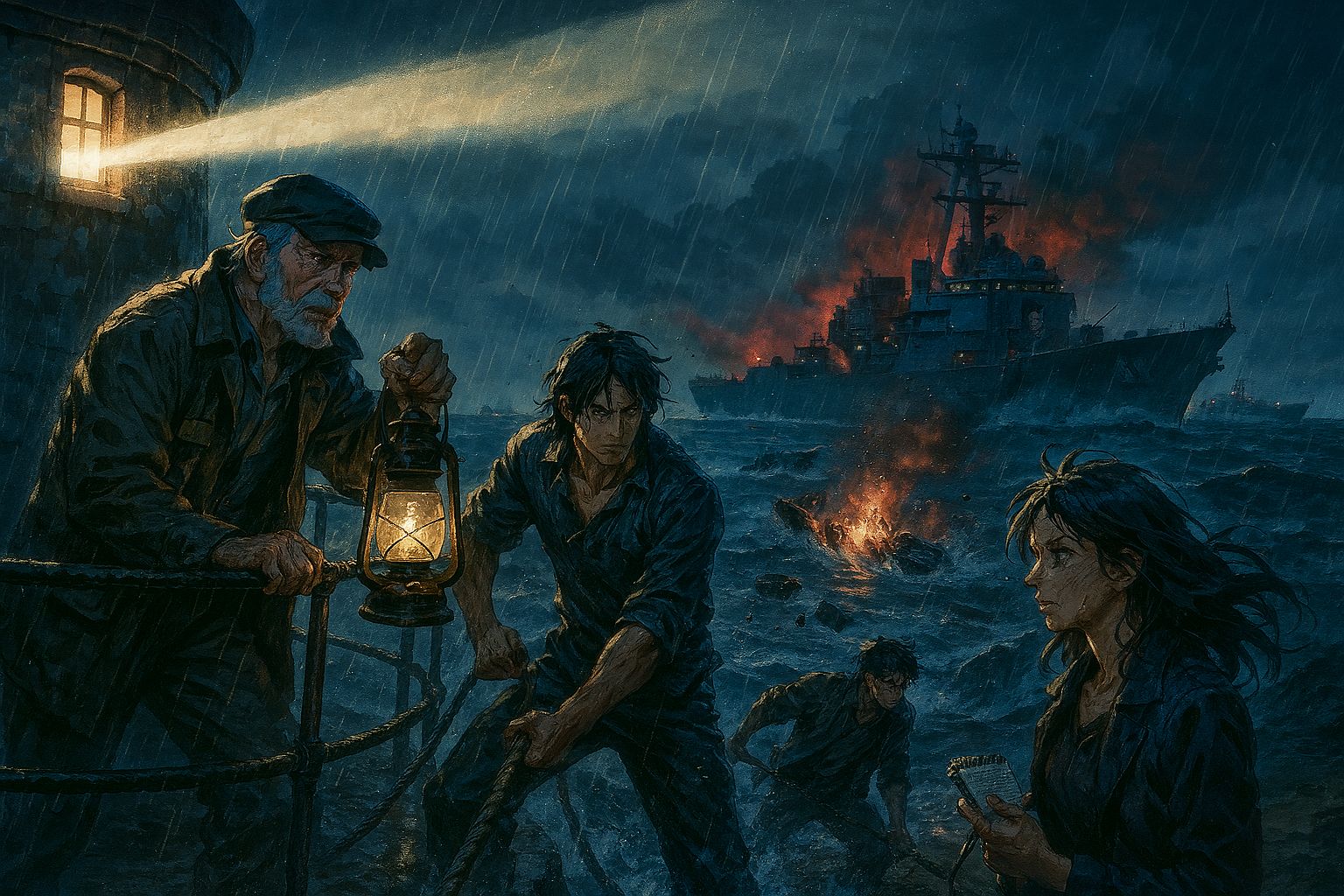
Night fell like an iron lid over the Caribbean. The lighthouse, a needle of salt-stiff stone, spat its beam every twelve seconds: a small sentence nobody had asked for but everyone had to read. Mateo, the lighthouse keeper, rested his palms on the railing and breathed the sea: he knew the secrets the foam brought and those it carried away. "Listen," Joaquín said beside him, his voice between his teeth. "They're moving again. Three engines, heading south." Mateo didn't need to look. His hands, calloused from decades, found the handheld torch. The night answered with a tide of shadows. "They're not ghosts," he murmured. "They're men who think the sea can buy them a future." On the deck of the frigate, Captain Sarah Delgado pressed her forehead to the bridge glass. The radars had marked contacts; the orders had traveled by satellite; politics had arrived wrapped in official papers. There was no room there for soft words. "Prepare maneuvers," she ordered. "We don't get to panic or create needless tragedies. Intercept, fire if necessary, and avoid harming innocents." Camila Rivera, her notebook damp with sweat and ink, watched the scene like someone poised to strike a lethal verb. Her recorder clicked on silently; truth always made noise when she stepped on it. Under the shadow of a warehouse on the coast, Hernán Cruz smiled as if distributing caresses. His men loaded bundles onto small rafts, hands that knew arithmetic better than mercy. "The Navy likes to beat its chest," Hernán said. "Let them. We move like rats: change tunnels. Tonight won't be any different." An engine started in the dark, a howl that sliced the air. Three boats tore through the calm; they carried packages wrapped in plastic, and in each package pulsed the promise of bills that bought silence. They headed toward the meeting point, along the route that would take them across the Caribbean to ports that charged little and demanded much. The frigate turned like an awake animal. Patrol boats spread out in a fan. Tense voices filled the radio; in Sarah's gut was a knot that wasn't strictly professional. "Visual contact at two miles," the operator reported. "Three boats, high speed." "Prepare signal lights and flares," Sarah ordered. "If they don't respond, cut engines. If there's resistance, neutralize." The first flare burned the night: a red river that rose over the illegal crew's heads. The reaction was instant. One boat sparked improvised radars; another turned, searching for a gap. The Navy answered with measured maneuvers, blinding lights and engines roaring to intimidate, but Hernán's men did not flee without a fight; they'd learned that fear didn't pay debts. The first impact landed like a hard punch. A controlled detonation, timed to neutralize engines and cargo without opening a hole that would swallow lives. Water and plastic burst into a short, cruel rain. Burning fragments fell like meteorites: the destruction of the boats carrying illicit goods left wreckage floating on the surface like anchored graves. "People in the water!" Joaquín shouted, his face lit by the flashlight like a mask of horrors. "Two at the stern, one at the bow!" Mateo threw a rope to the young man with the calm of someone who'd seen too many rescues. "Pull one up, quick," he ordered. "Don't look them in the eyes; they'll tell you things so you won't save them." In an auxiliary craft, a sailor from the frigate grabbed a drenched, bleeding man; his hands trembled, not from the cold but from the sum of decisions that had led him there. Hernán, on the shore, pressed his lips together. Not everything had been destroyed; there had been human losses on both sides, and in the night's depths the economy that financed his empire burned with borrowed flames. Camila ran toward the beach when the operation ended, dodging police and sailors, her recorder clutched tight. She found a fisherman with a face full of remorse. "Why did you do it?" she demanded, her voice hard. His answer came as a dry rain of need. "Do you know half of what my mother eats?" he answered. "Do you know if I don't do this my brother will leave from lack of bread? I didn't come because I like the risk; I came because there was no other door." The new naval presence left a trail of debris and decisions. In offices where policy is written during business hours, officials spoke of operational success. In the streets, barbers and mothers saw the price of the intervention: broken jobs, stalled projects, and anger multiplied by scarcity. Hernán did not cry. He adjusted his clothes like someone changing a tie before a macabre party. "They're wrong if they think this finishes us," he said softly. "They can sink boats. We have ideas. We'll always have ideas." On the frigate, Sarah looked over the papers with a mix of fatigue and contained anger. She knew the operation was one piece on a board that required many more pieces: alternative economies, financial tracking, state presence not only on the coast but in people's lives. "We can't kill a continent's thirst with one explosion," she told her deputy. "We scare them, take boats; but if we don't offer opportunities, they'll come back." Mateo lit his lighthouse again and watched the horizon. Joaquín sat on an empty crate, tossing aside the rope he'd used to save a man. "If they offer me something else," Joaquín said in a broken voice, "I'll take it. I don't want my son to inherit this." Camila put her recorder in her pocket, certain this night would not be a single headline. It was the first chapter of a long, bloody story. Sarah knew they'd return; Hernán planned alternate routes; Mateo added new names to the list the wind had brought. The war on narcotics continued like an untiring pulse: a succession of battles and concessions, tactics and adaptations. The naval fleet remained in the Caribbean like a shadow that watches but does not heal, one more actor in the drama that unfolds where North America and South America meet in salt water. And at the lighthouse, under the fine rain and the smell of diesel, the beam turned again, relentless. Nobody could say whether that night had been a victory or merely a fire that would leave ashes for the next blaze. Only the sea, old and wise, knew that the next wave would bring more secrets to bury or to reveal. Source of the images. Image created with Bing.
No comments yet