 @mc5punk
more from that month
@mc5punk
more from that month
Short story: The Station of Masks
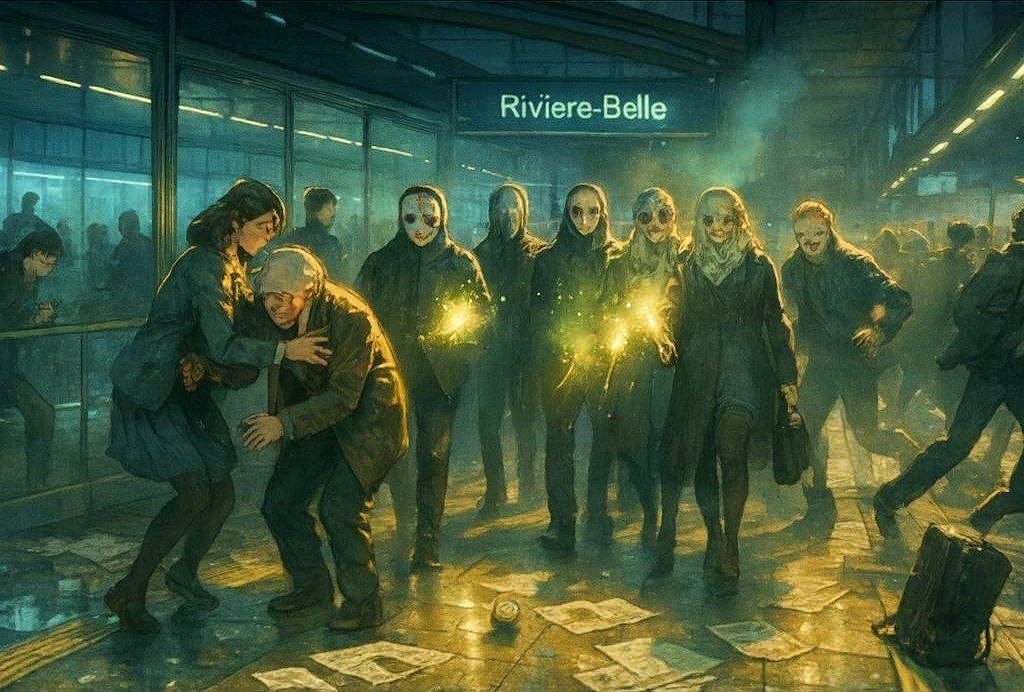
The station slept half-awake, that light slumber that precedes dawn: the smell of metal and coffee tangled with the murmurs of travelers, footsteps tracing familiar routes, and headphones like little helmets isolating people from the world. Rivière-Belle seemed like a patient creature, accustomed to the repetition of each day; its fluorescent lights hummed with a habitual fatigue and the glass walls returned the gray light in tired reflections that multiplied faces. Some read the paper with the determination of someone ritualizing the morning; others ran through meetings in their heads; some simply waited for the train as if waiting for something inevitable to happen. “Are you going to be late again today?” murmured a refined woman to the man beside her, her voice barely above the station’s mechanical hum. “If you miss this one, you won’t make the presentation.” He smiled without conviction and swiped his screen with the mechanical precision of someone seeking security in the familiar. A few meters away, a street musician, guitar case open at his feet, tuned with the slow gestures of someone who depends on the chance of coins. An old man leafed through a newspaper with trembling fingers, routine as a support; a young woman rushed a coffee, eyes already on the automatic doors; teenagers chatted, phones in hand, their conversation light as bubbles. They arrived without warning, like a masked omen. Six shadowed figures wearing masks emerged from the opposite platform with the contained violence of those who have rehearsed every movement to perfection. It was not a hysterical storming in; it was a measured, calculated entrance in its theatricality. The masks—frozen beauties—seemed carved from broken dreams. Each had its character: the first, cracked porcelain, bore a smile in pieces, as if joy had been shattered; the second was traced with red lines like scars; the third, covered in tiny mirrors, splintered the station into glinting fragments that returned fractured gazes; another was smooth and black, featureless, a shadow made object; the fifth combined floral motifs that felt out of place in that context; the last showed an expression of frozen horror, eyes exaggerated, mouth open in a perpetual scream. They walked in silence, and that silence itself became a palpable threat: the shock of the crowd seeing figures that did not belong to the everyday landscape. In their hands they carried fireworks. They were not controlled festive pyrotechnics but improvised objects that spat sparks and the smell of gunpowder; each spark was an urgent heartbeat tearing the calm and igniting the breath of those present. The first explosions burst like small light-bombs—yellow, green—and for a moment the station was lit with a clarity that seemed to want to reveal something ordinary life had hidden. The crowd parted at their passage as if a current had encountered a stone: cries, hurried footsteps, the dull thud of falling bags; newspapers opening like wounds. In an instant, Rivière-Belle lost its script and became the stage for an unexpected, violent, and gratuitous rite. “What are they doing?!” someone exclaimed, voice broken by fear, a woman leaving her coffee half-drunk who was nearly pushed by the surge of people. They sought neither loot nor propaganda. Their movements seemed rehearsed for a single purpose: to disorder the everyday, to unsettle the minimal trust that holds the city together. They threw firecrackers beside waiting groups to provoke startle and dispersion; they shoved a frail-looking man on the handrail with deliberate brusqueness; they ripped devices from the hands of those attempting to record. They mocked with muffled laughter when someone, trembling, lifted a phone to capture the scene. These were small, precise stitches of violence that, together, wove a fabric of panic. One of the masked figures, the mirrored mask, leaned toward a teenager filming with shaking hands. The mask multiplied the boy’s image into thousands of fragments. “Turn that off,” he said in a hoarse voice, his mouth barely hinted behind the mask. “You won’t want to appear in this.” The teenager let the phone drop with a choked sob and retreated until he bumped into someone else. The feeling of helplessness mixed with a cold rage in some: there were those who, by instinct, tried to confront them, and those who, out of fear, crouched and sought protection. The assaults were short, hard like sparks: a cold punch, a shove that made bodies tumble, the force that ripped purses with the complacent ferocity of someone who enjoys their own power. An old man was pushed in a way that violated not only his balance but his pride; a pregnant woman was shoved and let out a cry that rang beyond the noise; a hurried traveler received a slap that left his cheek burning. Not all harm was visible. Some passengers left with skin bruises; others with wounds you cannot see: persistent trembling in the hands, nights returning in the shape of fireworks, the simple sensation that safety no longer existed. “Help me, please!” cried the old man when shoved; he leaned on the handrail, breath ragged. “My heart is weak…” A young woman, who until then had been barely a presence among others, bent down without thinking. Her hands, though trembling, moved with determination and supported the old man under the arms. “Calm down, sir,” she said. “Don’t move. I’ll get you out of here.” The old man looked at her with glassy eyes, his voice breaking with surprise. “Thank you… I thought I would fall; I thought this wasn’t for me.” His gratitude mingled with the noise in a small, human image that contrasted with the violent theatricality of the attackers. A few steps away, the street musician, who had dropped his case to the ground, decided not to flee. His fingers found the strings with a deliberate, awkward steadiness. “Play,” an older woman beside him whispered. “Please, play something… anything.” The musician nodded and began to strum a melody—clumsy but steadfast—that seemed not to belong to the moment but paradoxically anchored some in a feeling of normalcy. The music did not halt the violence, but it created a counterweight: notes that, for brief instants, offered listeners the sense that life, though battered, would continue. An off-duty guard—a large man with a tired gaze who still carried the discipline of his work—took off his jacket and stood between the crowd and the most vulnerable. His figure planted like an improvised wall. He shoved one of the masked men with contained anger. “Get out!” he shouted in a commanding voice. “Leave now!” One masked attacker responded with a shove and a barely audible chuckle, and for a moment it seemed the situation might worsen. Yet the guard’s resolve allowed several passengers to escape to safer spots. There followed an exchange of brief blows; the violence was raw but limited, contained by the arrival of more people who, despite fear, rolled up their sleeves to help: a woman used her umbrella to ward off an assailant; two students held a victim until he could regain breath. Police arrived at the end, as those who come to recount what remains unfinished. It was not a cinematic intervention: cars screeched, sirens mixed with the ragged breathing of those present, officers hurried down the stairs. When the agents appeared, the masked figures dissolved into the city with the agility of shadows: they split in different directions and vanished down alleyways and secondary exits, leaving behind a station that was just beginning to recompose and a question embedded in the skin of those there: why? Investigators later spoke of half-abandoned masks, traces of gunpowder on clothing, and blurry videos that circulated overnight with comments trying to force meaning where perhaps there was only spectacle. Inconsistent leads surfaced: notes in a damaged phone, the partial recording of a laugh someone thought they recognized, witnesses’ accounts that varied. Headlines proposed hypotheses—organized protest, violent performance, uncontrolled vandalism or a mix of incoherent ideologies; forums speculated; television commentators dropped names of alleged groups, rushed reconstructions, and, above all, certainties about what was not known. “Do you think it will happen again?” the woman who had been waiting for the train asked, her voice tiny among the crowd of questions. “Should we be afraid every time we go out?” “I don’t know,” the man beside her replied. “But I don’t want my grandchildren to come here and feel the same. I don’t want this place to take away their innocence.” The following days were slow recovery and small repairs: cleaning crews working overtime to erase the remnants of gunpowder; technicians checking damaged cameras; municipal psychologists attending those who requested help; information campaigns offering victim support. Rivière-Belle reclaimed its benches and flow; newspaper vendors folded pages again with hands attempting to feign normalcy; trains resumed their rhythm in an effort to impose continuity. But the small cracks remained. The old man stopped sitting on the bench where he had been shoved; he preferred a seat closer to the exit, as if anticipating the path were a defense. The young woman who had helped him still carried tightness in her neck and, when she heard a distant firecracker, turned instinctively. The musician put his guitar away for days; when he played again, it was softer, as if not to disturb. A platform lamp retained, in its metal, a faint smell of gunpowder no one could fully remove. Memories clung to routine like a sore that would not quite close. In a corner, among crumpled papers someone had dropped in the flight, one of the masks lay face down. It was the cracked porcelain mask: a half-smile, a thread of dried blood at its edge that suggested something done in haste and disorder. The mask seemed useless outside its function: an aesthetic object that had served to hide faces and give anonymity to violence. Someone picked it up later; perhaps a woman returning home who stopped out of curiosity, perhaps an inspector keeping evidence, perhaps a young person thinking to make profit or issue a warning. “What will you do with it?” a voice asked nearby, doubt always accompanying the undefined. “I don’t know,” the holder answered. “Maybe I’ll keep it. Maybe I’ll destroy it. Maybe I’ll show it so people don’t forget what happened.” The mask, like the city, bore the indelible mark of something that cannot be fully named: the choice to ignite chaos and the decision, sometimes fragile and sometimes heroic, to try to extinguish it. Questions about motives and actors lingered in cafés and precincts; conjectures and ill-founded certainties circulated for weeks. But beyond theories, what remained were faces: hands that linked to help; eyes that learned to look again; scars—visible or not—that reminded everyone the city is both fragile and resilient. Rivière-Belle went on with its daily existence. Trains continued to arrive; passengers kept entering and exiting through its automatic doors. Yet the station lived on with memory attached, with a silence that now contained the possibility—not the certainty—that normalcy can be broken at any moment. Masks, literal or symbolic, continued to hide faces elsewhere; people kept moving, but the city, at least for a while, learned to move with a new caution, heir to a night when violence dressed as spectacle and left behind small cracks and testimonies of humanity. Source of the images. Image created with Bing.
No comments yet