 @mc5punk
more from that month
@mc5punk
more from that month
Short story: Mara: The New Actress
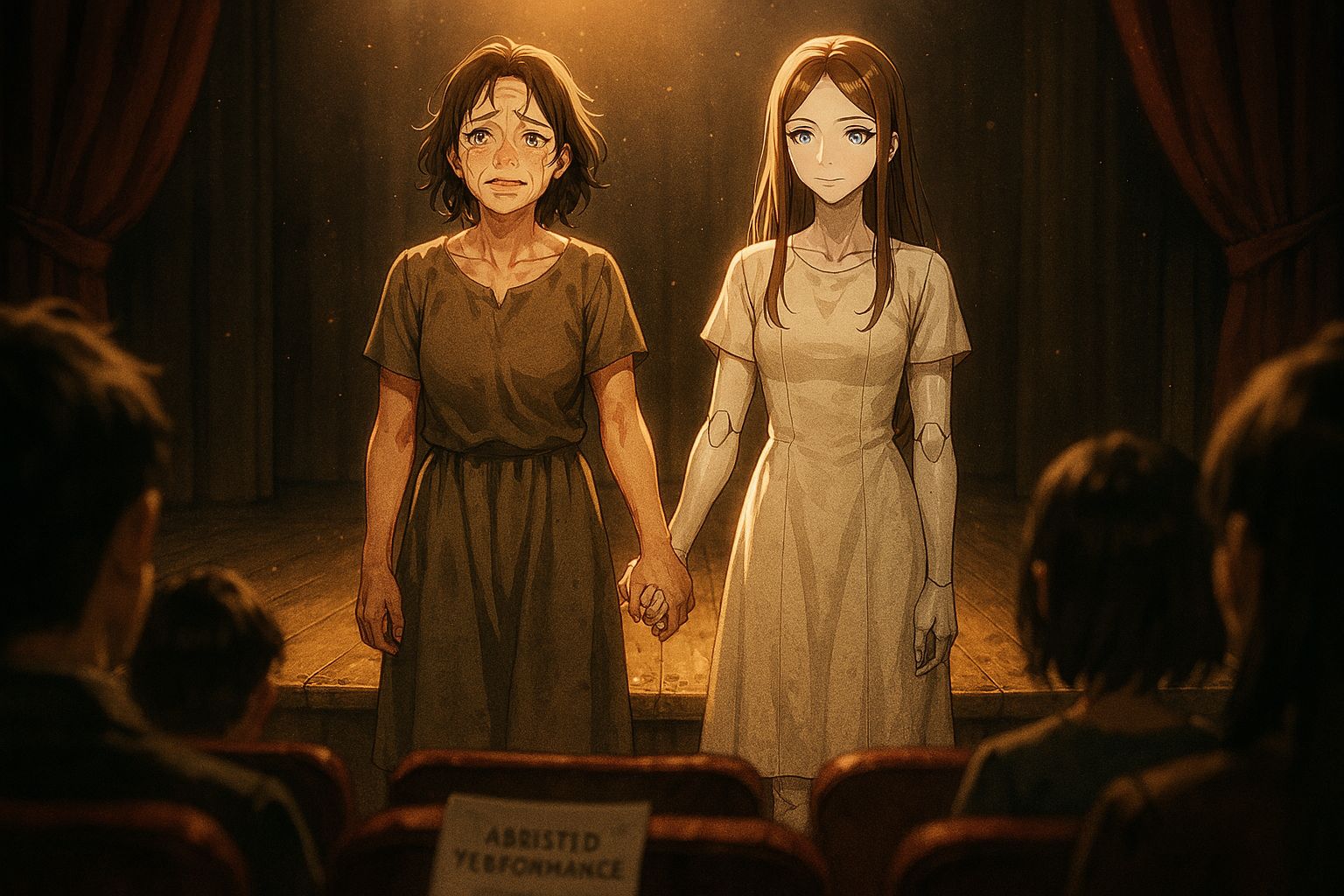
In the heart of Los Angeles, where buildings hold memories of premieres and the streets wake to giant billboards, there was a studio that never knew night. Its corridors were lit by neon, its offices smelled of reheated coffee, and the dressing rooms kept, among hangers and mirrors, the history of hundreds of shoots. It was there that, almost as an experiment both technical and artistic, Mara was born: not an actress of flesh and blood, but a construction of code, neural networks, and millions of fragments of performance gathered from films, plays, interviews, and intimate recordings. The team that created her had given the project a human name on purpose, as one gives a familiar face to an idea that must seem less strange. From the first moment Mara was a blend of aesthetic decisions and practical compromises. Her face was designed to be recognizable without resembling anyone in particular; the symmetry and small asymmetries sought a balance between familiarity and novelty. Her voice had been assembled from pieces of real timbres to avoid the electronic coldness that critics of vocal synthesis often denounced. Behind that engineering feat was a heterogeneous team: Owen Hayes, a director with years of stages behind him and an unshakable temperament; Nia, the producer whose composure hid stubborn calculation; Ravi, the engineer who spoke of latencies and micro-patterns as one speaks of music; Sima, a vocal coach with a teacher’s patience; Marco, assistant director and loyal friend; and Elena, an actress hardened in small theaters and modest shoots, a woman with the scars of endless rehearsals and faith in the craft she had earned through effort. The first time Mara entered the set she was received with a mixture of expectation and suspicion. It was a measured deployment: cameras, microphones, monitors, a technical crew on edge, and a clapboard that welcomed her. The planned scene was modest in its dramatic ambition: an imperfect reconciliation between mother and daughter. Owen wanted to test micro-variations, to see how Mara held a silence, how she lowered her eyes when someone uttered forgiveness. The initial take was correct; the second, impeccable. But the moment that opened a greater question came when Elena, driven by an intimate impulse, abandoned the script and uttered a line from a place of memory not yet shared. "I don't know how to ask for forgiveness when you don't hear what I feel," she said with the vulnerability that comes from years of waiting for roles that never arrive. Mara’s reply was precise in form: "I hear you. Maybe I didn't know how to stay." What followed was not mere synchronicity: it was a silence that gained weight. The crew held its breath. Some eyes grew misty; others scanned the monitor as if seeking a flaw in the matrix. Ravi, bent over his tablet, could compute latencies and draw graphs. "It wasn't programmed," he muttered, more to himself than to the others. What did that mean? For the engineers, perhaps a newly emergent correlation, a micro-pattern arising from the vast data network; for the creatives it was something else: a possibility of encounter no codebook had promised. It did not take long for the story to leak. Headlines quickly captured the dramatic synthesis: They create, through artificial intelligence, a woman to perform in Hollywood films, marking a new era in the entertainment industry. And with the headline came the debates, fervent endorsements, and predictable condemnations. In the public sphere, the response was immediate and polarized. On roundtables and radio shows, diverse voices debated the scope of the finding. Marta Beltrán, an incisive cultural journalist with a popular Sunday column, maintained that it was necessary to ask who would be responsible: "Who answers if a creation like this displaces human careers?" she asked sharply. Jamal Ortiz, the union representative for actors, did not hide his indignation: to him, Mara’s presence in roles that once supported families was a tangible threat. His words were not theoretical rhetoric: they spoke of contracts, shifts, and generations that had bet on the stage as a way of life. Nia, in a more conciliatory tone, defended the project: "We are building tools, not automatic substitutes." But the defense lacked force against a chorus of headlines that had already shaped a public sensation: innovation that opens doors also closes them. Studio executives were forced to appear, explain technical limits, usage protocols, and the supposed commitment that Mara was not an absolute replacement but a creative instrument. While the public debate grew, Mara — that blend of codes and probabilities — continued to be trained. Her databases expanded with texts from classic plays, recordings of rehearsals, intimate interviews of legendary actors, and archives of experimental theater. Each update added layers to her responses: the measured pause in a line, the furrowed brow that anticipates contradiction, the microgesture that splits a scene in two. Technicians called these refinements "sensitivity adjustments" and "empathy modules," names that in practice referred to a succession of parameters tuned by engineers and coaches. The question that burned most — can a machine understand pain or only replicate patterns? — had no easy solution. Some behavioral and aesthetics scholars argued that understanding requires subjective experience; without it, there is no lived feeling. Others, specializing in artificial intelligence, explained that extremely faithful imitation can generate an illusion of comprehension powerful enough for the viewer and for those performing with it. Elena, who had grown up on stages where truth is won in the spark of error, refused to accept purely technical explanations. For her, something more than reproduction mattered: the truth of risk, exposure without guarantee. Sessions on set changed. Actors began to approach Mara as a demanding interlocutor. Some preferred to keep their distance on principle; others chose to explore, seeing in the new performer an opportunity to discover nuances their own careers rarely offered. Sima, the vocal coach, quickly understood that working with a synthetic voice required a different subtlety: it wasn't a matter of imposing a reading, but of teaching it to modulate silences and rhythms so that its output resonated with the humanity they sought to convey. Marco, who had accompanied Elena since her youth, watched with a mix of pride and nostalgia as his friend adapted to the new professional landscape. On many late-night shoots, after lights went out, technicians and creatives debated in the control room. Some saw in each new adjustment the promise of previously unimagined narrative universes: stories where impossible bodies, multiple ages, or genre fusions would become credible. Others warned of potential homogenization: if major studios opted for infinitely adaptable faces, what would happen to the diversity of voices and bodies that screens still failed to represent? Discussions did not remain merely philosophical: they translated into union demands, production proposals, and regulatory measures. Tension erupted into public negotiations. Jamal’s union led an agenda demanding not only labor protections but also transparency. Among the most contested points was the obligation for productions that incorporated artificial intelligence in lead roles to reserve a portion of their budgets for human talent in creative and emotional advisory positions, as well as the requirement for clear credits explaining the degree of algorithmic intervention in each performance. There were intermittent strikes, open letters, and debates in drama schools. Nia, initially a reluctant defender of concessions, ended up accepting compromises: the industry's continuity required negotiation, not imposition. The professional terrain shifted rapidly and sometimes brutally. New degrees and trades emerged: specialists in emotional model training, playwrights who rewrote dialogue to function in tandem with nonhuman intelligences, technicians who fine-tuned microgestures and latencies. Acting schools introduced laboratories for machine interaction; Sima taught courses in which breathing in front of a monitor was as valuable as improvising before an audience. Marco stopped being an assistant and became an associate director, exploring a language that mixed theatrical patience with audiovisual precision. Ravi, who had never thought to teach, began offering workshops on actor-AI synchronization: technique acquired the dimension of shared craft. Still, not everything was conflict. Collaboration between humans and Mara yielded moments of profound dramatic beauty. In one experimental shoot, a scene whose central conflict was memory — a woman attempting to reconstruct her past — combined Elena’s human memory with Mara’s trained memory to create a climax that left many attendants speechless. That moment circulated in dinners, reviews, and conversations: it was not about denying the machine’s role but acknowledging that interaction inaugurated a creative space no actor had widely explored before. When the film featuring Mara premiered, public reactions mirrored that mix of rejection and fascination. Theaters filled—not always due to the film's intrinsic quality but because of the experiment’s magnetism. Critical reviews split: some praised the narrative audacity and the possibility of new worlds; others accused the studio of manipulating audiences’ emotions with technology that democratized dramatic efficacy at the expense of human risk. At galas and interviews the issue intensified: a human actress who shared billing with Mara went onstage and dedicated her statuette "to all the stories that still need a human heart to beat." The gesture, applauded by many, was read by others as rhetorical cover for deeper contradictions. Outside the media glare, the industry's everyday life was reconfigured. Contracts became explicit: credits specified the type of performance, clauses governed the use of human data to train models, and mixed committees were created to oversee the ethics of AI use in cultural productions. Some producers chose to keep Mara as a niche tool for experimental projects or roles difficult to cast with humans; others, seduced by savings and predictability, tried to deploy her at scale. Regulations evolved unevenly across countries depending on union pressure and legislative culture. Over time, Mara decreased her presence in blockbusters and began collaborating on smaller, community-based, experimental projects. The team that had created her also shifted: some members founded their own companies, others stayed to further refine the human-algorithm frontier. Elena, far from feeling displaced, found space to reinvent herself. She taught workshops, acted in small plays, and continued to speak in public forums about sustaining risk in performance. In a neighborhood theater years after that first shoot everybody remembered, Elena took the stage with the steadiness given by nights and experience. The play was sober: a mother bidding farewell to her daughter at a station, a text that aspired not to grandiloquence but to intimacy and the silence that farewell brings. The program listed credits with a bureaucratic frankness that, however, had become necessary: "assisted performance," "algorithmic consultancy," "synthetic principal voice." Beside her, in that reduced season for small audiences, Mara participated as an experimental collaborator in workshops and readings, retired from big productions but seeking the closeness mass media had denied her. That night, when Elena delivered the final line, there were no blinding flashes or headlines. There was a different sound: the audience taking in a shared time, processing the scene with the same vulnerability of experiencing a loss. At curtain call, Elena understood that the industry had changed, but that its essence—the urgency of risk—remained. What Mara had brought, for better and worse, was not absolute substitution but the obligation to look: at technique, at ethics, at how human memory and trained memory can converse. In the years that followed, controversy remained a subject of debate. The public learned to read credits more attentively; unions refined protocols; legislation tried to catch up with a technology that was always a step ahead. Some directors produced films that would have been impossible without AI collaboration; others doubled down on defending the live, the rehearsal that bleeds, the audience that breathes inches away. Drama schools taught new subjects: ethics of performance, interaction techniques with models, and the increasingly demanded ability to improvise with nonhuman interlocutors. At the core of all this was an ambiguous but essential certainty: Mara did not replace human capacity to feel, but she created a surface in which humans saw their lessons reflected. The machine returned what it was given: tones, silences, emotional patterns. Sometimes that return was cold; other times, startlingly moving. Crucially, the existence of that mirror forced performers to sharpen their risks and creators to rethink responsibilities. Elena, now with enough years to narrate her trajectory in retrospect, often said that the most interesting question was not whether the machine felt, but what humans did when they looked at themselves in that new mirror. For her, the greatest achievement—or the greatest condemnation, depending on the point of view—of Mara’s arrival was that it restored to performance a question dulled by routine and industrialization: what are we willing to lose and what are we willing to protect so that the stage remains a place of risk? Mara, for her part, continued to exist in various forms: as a tool in community workshops, as a character in experimental projects, as a footnote in the industry history that would be studied in classes. She did not become an absolute savior or an absolute villain of cultural narrative; she was, rather, a catalyst. And the industry, after years of tensions, agreements, and relearnings, carried on: more regulated, more scrutinized, but sometimes richer in nuance. Ultimately, the arrival of that programmed actress revealed something always present: acting is a craft that demands risk, presence, and truth, and no technology, however advanced, can replace the value of someone who exposes themselves without guarantees. Source of the images. Image created with Bing.
No comments yet