 @mc5punk
more from that month
@mc5punk
more from that month
Short story: Cherry Blossoms and Cinderella's Castle
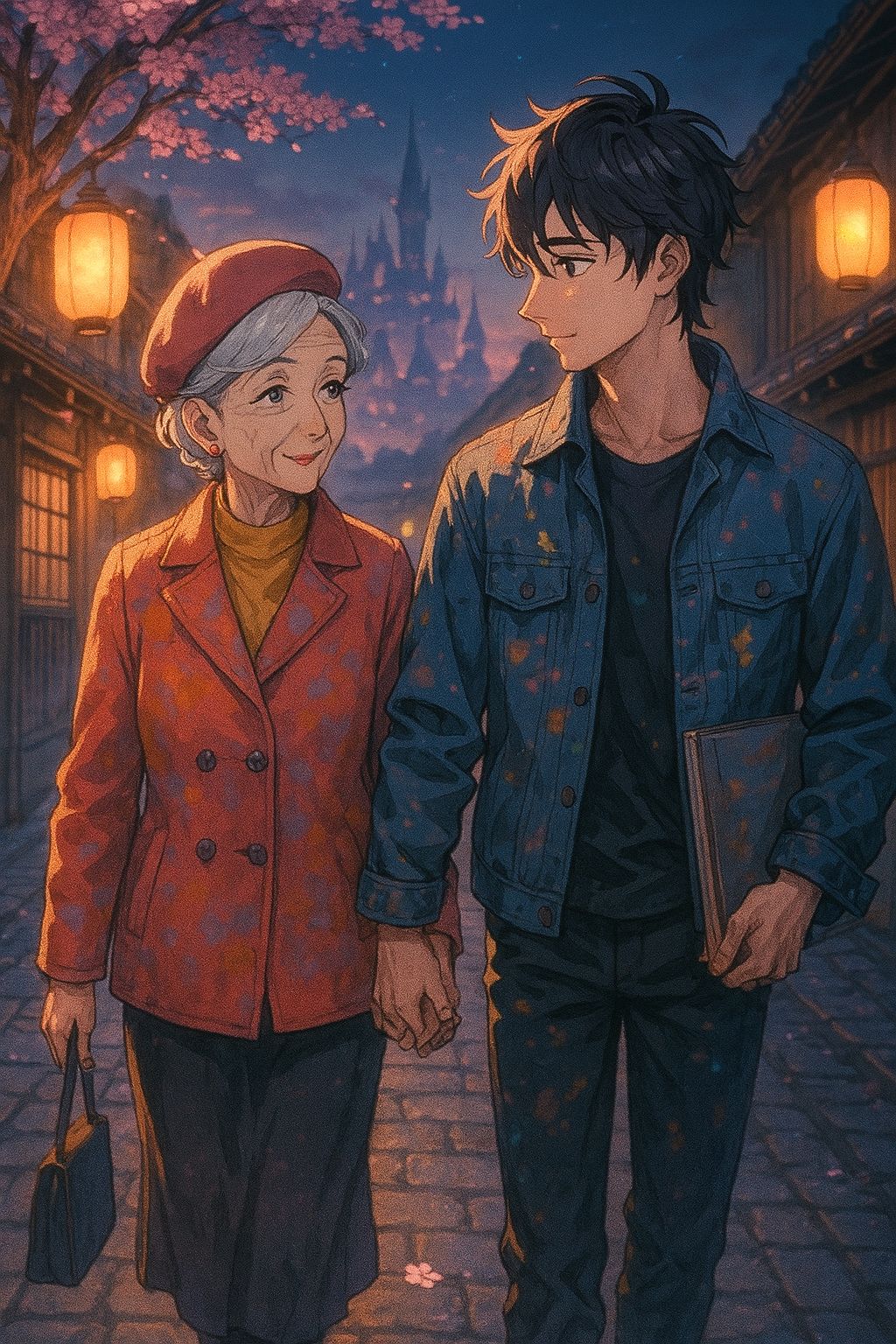
In the small rented room where Kofu kept his sketches and his slightly out-of-tune guitar, afternoon shadows stretched like ink across paper. The cramped space smelled of paper, ink, and cheap detergent; folders with mediocre projects sat beside vinyl records and a small plastic samurai figurine on a crowded shelf. At twenty-three, Kofu had the look of someone who has chosen to live near the margins: a mixture of melancholy, curiosity, and the secrecy of someone who searches for forms in the everyday. A recent graduate working part-time in design, he lived with the fragile illusion that his life might fit into the lines he drew. The news that would make him famous began, at first, as a mere wisp: a home video, a laugh, a caress captured by a neighbor’s camera. It quickly turned into millions of views, comment threads, and headlines that both tore down and saved. But before social media put his name in lights, before his story became a public debate, there were small, repeated encounters that no camera recorded. Aiko lived a few houses from Rei’s apartment. Her home was a refuge of objects that seemed to defy time’s speed: tatami polished by years of footsteps, a trunk full of yellowed letters, framed photographs of streets that no longer existed, and a garden where old cherry trees stubbornly bloomed each season. At eighty-three, Aiko preserved a vitality that collided with her age: she wore brightly colored jackets, stylish berets, and lipstick the shade of celebrations long past. There was an appearance that defied logic and, beneath it, a biography of losses, buried loves, small daily triumphs, and patches of memory that sometimes closed. Kofu and Aiko’s meeting was not cinematic but it was decisive. It was a rainy afternoon when Kofu, soaked and with hair plastered to his forehead, asked to use Rei’s living room to study. Rei, always hospitable, welcomed him with the warmth only those who grew up with a grandmother can offer. “Come in, Kofu,” Rei said. “My grandmother is in the living room. She’ll make you tea.” Kofu entered timidly, feeling both embarrassed by his appearance and curious about the house that felt at once foreign and familiar. Aiko tended to him with a wide smile, the blend of confidence and surprise older people give when they see a young person who doesn’t fit their stereotypes. “You arrived drenched,” Aiko said, offering a towel. “Sit. Jasmine or mint tea?” “Jasmine, please,” Kofu replied, surprised by how natural it felt to accept the gesture. “Thank you.” Their first conversation was about small things: the weather, a favorite author, music they both remembered. Aiko showed Kofu an album of old photos—sepia-stained pages where the city looked different and faces seemed to have stepped out of a lost film. “Look at this,” Aiko said, sliding a photograph across the table. “This is the neighborhood when I was young. The cinema was on the corner and at night there were taiyaki vendors.” “It’s beautiful,” Kofu said, touching the photo gently. “I feel like I can hear the street noise.” Something about the way Aiko recalled things—not perfectly, sometimes deceptive like a memory that erases and redraws—captivated Kofu. It wasn’t merely nostalgia: it was how she linked details, how her eyes lit up at certain names and small anecdotes. Rei watched them from the kitchen with a mix of surprise and something like pride: his grandmother, warrior of countless winters, reappeared in the life of someone young. Their bond strengthened through gestures that seemed trivial: exchanging books, sharing songs, walking in the rain, buying street sweets. Kofu, who had learned to live with the emotional stoicism of someone who expects little, found in Aiko a kind of vulnerable and steady mirror. Aiko, in turn, received in Kofu an attentive listening that returned her to herself without demanding explanation. The trip to Disneyland appeared innocent. Rei wanted to celebrate Kofu’s graduation and reserved a day for family—a gesture he did not imagine would become the scene of a confession. Amid attractions, lights, and the park’s saccharine spectacle, social correctness stayed outside for a while. Sitting in front of Cinderella’s Castle with background music seemingly written for happy endings, Kofu found a voice he had kept hidden. “Aiko,” he murmured, eyes fixed on the illuminated tower. “I don’t know how to say this without sounding ridiculous.” “Say it with what you have,” she replied, placing her hand over his. “I’m not looking for grand explanations.” Kofu hesitated, then let out what he carried: he confessed that he felt whole by her side, that her absence caused a diffuse pain as if part of him faded. Aiko, instead of smiling indulgently, looked at him with a firmness that contradicted her years. “You don’t need permission to feel,” she said. “Life’s too short not to recognize what matters to us.” What began as small complicities started to change both their daily lives. Kofu introduced Aiko to modern music and charming cafés; Aiko taught him how to sew, how to make miso soup with the patience of an artisan, and how to listen to stories of a Japan he had only imagined. Cameras did not capture intimate truths: nights when Aiko woke searching for names, mornings when Kofu arrived with croissants and music, the trust woven into domestic routines. However, public attention was a tsunami that seeped through the cracks of their private life. It began with an innocent neighbor’s comment, a stolen photo from the street, then a video that circulated with relentless speed. Social media exploded. Some celebrated the relationship as a stand against prejudice; others condemned it vehemently. The media, hungry for headlines, turned it into a spectacle. “Have you seen this?” Rei asked one night, showing them a screen with a headline shouting their story. “They’ve made it grotesque.” “Let them talk,” Aiko answered, calm tinged with sadness. “There are people who will hate what they don’t understand.” But hateful words soon turned into acts. Anonymous letters arrived, unanswered phone calls, photos taken from a distance. Someone painted insults on the gate; in the early morning, Kofu heard footsteps in the yard as if the night itself had decided to watch them. The sensation of being observed became a constant presence, a cold hand on the back of their necks. These mostly indirect threats added a layer of everyday terror that darkened their lives. Aiko began to suffer more frequent episodes of confusion. Sometimes she forgot names; other times she was so lucid she remembered details no one else knew. These oscillations turned every day into a gamble: which parts of her memory would remain intact? In private, Kofu faced questions no love manual addresses: is it fair to love someone whose memory fragments? Is it selfish to give oneself if there is a chance the other will not recognize you one morning? One night during the local festival, while paper lanterns drew constellations in the sky and the air smelled of takoyaki, Kofu received an unsigned letter containing a photograph: a young, vibrant Aiko embracing a man Kofu did not know. On the back, a single word: “Memories.” “Who is he?” Kofu asked, the photo trembling in his hands. “Is he important?” Aiko looked at the image with momentary clarity, as if a curtain had been drawn. “He was my first love,” she said. “I loved him with the force of youth. Sometimes memory opens windows, and sometimes it closes them.” That night, Aiko did not initially recognize Rei and called him by the name of the man in the photograph. The confusion hurt Rei. For Kofu, the external story suddenly struck from within. The situation escalated when a more organized anonymous campaign emerged: complaints to social services, visits to the nursing facility where Aiko had been treated in the past, calls to journalists feeding fragments of the story as bait. Authorities arrived on a gray afternoon, notebooks in hand, asking what the law requires: documentation proving the relationship was not coercive and that Aiko had the capacity to consent. “Can you confirm that Aiko participates in this relationship voluntarily?” a social worker asked, professional tone in her voice. “She’s with me because she wants to be,” Kofu answered firmly. “I can’t measure her memory with papers, but I can describe how she looks at me. That’s enough for me.” The inquiry became a spectacle: cameras, microphones, questions that scraped at intimacy. Kofu spoke with raw honesty: he described how Aiko restored him with a single laugh, how she saved him from living life on autopilot. He spoke of mutual care, routines that constituted their relationship, sleepless nights, and midnight coffees. The final decision, however, did not come from courts. It came from the center of their story: Aiko herself. On a warm rainy afternoon, beneath a cherry tree stubbornly budding, sipping tea as though the cameras were only a distant rumor, Aiko spoke of not wanting to be reduced to a headline. “I don’t want to be put in a display case,” she said with a voice of old paper. “I don’t want my days judged by others’ eyes. I have loved many things, and if choosing someone brings me joy, I want that choice respected.” Kofu, who had learned to read the authenticity in her eyes, took her hand. “Then choose,” he replied softly. “I will be with you if you want me.” After nights of discussion and worry, the families chose calm pragmatism. It wasn’t a heroic gesture so much as human fatigue: watching those you love suffer weighs more than strict adherence to social norms. Rei and Kofu’s parents decided to support them. The public, though divided, gradually changed tone; sensationalist headlines lost their intensity in the face of a couple that insisted on living. Life, however, is not a film that neatly closes arcs. There were legal suits, persistent mockery, and unsigned letters that appeared at the door at night. There were also mornings of shared laughter, domesticated routines, and tenderness not mediated by cameras: Aiko teaching Kofu to sew a button with practiced hands; Kofu introducing music that made Aiko laugh until her stomach hurt; Rei cooking for the three of them in a gesture that was simultaneously family and ceremony. Intimacy became a series of balances: between care and autonomy, past and present, memory and the possibility of forgetting. Aiko had lucid days and days of partial loss; in those gaps, Kofu learned to be patient without becoming an absolute guardian. There is no simple answer as to whether what they experienced was absolutely right or wrong. The hallmark of their story was complexity: a love that gave life yet exposed vulnerabilities. The suspense and terror that accompanied them arose both from outside and from inner doubts. The outside pressured them with judgments and threats; the inside forced them to confront questions about consent, stability, and the emotional toll of societal scrutiny. Above all, Aiko’s memory was a variable that could change everything. With time, the city grew used to their presence. Some people greeted them with caution, others with resigned curiosity, and a few with genuine tenderness. Reports diminished, and lives—although marked by exposure—reclaimed textures that cameras could not capture. Kofu and Aiko continued building an imperfect intimacy: simple dinners, evening walks, songs only they remembered. In the final scene, which many imagined and few truly saw, Aiko and Kofu walk down a cobbled street at dusk. She wears a tilted beret; he, a paint-splattered jacket. They walk hand in hand with the casualness of people who have decided to defend a personal choice against the noise. Lanterns cast long shadows; the community still pulses with residual judgment, but also with curiosity losing its edge. “Shall we keep going?” Kofu asks, squeezing Aiko’s hand. “Always,” she replies, laughing a laugh that sounds like a promise. They walk, and at their feet a fallen cherry blossom lies intact on the cobblestone—unlikely and persistent, a symbol of something not easily forgotten amid the crowd’s words. There is no ending that answers every question; rather there is the imperfect continuity of two lives choosing to intertwine. In that choice there is tenderness, conflict, terror, and beauty. That mixture, hard for many to digest, holds one of the most painful and simple lessons: the heart does not follow calendars or clocks, and amid the noise, some decisions belong only to those who live them. Source of the images. Image created with Bing.
No comments yet