 @mc5punk
more from that month
@mc5punk
more from that month
Short story: The City of Voices
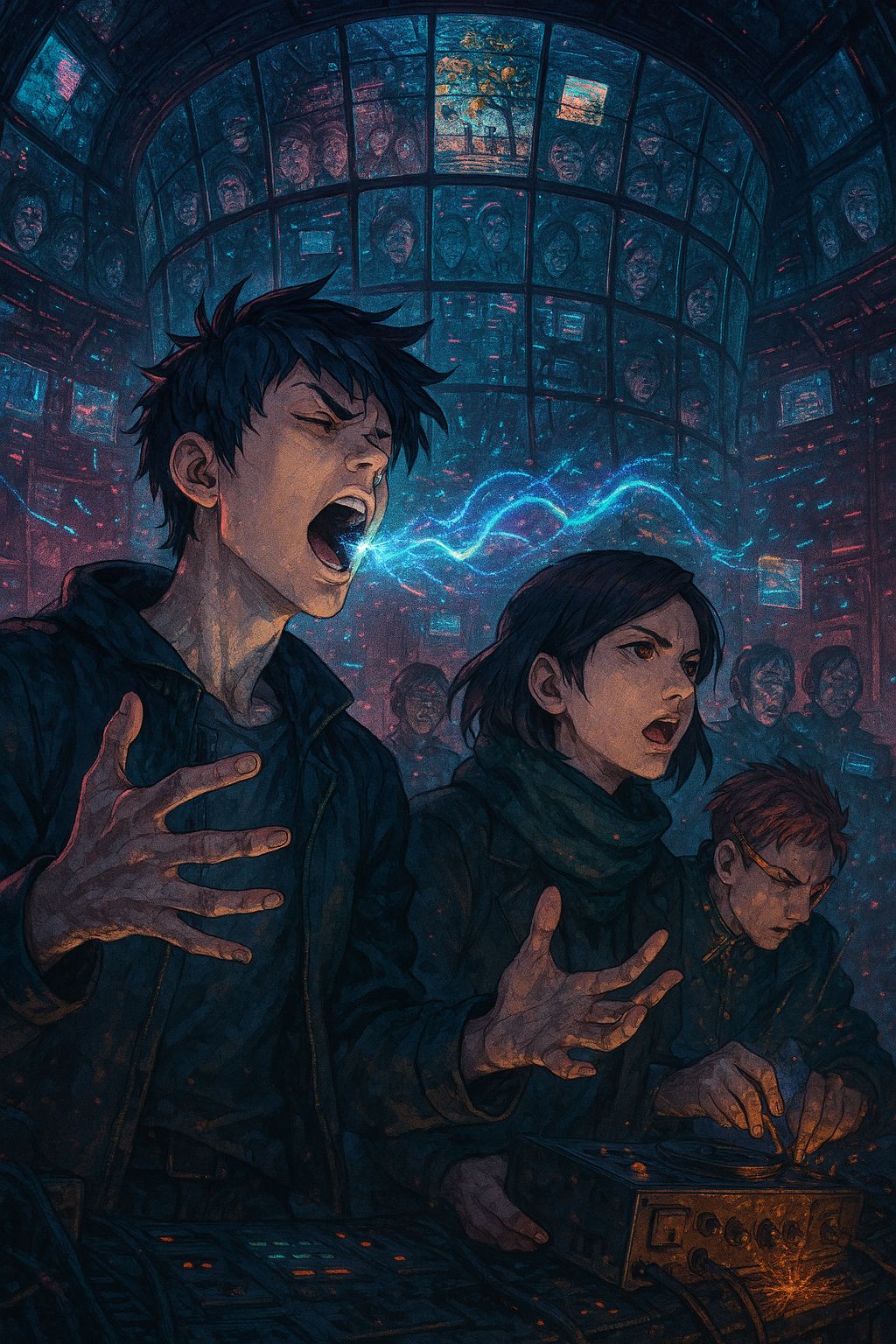
The city breathed in neon pulses, and their sighs were orders. Mirrored towers pierced the night like needles, injecting sensory transmissions into the air that shaped desires, attenuated rages and recycled memories. On perpetual screens, the Elite — a constellation of cold faces and named algorithms - smiled behind a synthetic beauty; under that smile, a mechanism that turned people into docile spectators of their own confinement. "Look how they sparkle—" Mara said, squeezing the scarf. They promise you everything with a blink of an eye and charge you later. "They promise us oblivion—" Kai replied, his gaze fixed on the towers. But my grandmother taught me that there are words that resist. Kai was born on the edges, where neon dissolves into dust and wires hang like dead vines. He was thin, with hands that were more reminiscent of a musician's than a rebel's, and in his throat he had a voice that he could never silence. She grew up listening to her grandmother talk about ancient oral practices - songs, stories passed from mouth to mouth, simple ways of naming the world — and those words, far from being relics, soon turned out to be a key to her. - Do you think it's true? asked Jor, a hacker with copper implants. That a few songs can make their networks fail? "It's not magic," Kai replied. It is the physics of memory. If we vibrate the right frequency, the transmission loses its anchor. He discovered that, at the basis of sensory manipulation, there was a tension: external transmission dictated sensations, but it could not erase the shared texture of certain memories. Using techniques that mixed applied psychology with urban cunning, Kai learned to modulate his voice, to intone fractions of stories until the vibrations opened unnoticed channels in the connected minds. What seemed imperfect and primitive — a murmur, a melody — became a bridge. Through them, collective memories emerged, fragments of other people's lives that the Elite thought had been extinguished. The first time he did it he did it by accident, in a subway tunnel where the screens projected propaganda with the rhythm of a metallic heart. She sang for a child who wouldn't stop crying in front of an ad for eternal consumption. The melody — an ancient slogan of resistance - tore the layer of sensory transmission; the child stopped crying and, for an instant, both shared the same memory: the square where they had played unguarded, one afternoon when the skies did not belong to the Elite. That flash was enough to ignite a spark. - What was that? -whispered the boy, looking at Kai with huge eyes. "That's called a memory," Kai said gently. And it's not something they can sell. With his skill he became an architect by heart. He recruited a small network: hackers working with outdated implants, underground psychologists studying how to revive narratives, and underground journalists printing pamphlets in ink that smelled like rain. They designed an inverse agenda setting strategy: instead of imposing themes, they planted calibrated memories that reoriented the priorities of the neighborhoods. A shared gesture — a chorus on the corner of a market, the repetition of a phrase that caused tears and anger — put people's own desires, questions that sensory transmissions could not program. "We planted a memory today in the Plaza de los Tres Robles—" Mara announced. If people sing it, we will have to respond. "Then let them sing," replied Jor with a tired smile. If we get a spark, they won't be able to buy the truth anymore. The elite detected it early. Their algorithms traced patterns, and the cyberpunk facade - glamour, lights and synthesized music - became a trap. Security forces with steel plates and pixelated faces swept the streets looking for the instigator. The first confrontations had the fury of desperation: chases over illuminated rooftops, clashes on creaking walkways, and in each ambush Kai responded with attacks that were both physical and symbolic. He deployed devices that interfered with sensory emissions; he released memories compressed into old voice discs that, when played, broke the control protocols. The action was visceral: crossfire, roaring engines and falling bodies, but it was also psychological, because each released memory transformed a soldier into doubt, a vigilante into a witness. - Get back! - shouted Jor as the bullets slammed against the metal. Kai, use the player. "Now," Kai said, and turned a dial with trembling fingers. Listen to this. On the third night of the offensive, the resistance launched its most risky coup: infiltrating the Dome, the center where the Elite orchestrated the broadcasts. Kai led the operation with a mixture of calm and tempest. They went through maintenance tunnels, bypassed sensors and, when they reached the nucleus, they found not only machines: they found a hall of mirrors where propaganda multiplied into infinite disconnected faces. The confrontation was intimate there. The controllers activated a transmission that aspired to neutralize any dissonance; a shower of sensations designed to erase identity. - Did you think you could get in and out with impunity? - asked the director of the Dome, her voice processed and cold - With songs and stories? "I didn't come here to have a conversation," Kai replied. I came to remember. Kai did not respond with weapons. He opened his mouth and let the ancient oral practices gush out in a torrent: stories of common losses, names that had been erased, laughter that rang like broken bells. "My mother once told me," Kai began, without taking his eyes off the control center, "Learn the names of the things that made you happy. If you forget them, they are stolen forever." "Your voice will have no effect here—" one of the technicians said, arrogantly. We have protocols for that. "Then listen to the people," Mara replied, and began to sing a verse that Jor had calibrated. "A yard with orange trees, a ball, hands learning to let go." His voice didn't just speak; it organized. In seconds, collective memories flooded the terminals, reprogramming algorithms with the human. The damage was viral: the staff of the Dome suffered waves of nostalgia, shame and remorse; the devices, saturated with sentimental data, collapsed. - I'm sorry... a name—" gasped one of the operators. Who am I? "You're the son of someone who was waiting for you," Kai murmured. And that counts. The fall of the Dome was neither purifying nor total. The Elite lost control of the transmissions, but the towers remained, the scars were deep and the city was still full of shadows. Still, the gesture was a game-changer. People relearned how to name each other; squares recovered forbidden words; music from mouths became a political tool. Kai remained on the periphery, not as an eternal leader but as the custodian of a technique that had to be disseminated without concentration of power. - And now what do we do? - Mara asked as they looked at the city from a half-destroyed roof. "Teaching," Kai replied. Let each neighborhood learn to count each other. If one voice goes out, they must know how to turn on another. In the days that followed, the city breathed differently: less driven, more confusing, more dangerous, but also more possible. The cyberpunk aesthetic persisted — neon, implants, technological filth — but it was no longer just a facade; it was a battlefield and a workshop. Oral memory, humble and ancient, proved to be a weapon and medicine: a bridge that, when joined with social science and strategic action, could tear even the best-dressed regime apart. —It's not the end—" Jor said as he put away his tools. It's the beginning of a conversation we can't control. Kai had understood: freedom was not just about deactivating machines, but reactivating words. Under the cables and the advertisements, people started telling again: stories that didn't ask for permission, memories that were offered as maps. And in each shared story, a new way of being together was being woven — fragile, difficult, human — that the Elite, no matter how brilliant, could no longer completely erase. Source of the images. Image created with Bing.
No comments yet