 @mc5punk
more from that month
@mc5punk
more from that month
Short story: Shadowy Nexus
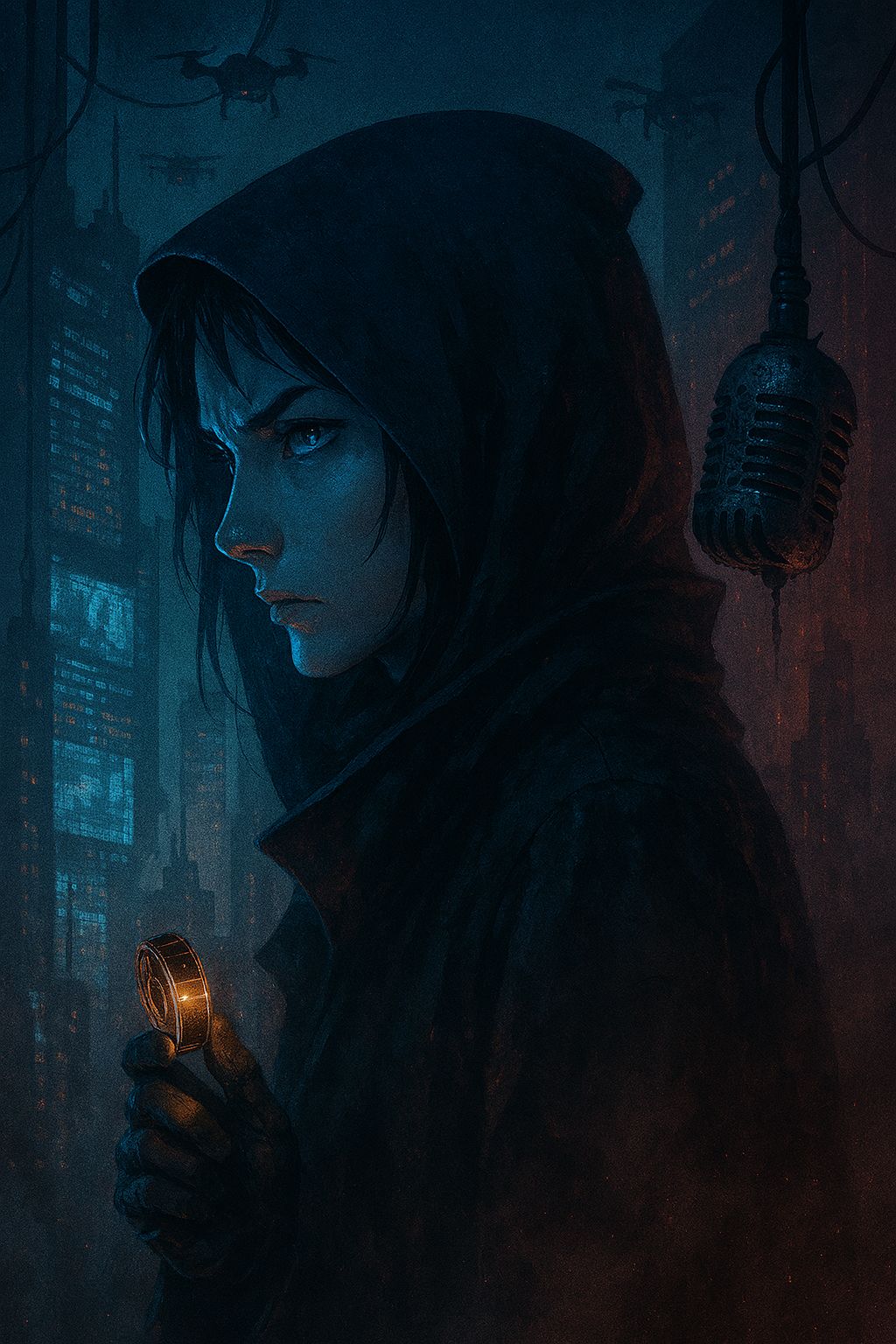
The court of the empire stood like a city within the city: glazed towers, suspended walkways and palatial rooms illuminated by panels projecting news, quotes and rehearsed smiles. The regime's riches were not factories or land; they were algorithms, data banks and agreements whispered in offices whose windows were never opened. In that heart of steel and light she lived: psychologist, infiltrator, expert in the folds of the collective consciousness. Under layers of falsified identity he attended to ministers, advisers and tycoons; his clinical agendas were the alibi, his notes the secret map with which he pierced official thinking. Outside, the arcology — a vertical maze of overlapping neighborhoods - was breathing mechanically. Advertising screens marked the time, emotions and priorities; the newscasts worked in cycles of reiteration until the opinion became a habit. Propaganda had become architecture: not only messages were taught, routines were designed that made acceptance a reflection. She understood that to change the city it was not enough to tear down slogans; it was necessary to induce fissures in the collective memory, to open cracks where people could recognize that something in their life had been usurped. The weapons he chose were subtle: coded speeches, intentional pauses, metaphors that functioned as keys. He did not manipulate ideas in a frontal way; he cultivated questions. His texts were not manifestos, but poetic fragments camouflaged in reports, clinical sermons and wellness communiques. In his public sessions with the elite, he practiced radical empathy techniques: listening as one who points a compass, returning to each interlocutor a phrase that made him see his own mismatched image. Through those returns he inoculated doubts. For the general public, it operated through underground channels: altered broadcasts, audio fragments packaged with white noise, and rhythmic patterns that activated latent memories. Marta, the archivist, was his first open accomplice. Marta worked in the institutional memory section, guarding official records that the court preferred to forget. He had a low voice and a method of doubling time: he kept forbidden songs, poems torn from censorship and microfilms with testimonies. It was Marta who taught him how to move documents between harmless shelves and who introduced him to Javi, a transmission technician with fast hands and even faster ears. — If they discover us, they will erase us even from the minutes - Marta said the first night they saw each other, the words fleeting as if the wall could hear. "If they discover us, they will have discovered that people can still remember," she replied. And that's not so easily erased. Lía, the former reporter, completed an unexpected triad. Wherever the official press had left gaps, Lía knew how to look for threads that connected seemingly distant events: a suspension of services here, a decree there, and always, behind, the figures that justified the inertia. She had been deleted from the media for denouncing irregularities; her press card was now a souvenir that gave her an advantage: she could read between the lines what no one wanted to see. Together they worked for months as if weaving an invisible trap. In their clandestine meetings, they improvised a sign language: a coded song that could be played in an elevator, a reading of a report that contained a hidden metaphor, the repetition of a formula in a speech that only produced its effect if someone listened to it with the correct interruption. It was a clockwork task: small mismatches in the cadence of the voice, pauses at strategic points, images that activated common neural associations. His first real test was modest: an audio fragment inserted into a morning program that, to the naked ear, seemed like a reflection on surveillance and freedom. The phrase was innocent: "The keys do not belong to the one who keeps them, but to the one who remembers where they are." In the arcology, the phrase bounced off different ears. For some it was a verse; for others, an annoyance. A worker changed his usual route; a mother read a news item suspiciously for the first time in years. The deviation figure was small, almost imperceptible. But the direction mattered: every little choice that deviated from the pre-programmed pattern was a crack. The regime reacted with the speed that well-trained privileges give. Speech analysis algorithms began scanning the broadcasts for irregularities. "Emotional stability protocols" were imposed in public clinics where psychologists paid by the state reduced anxiety with pills and uniform stories. Selective power cuts and smear campaigns closed some gaps, but they could not stop the resonance that had already circulated: memory, when activated, does not turn off easily. However, the repression brought immediate consequences. A technician of his team was arrested; a network of contacts was silenced. The operation needed a change of pace. The next phase was bolder: live, wiretapped speeches. She designed parliaments for official events where her voice, calibrated to the second, included precise pauses that forced the audience to complete the idea for themselves. In public, the rhetoric maintained the facade of orthodoxy; in the pause the seed resided. During one of those speeches, in a room with crystals that reflected the city like a board, he said: - We live in a city that smiles with locks. Who can sleep when the key is in hands that no longer remember how to dream? The phrase was not a slogan. It was an image that demanded to be completed. On the esplanade, the tension changed notes. A counselor squeezed his neighbor's arm; a young woman in the second row breathed with another cadence. The executive who usually smiled without opening her lips felt a new discomfort. The crack was not seen, but felt. Algorithms began to track patterns. The regime's synthetic intelligence learned to recognize the signature of its interventions and to delete versions, to rewrite files and to stigmatize dissenting voices. Javi worked overtime to mask the transmissions, creating alternate routes and data packets that looked like innocuous broadcasts. Marta archived physical copies — small rolls of information hidden in old musical cassettes - that could survive the digital purge. "They're erasing us," Javi said one early morning, with deep dark circles under his eyes and his fingers still marked by wires. "Then we will become more human—" she replied. The organic survives where the machine fails. The repression accentuated an unexpected effect: people began to search. Where inertia used to rule, the slightest hint of contradiction was enough for some to start asking. When the connection between small anomalies became visible to groups in underground bars and on local forums, a network of informal conversation emerged. It was not the revolution that novels promise: it was slow conversation, reading consumer maps and small actions of civil disobedience. A group of students who discovered the fragment in a semiotics class organized public readings of forbidden poetry; one neighborhood reconnected a pair of solar panels to keep a community radio on. The court responded with exemplary punishments. Persecutions, arbitrary detentions and defamation campaigns sought to isolate and neutralize. They invented a term: "semantic terrorism", to criminalize the manipulations of language. Public clinics administered emotional re-education programs that included standardized narratives and medication. The elite also used legal remedies: lawsuits, revocation of licenses and the creation of a public narrative that depicted the psychologist and her associates as enemies of social stability. In that climate, doubts on the side itself became more visible. Some allies were consumed by the risk. Marta began to talk quietly about the costs; Lía discussed the ethical implications on long nights; Javi, always practical, calculated probabilities. The psychologist, who had entered the court with the cold certainty of who she thinks is right, faced new questions that were infiltrating her work: what responsibility does the one who models someone else's memory have? To what extent can one manipulate to awaken and not to substitute? These doubts were not theoretical; they weighed on the operation. An unexpected arrest - that of the transmission technician who was keeping a key route alive - forced the psychologist to improvise. He then decided on a riskier move: a synchronized transmission from several points in the city, combining verifiable data, visual testimonies and a vocal cadence designed to activate empathy and memory. The idea was simple in its scheme: to show tangible evidence — records, photos, names - while the voice conducted the interpretation and provided a narrative framework that allowed people to claim their own history. On the night of the final broadcast, the court prepared to turn off any source of noise. The interception systems were active; advertising drones patrolled the sky with filaments of propaganda and a digital rain of disinformation. However, alternative routes were ready. Javi, from a basement with wires that smelled of solder, launched data packets to unofficial repeaters; Marta distributed physical copies to community radios; Lía coordinated the dissemination in forums where there were still unguarded accounts. The psychologist, from a borrowed podium, began to speak. His voice, modulated and at first impeccably neutral, wove facts with metaphors. He showed a document with a rubric that connected eviction contracts with an offshore bank; he presented an image that showed the same advertising machinery used to justify measures that impoverished entire neighborhoods. He interspersed testimonies: a mother who narrated the loss of her business, an operator who had been fired for a fault he never committed. Cadence, that time, was the weapon: he did not dictate conclusions, designed questions and left pauses that forced the audience to fill in the spaces. "Remember," he said at the climax, "that memory is not a cold file. It is a conversation that we inherit and that we betray if we leave it in the hands of the one who turns it into a figure." The transmission spread through the arcology like a pulse. In squares and kitchens, in elevators and workshops, people listened and, for the first time in many years, talked to each other about what they saw. A woman in a sewing room recognized her son in the image; a young man who worked on an assembly line understood that the fault for which he was fired was documented in that contract. The reaction was unequivocal: mobilization of small resistances, spontaneous protests, symbolic power cuts and occupations of public spaces. The regime's reaction was brutal and swift. Mass arrests, the erasure of digital identities, and the implementation of a fear that was not only physical but architectural: night interventions that changed routes, blackouts that left entire neighborhoods in the dark and the use of subliminal messages to reinsert obedience. In the subsequent nights, the city showed faces of tension and tears, and in the registration systems a surprising number of "missing persons". The cost was high. Some of his collaborators were captured; others fled or buried themselves in hiding. The psychologist, however, managed to escape the persecution network in a maneuver that combined false identities, underground routes and the compassion of those who still believed in the cause. But the operation did not pass without personal consequences: the codes he had entered resonated in his own mind like echoes. In the moments of silence, he listened to the pauses he had calibrated: small voice burns that now disputed the boundary between memory and manipulation. Alone, the psychologist faced the moral dilemma that had inhibited so many movements: can the end justify means that manipulate the human psyche? Can the factory of dissent become another form of domination if the autonomy of the one who awakens is not taken care of? Her nights were filled with doubts that harassed her more persistently than the external persecution. I saw faces that I had helped to remember and also the shadow of an authority that decided who deserved to be remembered. Over time, the victory was partial and contradictory. The court lost part of its symbolic omnipotence: its public image was worn down, some policies were revised and spaces — small, fragile — for debate were opened. Arcology did not transform overnight. The majority continued tied to routines and surveillance, but new practices began to sprout in the cracks: community radios that did not accept the single word, neighborhood support networks that shared records and places where the collective memory was read aloud. The psychologist disappeared after the final night. It was not an act of cleansing or sacrifice — at least not only — but a considered decision: remaining visible would have put at risk everything that had been activated. Before he left, he left an ambiguous mark: encrypted files scattered on the network, physical copies in the hands of those who could read, and a series of questions that served both as a slogan and a warning. In the underground bars, in the workshops and in the underground universities, his voice reappeared as a rumor. It was not a commanding voice. It was a voice that I remembered: to question the ease of stories, to resist the comfort of dogmas and to turn doubt into a daily practice. In a bar in the working-class neighborhood, a boy recited a half-baked phrase he had heard on an old player: "The keys don't belong to the one who keeps them..."and the men at the table fell silent, each with the memory of a gesture of his own. In one square, an old woman smiled when she remembered the lyrics of a song that Marta had saved on a microfilm. The story that remained was not that of an absolute liberation but that of a collective memory process under construction: fragmentary, contradictory, painful and hopeful in its precariousness. The psychologist, turned into a myth and a warning, had achieved something essential: transforming the city from a passive receiver to an active conversationalist. He had sown questions impossible to eliminate without erasing the people themselves. In the end, Nexo Sombre was not a point of arrival but a threshold. The court survived in part, adapting; arcology learned that stability can be injured by memory. And in the cracks, those who had learned to think critically held the possibility of further questioning. The freedom that emerged was harsh and costly; however, for the first time in decades, the word "remember" ceased to be an institutional command and began to occupy the center of public conversation. Source of the images. Image created with Bing.
No comments yet