 @mc5punk
more from that month
@mc5punk
more from that month
Short story: Shadows in La Esperanza
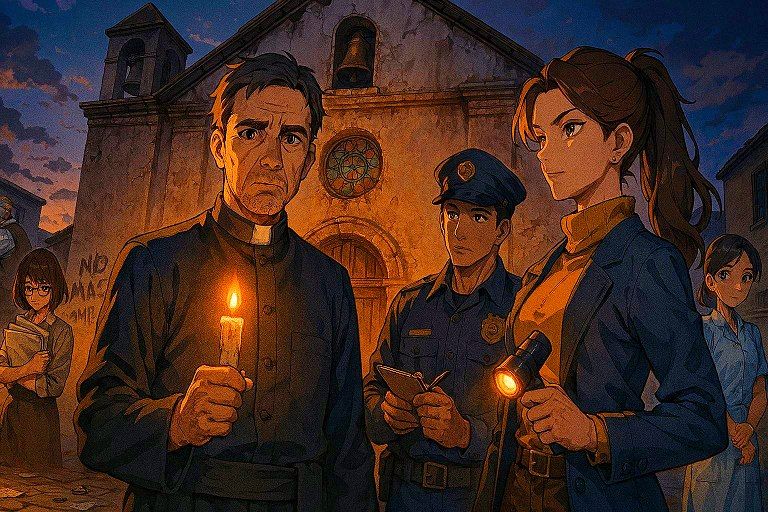
La Esperanza was one of those towns seemingly born to keep secrets. Its streets curled around a central square where the municipal clock kept time with the slowness of someone who had seen too many seasons. Yellow streetlamps, flaking walls and the smell of strong coffee completed the scene. On the hill that watched over the town stood the San Marcelo chapel: a cracked stucco façade, cloudy stained glass and a bell whose voice had grown hoarse with the years. There, among wooden pews smoothed by knees and hands, Father Esteban Rojas kept his rounds, mixing sermons with the unease of someone who knew every neighbor. One autumn dawn, when the fog still seemed freshly arrived from the river, Esteban opened the door as he always did: with devotion and a candle in his hand. But the interior did not smell of incense or old wax; it smelled of ink and menace. The vestibule walls were covered in crooked letters that bit the paint, as if someone had spat words. Threats, short phrases, crossed-out names: messages that did not ask, they demanded. “Did you hear that, Rosa?” Esteban murmured, more to anchor his voice than from a need for an answer. Rosa Méndez, catechist and pillar of the community, swept her flashlight across the walls with the same precision she used to schedule tasks and meetings. Her eyes found the text and blood rushed to her temples. “This is not a joke,” she said. “No one writes like this for fun.” The notes were not an isolated incident. In the following days they appeared in the confessional, in the pages of the hymnals, stuck to the ivy on the low wall. Each message seemed written by different hands: a quick, cutting voice; a mocking one; another cold and calculating. Between ink and paper, the phrase repeated most often struck like a verdict: “Don’t ignore what you know.” At night, the parish office phone began to ring with calls that did not seek dialogue: breathings, short tones, whistles on the other end. They were provocations that needed no face to be real. The community drew in. Neighbors who until then walked the square without worry began to look at the chapel as one looks at a sick animal. Rumors grew and with them came hypotheses: old grudges, settling scores, a web of influence—or simply the blackmail of someone who uses violence to impose silence. Bishop Miguel Ávila arrived one morning with the solemnity of someone bringing comfort on paper. He climbed the steps with measured pace, declared from the pulpit condemnation of the acts and called for prudence. His words fell on the congregation like warm rain; they comforted but did not heal the wounds. Outside, in small groups and at doorways, theories and suspicions were spun while gazes searched for culprits. Among those who refused to look the other way, decisive figures emerged. Rosa, with iron memory and firm voice; Don Pablo, the watchmaker who spent afternoons listening to confidences and adjusting hours; Lía, a young nurse with steady hands who visited the elderly; Marta, the librarian with the soul of a detective; and Tomás, a former municipal accountant who had resigned rather than join dubious arrangements. They were the network that began to support Father Esteban when fear threatened to break him. Sergeant Omar Calderón arrived on the scene without drama. His uniform a bit rumpled, practical gaze and the patience of someone who had seen things repeat themselves, he took matters with methodical calm. He promised no miracles or rousing speeches. His promise was action: patrols, records, notes. For Omar, the investigation was a sum of details, of routes, of timelines. His presence forced the aggressors to sharpen their silences, but it did not stop them altogether. One night someone pinned a photograph to the office wall with a rusty pin. It was the chapel’s façade taken from the dark; in one corner the office window was open and inside two indistinct silhouettes moved. At the bottom, a date: the next mass. The photo was both a warning and a provocation. “Who’s watching us?” Tomás asked, more unsettled than afraid. “Someone who knows our prayer hours and who we call,” Rosa answered. “And who doesn’t fear showing us they can enter our homes.” On the marked eve the chapel filled with candles and gazes that did not dare leave the doors. The homily became an act of resistance: worshippers who attended not just out of faith but from the need to stand together in the face of the threat. During the mass a motorcycle sped across the square; someone left an envelope in the confessional and left. Inside, a rusty key and a note that read, “The truth opens doors.” The key became a talisman and a metaphor; an object passed from hand to hand, a cause for vows and fears. With Rosa, Don Pablo, and the technical support of Tomás and Marta, Esteban reviewed archives, dates and coincidences. Under a loose floorboard in the parish archive they found a metal box hidden for years. Inside, unsigned invoices, letters from donors and a collection of receipts that did not add up. On the list of beneficiaries of social aid many names were crossed out. A handwritten note read: “Delivered to he who does not ask.” “This isn’t charity,” Rosa said, her contained anger rising. “It’s a ledger of favors.” At the bottom of the box, an envelope with a written confession: signatures and data pointing to Horacio Velázquez. Horacio was the type of benefactor with a broad smile and an outstretched hand at town events; a man with businesses and a presence at inaugurations. His name, now, was tied to documents that spoke of transfers, shell companies and payments entering an opaque circuit. The discovery marked a before and after. The calls stopped being anonymous. They now mentioned baptisms, addresses and work schedules of parishioners’ children. Intimidation gained detail and the community felt the issue was no longer merely moral cleansing but physical safety. Omar increased patrols and requested reinforcements. His work was methodical: monitoring routes, noting faces, cross-referencing patrol schedules. He organized discreet watches and ensured evidence was collected without contamination. For some his presence was a comfort; for others, an annoyance. Still, his firmness created a visibility that complicated the movements of those hiding behind threats. Symbolic violence escalated: one dawn the confessional was opened and a Bible with torn pages was left inside; on top of it someone had placed a saint’s portrait stained with ink. On the doors, phrases written with the intent to humiliate: “Don’t try to clean what belongs to you.” The act sought to break the institution’s dignity and sow shame among those fighting for transparency. Faced with the escalation, the citizen group that had formed redoubled its efforts. Marta and Tomás delivered copies of civil records and balance sheets; Rosa gathered testimonies from beneficiaries who said they hadn’t received promised aid; Lía compiled statements from the elderly and neighbors affected. With all that material, Esteban and his allies decided it was time to leave secrecy behind. They took the evidence to the square, setting aside shame and fear. The call was made without grand announcements: copies of receipts, sheets with transfers and the list of crossed-out names circulated among the people. Many looked and walked on; others stayed. The effect was immediate: what had been whispers became a clamor. People who previously avoided conversation now armed themselves with phones and cameras. The square filled with recordings: voices narrating events, hands holding papers to the sun. Horacio reacted as the powerful often do: by discrediting the evidence, questioning motives and sending his lawyer to sow doubt. The defense used a wear-down strategy: impugn papers, challenge signatures and point to minor discrepancies as proof of fraud. Hours of disputes tried to turn evidence into procedural noise. “These are old strings, ghosts of the past,” his lawyer said at the prosecutor’s office. “They don’t prove embezzlement.” But the constellation of proof was solid: Tomás showed bank movements that matched event dates and payments to companies linked to Horacio; Marta corroborated public records in archives; Rosa presented testimonies of receipts signed by intermediaries no longer living in the town. Omar produced an activity report correlating threatening calls with the movement of vehicles and people in strategic areas. On the morning they filed the complaint, the square filled with people different from those of previous days. They were not just worshippers; they were witnesses, relatives, neighbors and those who had decided that silence cost more than risk. Omar handed the file to the regional commissioner. The prosecutor opened a preliminary investigation; the legal machinery would take time, but the shroud of impunity had been pierced. Horacio felt the first crack: his name, formerly cited in toasts and sponsorship photos, now appeared in records and minutes. Without the veil of benefaction his image tarnished. His lawyer announced appeals and legal maneuvers; the battle moved to offices and courtrooms where delays and technicalities would open new fronts. Threats continued for a while, with episodes of low-grade violence and persistent harassment: a stolen bag, a door left ajar at dawn, a flush of rumors seeking to sow distrust among collaborators. However, visibility, copies in many hands and the effect of community organization forged a defense difficult to dismantle. Omar, Marta and Tomás continued to supply documentation; Rosa and Lía kept morale high; Don Pablo kept listening, storing small clues that proved useful in interrogations. Over time the nights remained long, but they ceased to be dominated by absolute fear. The chapel reopened with reinforced doors, new locks and a sense of communal vigilance. In one of the first masses after the complaint, Esteban took the pulpit and, without grandiose tears, gave thanks. “We do not ask for vengeance,” he said. “We ask for justice.” The candle someone had left on the gate the night of the first public hearing remained intact. No one lit it: it was a witness, a symbol. Omar spent the night the candle appeared patrolling the square; seeing it intact he left a short note beside it: “We watch.” Lía found the note in the morning and kissed it silently. On a nearby wall someone spray-painted in black: “No more shadows.” It wasn’t just a sentence; it became the slogan of a community that had chosen to stop living in fear. Over time the investigation moved through offices: subpoenas, audits, hearings in which Horacio filed appeals and his defense sought diversion. Meanwhile, the community rebuilt what had been damaged. Cracked stained glass was restored; the bell regained its ring; the doors were reinforced and the chapel returned to being a meeting place. But the scars remained: in the varnished wood, in the cautious questions parishioners asked before speaking and in the memory of those who had seen the inner workings of power. The victory was not total. Horacio was not toppled overnight; his lawyers continued with technical defenses and dilatory maneuvers. Nevertheless, public pressure and evidence put the ostentatious impunity he had enjoyed on the defensive. More importantly, the community gained something not recorded in files: the conviction that silence is the main ally of corruption. The protagonists who had emerged in the plot consolidated lasting roles. Marta continued to archive and reconstruct evidence; Tomás advised with precision on accounting expertise; Rosa persisted in social work and supporting victims; Don Pablo remained the attentive ear that recorded details; Lía kept caring for the most vulnerable while judicial processes advanced. Omar maintained a firm, professional profile: he never stopped noting, testifying and coordinating protection. There were nights when anonymous envelopes returned or calls came with silence. There were also acts of solidarity: families sharing information, young people offering to watch the square and neighbors recording and documenting events. The collective no longer allowed intimidation to find fertile ground. At dusk, when long shadows again colored the streets of La Esperanza, routines resumed with a different light. Don Pablo adjusted the square clock; Marta locked the library with more care; Tomás checked numbers in his notebook; Lía visited an elderly woman who had returned to mass; Rosa and Esteban organized community rebuilding activities. The San Marcelo chapel recovered rites and celebrations, but also became a civic meeting place. Although the story did not end in an immediate triumph of justice, it marked a radical change: people had learned that truth required eyes and hands, and that justice was as much the product of law as of collective effort. The candle on the gate remained a symbol: it was not lit, but stayed as a mute witness of the vigil that had occurred. On the wall the graffiti “No more shadows” became an everyday greeting, a reminder and a promise. The investigation continued in the courts and, over time, some responsibilities began to be established. For La Esperanza the process was a painful and necessary rite; the community suffered and resisted, and in that resistance built a network that today watches as much as the law. In the town’s memory remained the voices of those who dared: names written in records, stories told in the square and at kitchen tables, and the conviction that the light, when shared, has the power to dismantle shadows. Source of the images. Image created with Bing.
2 comments
Thank you for sharing.
You 're welcome w