 @mc5punk
Short story: The Cry in the Rain
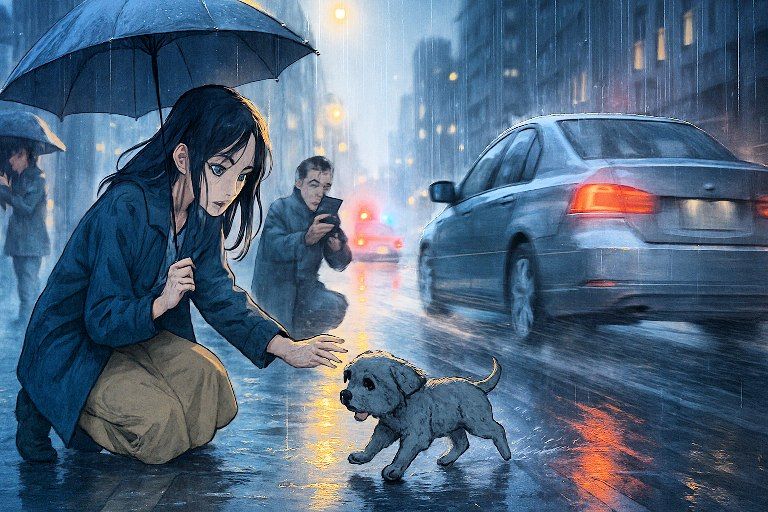
The rain fell like knives on the asphalt; yellow lights reflected in puddles that trembled under passing cars. Amid the city’s muted murmur, a small gray-furred puppy trembled by the curb, looking with big, wet eyes at the vehicle that sped away. The collar, worn and with a barely legible tag, hung from its neck like a reminder of some home that now seemed strange and distant. Carlos (pedestrian, 42): —Stop that car! —he shouted, pointing with his soaked arm—. They left it there! The puppy, its body curled against the cold and fear, gave a hop and began to run with short strides, its paws slipping on the wet pavement. Its heartbeat seemed louder than the rain; its breath was a short whine that mixed with distant horns and the hum of engines. It didn’t understand why they had left it, nor did it grasp human motives; it only knew that the figure that was leaving had been, until a few moments ago, its point of safety. Narrator: It ran desperately after the vehicle that had abandoned it, as if its life depended on not losing sight of it. Mariana (young woman, 25, witness): —I can't believe it… I saw it jump out of the back seat, I saw it… they left it! —her voice broke—. How can people do this to a living being? The scene, lit by headlight flashes and shadowed by indifference, unfolded with the mute violence of an injustice. The car, a gray sedan whose license plate blurred in reflections, pulled away down the avenue, leaving a wake of guilt and sprayed water. The puppy didn’t understand names or excuses, only the instinct and love left for those who had given it a moment of warmth; it chased the vehicle like someone chasing the last light on a winter night. Neighbor (elderly woman, 67): —Poor thing… —she whispered, wrapping her shawl around herself—. It’s scared. We must cover it, don’t let it stay there. Carlos and Mariana looked at each other; without thinking twice, they crossed the street with broken umbrellas. Other pedestrians, soaked and on their way, stopped; some had phones already recording, others frowned in silent condemnation. The city’s sound continued, but in that small corner all attention focused on one point: a being that could not speak and yet begged for help. Mariana: —Come here, little one —she said as she knelt—. Calm… we won’t leave you alone. The puppy lunged toward her, bumping against her leg and leaving muddy prints on her pants. Its eyes, once full of anguish, began to awaken a small trust, like a flower opening after the gale. It approached hesitantly, sniffing the hands that offered warmth. Mariana hugged it with both professional delicacy and clumsy tenderness; her face mixed anger at what had happened with tenderness for the small creature trembling in her arms. Narrator: Within minutes, social media erupted. Videos and photos spread across screens; citizens demanded justice and immediate action. “Report those who abandoned it,” one post said. “Authorities must track down and sanction the responsible parties,” cried another. The images, filmed from different angles on trembling phones, showed the puppy running after the sedan, the plate blurred by rain, the wake of water and desolation written in each step of the little animal. Reporter (live on air): —Neighbors report that this puppy was abandoned on the road and ran desperately after the vehicle. They demand that authorities investigate and punish those responsible. A patrol car stopped at the corner; two officers stepped out in shiny raincoats. Their faces, hardened by hours on the job, softened at the sight of the animal sheltered under Mariana’s umbrella. The police’s arrival did not silence the upset, but it brought a thread of procedure to the collective anger. Officers collected testimonies, reviewed videos, and noted license details with hands no longer trembling just from the cold. Officer 1: —Thank you for saving it. Do you know if it has an owner? Carlos: —It had a collar, but no one showed up. The people who left it drove off in that gray car —he said, showing the video on his phone—. Everything’s recorded. Officer 2 took notes with precision; his face reflected, for the first time that night, concern and purpose. The formal complaint began: time, place, vehicle description, witness statements. Despite the rain, the will to document the facts was firm; the community wanted a record, not just the fleeting indignation of a rainy night. Narrator: The community not only demanded sanctions; it demanded that abandonment no longer be tolerated with impunity. In cafés, on buses, in chat groups, the phrase repeated like a hymn: “No more.” Calls were organized, links for filing complaints were shared, plate numbers and vehicle descriptions were recorded. The urgency to find those responsible fed on an indignation that refused to fade into words. Mariana wiped the puppy’s paws with a handkerchief. It looked at her as one thanks a small miracle. Its eyes, still damp, now sought a friendly hand and found several. Pedestrians who had moments before just watched now applauded silently, some with tears the rain couldn’t hide. Mariana: —I’ll call you Cloud —she whispered—. Because you came from nowhere and now you aren’t leaving. Carlos smiled, eyes wet from rain and contained rage. The feeling of helplessness turned into action: they would organize shifts to care for it until a permanent solution appeared. They spoke of taking it to the vet, checking its health and looking for a microchip if it had one. There was a collective resolve that would not be satisfied with momentary consolation: they wanted repair, they wanted the city to respond. Days later, and thanks to the pressure on social media and the quality of the neighbors’ footage, the investigation progressed. The images were analyzed, data cross-checked, and complementary testimonies gathered. It wasn’t an immediate or easy conclusion; it required hours of administrative work, interviews and tracing vehicle records, but the community’s persistence forced open doors that once seemed sealed. Officer 2 (on the phone): —We have sufficient evidence to initiate proceedings. They will be summoned for animal abandonment and negligence. The summons didn’t undo the fear or time lost for the puppy, but it was a symbolic act of collective care: a line drawn against indifference. The story reached local media and sparked a broader debate. The city divided between those who justified the action out of need or ignorance and those who condemned it; nevertheless, most agreed on the need for change in laws, penalties and social awareness. Narrator: As the investigation moved forward, Cloud—the name Mariana chose in a burst of tenderness—left behind the frightened look. Under veterinary care he gained weight, his coat began to shine again and his eyes recovered a playful gleam. Beyond physical recovery, attention and affection acted as a slow reconstruction of lost trust. Mariana, with Cloud recovered and playful in her apartment, watched the rain from the window with a mix of relief and vigilance. She thought of those who had not been so lucky, who never found helping hands on a cold night. That night the city, thanks to a recording and the reaction of several people, had taken a step; it wasn’t enough, but it was something. Mariana: —We can’t let this happen again —she said—. We must educate, sanction, and rescue when we can. Carlos, sitting at his computer in the early morning, began preparing a social media campaign: how to report, what numbers to call, what data to record so authorities could act. He formed a volunteer group offering temporary homes, transportation to vets, and citizen patrols to report possible abandonments. The public moved from indignation to organization. Narrator: The puppy that had run desperately after the vehicle that left it behind became a symbol. Its chase after a car sparked many voices; its image, repeated across countless screens, provoked not only sadness but mobilization. Not everything was resolved overnight: there were debates, administrative delays and institutional resistance. But the city no longer looked away. Days later, in a small plaza where Mariana and Carlos brought Cloud to meet other dogs and people who had responded to the call, a letter was read to municipal authorities asking for stricter protocols and clear penalties for abandonment. Signatures, testimonies and the presence of local photographers underscored the shift: what seemed like a fleeting news item began turning into a sustained demand. Cloud, in the dimness of a less cold afternoon, curled up on Mariana’s lap and sighed. His breathing, measured to the heartbeats of those who saved him, closed one night and opened another: a small truce against cruelty, sustained by the determination of those who refused to be bystanders. Looking around, Mariana imagined other nights when no hands would be ready to help; that is why she continued, with Carlos and others, pushing campaigns for education, shelters and laws that would make abandonment harder. Narrator: The sanction applied to those responsible was only a step: the real outcome, the neighbors insisted, was the mobilization that followed. Conversations spoke of responsibility, empathy and a civic duty that shouldn’t depend on an animal’s luck. Cloud’s story became a reminder: when a community acts together, it can turn neglect into action, indifference into commitment. In the end, the rain kept falling on the city, but it was no longer the backdrop of a lone injustice. It was rain that, shared by so many hands that didn’t stay indifferent, also washed away the possibility of repeating the same act. Cloud slept peacefully, and for the first time in a long while his sleep wasn’t interrupted by the distance of a car driving away. The End. Source of the images. Image created with Bing.
No comments yet