 @mc5punk
more from that month
@mc5punk
more from that month
Short story: The Last Kilometer
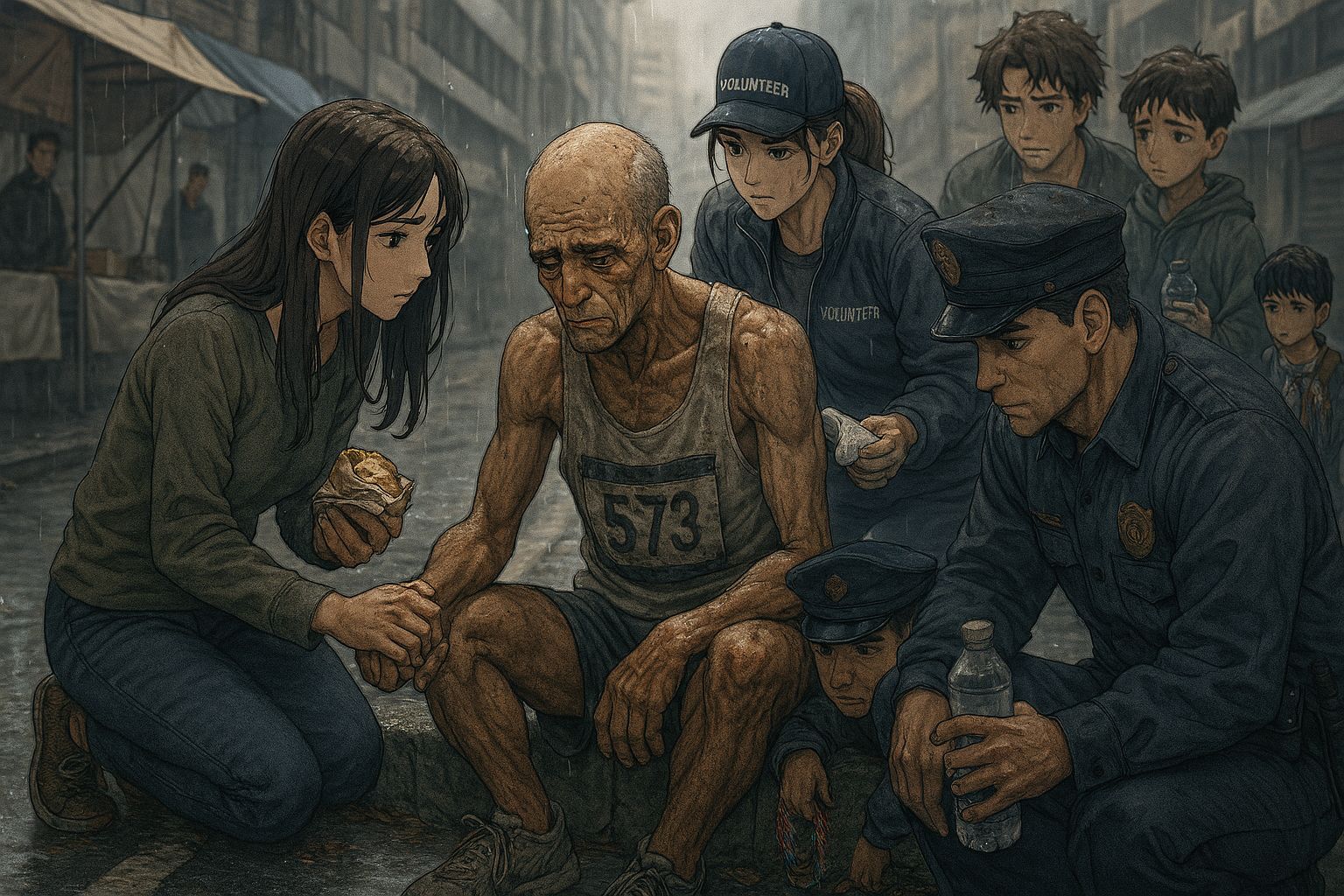
On the eve of the annual marathon, the city prepared itself without fanfare. Stalls along the main avenue hurriedly raised their awnings; vendors, their hands stained with flour or oil, counted coins as if each cent could mend the day. The event had lost its shine: the mayor’s office had cut the budget, sponsors had quietly withdrawn, and the prizes that once drew crowds were now modest envelopes that might barely cover one or two debts. Still, the race kept its pulse because, for many, continuing to run meant clinging to a possibility — however small — of changing something in their present. I did not come for glory. If I kept any trace of pride, I had turned it into pragmatism. I am an older man, bald, skin tanned and toughened by years working under the sun, thin and of average height. For decades I made my living as a day laborer and factory hand; later, age and circumstance pushed me into precarious jobs, work‑by‑the‑day, and nights when the roof over my head barely held up. I live in a small, cold rented room that I share with a radio without volume that keeps me company more in silence than in sound. The marathon prize, modest as it was, represented my last chance to pay several overdue medical appointments and buy an expensive medication that had been prescribed to me and whose price far exceeded my pension. I didn’t expect to stand on the podium; my goal was simple and born of necessity: to reach a certain point in the race where an acquaintance — a man who offered temporary jobs to those who finished the course — could hire me and help cover, at least in part, the debt that suffocates me. In the starting corral I was surrounded by faces that shared that mix of fatigue and determination. Marta, a young woman with long legs who sold empanadas between training sessions to support her child, offered me a contained smile as we settled in. “Are you coming from far?” she asked softly, trying to sound casual. “From around the corner,” I replied wryly. “And from further back — from years ago.” “Take care of your back,” she said. “Don’t push yourself too hard.” I returned the smile because in her advice I recognized a caress; the words became a kind of shared prayer. The start was never the celebration the brochures described: the sky was overcast and the crowd moved on in a heavy silence. I began cautiously, aware of the distance and of lessons taught by the past to ration effort. Within a few kilometers the route stopped being a mere urban line and became a living map of shortages: stalls still closed showed torn tarps, half‑working streetlights lit corners where facades bore the weight of time and dampness, and half‑open windows revealed faces marked by uncertainty. The other runners were not heroic characters from a sports narrative; they were exhausted companions whose breath of endurance was recognized in brief looks and in the silences between steps. At one point, before the cold and fatigue fully set in, I ran into Luis, a man with a hard expression and hollow eyes who had taken night shifts since he lost his job in a restructuring. I recognized him by a scar on his eyebrow and the way he adjusted his gloves. “How are you doing?” I asked, trying to keep my weakness out of my tone. “At a turtle’s pace, brother,” he answered without breaking his stride. “If I make it, they give me a bag of food. It’s not much, but it helps.” “Good luck,” I murmured, thinking how many “good lucks” depended on bags and scraps. Volunteers appeared intermittently, offering water and mechanical words of encouragement. At one aid station, an older woman with her hair tied back and a volunteer vest who’d seen better days, Clara, handed me a cold compress and a watchful look. “Are you all right?” she asked with the voice of a retired teacher who knows when pupils are faking. “Better than yesterday,” I answered, not daring to tell the truth. “Don’t lie to me,” she said firmly. “If you need me, I’ll stay. I won’t leave you alone.” Her offer struck something inside me: a small but real support amid general indifference. The race’s silence was briefly pierced by a television camera; the crew searched for images that would explain, in a short news piece, what they called “citizen resilience.” I went unnoticed. I didn’t appear on screen; my name would not be part of the report. Around me, some runners stopped to help those who stumbled, others ran calculating times and regaining positions. My breathing began to remind me of the old cough, the chronic pulmonary problem that never fully healed. Each breath seemed to cost more. The plan that had brought me there — to get paid temporarily by an acquaintance at the finish — became an engine that pushed my steps despite the pain. On a quieter stretch I saw an ambulance cross another street, siren subdued, a distant reminder of services that don’t reach everyone. I sped up. For a moment I felt that the chance of a temporary paycheck was more vital than any prudence. When I turned onto a less trafficked avenue, a sharp pain struck my chest. It was not only a stab of pain; it was the accumulation of years without care, of renunciations, of postponed medications. I sat down on the curb, barely leaning, and looked at my worn running shoes as if they held my life’s story. A small boy named Mateo, who sold bracelets with trembling hands, approached and timidly offered me one of his pieces. “Sir, would you like a bracelet?” he asked with the sincerity of someone who still believes in the value of an honest exchange. “I don’t have anything to give you,” I said roughly. “That’s okay,” he replied. “I just wanted to say… you run well.” His remark struck me unexpectedly; I smiled, though the smile was brief and filled with sorrow. Mateo’s innocence was a prop that, for an instant, lifted me. I didn’t ask for help. Asking, in my experience, involved humiliation and explanations I wasn’t willing to give. Runners passed by; some glanced at me with pity and kept going. Andrés, a young volunteer with a face marked by sleeplessness, came up and offered me a bottle of water. “Take this, brother. Don’t stop,” he urged in the voice he’d used many times. “Thanks, Andrés,” I said. “But this is mine. I have to try.” His insistence carried a tone between compassion and discipline; I felt guilty for not accepting more help, although dignity often weighs more than need. Each step I took felt like a loan my body had to repay with interest. The rain began as a thread and became a fine, persistent mist. It wasn’t a cinematic storm; it was a tenacious dampness that soaked through clothes and into the skin, slowly extinguishing the small hopes that had kept me going. The crowds along the route were thinner than in previous years; those who stayed watched with the distance of people who no longer expect miracles. The race clock marked the times of those running for pride; for others it counted down debts. Approaching the decisive kilometer, I felt my energy draining. I stopped at a traffic light, pressed my forehead against a cold metal bar and thought of everything I had not said in years: debts, missed medical visits, promises left unkept to my dead mother, voices that called me coward for leaving steady work. It was not a heroic choice but a quiet surrender. I let myself go. I didn’t fall with a crash; I simply lost the step. Commander Rojas, a police officer patrolling the area with a face weathered by too many shifts, came over with practical efficiency. “What’s wrong with you, old man?” he asked in a pragmatic voice, without drama. “I can’t catch my breath,” I replied. “I’ve been like this for months.” “Don’t move much,” he ordered. “I’ll get the ambulance.” He returned with a paramedic and in a few minutes they helped me into the ambulance. Marta, who had seen me fall, squeezed my hand tightly on the way. “Don’t give up,” she whispered. “It’s not the race that beats me,” I said. “It’s the other race — the one that’s been running for years.” Her look promised no miracles; it offered company, which at that moment felt like the only currency of value. In the hospital waiting room, hours stretched like strips of paper. The diagnosis was direct and clinical: my illness was advanced. The procedures, costly and with long waiting lists, exceeded my means. They offered me appointments with partial payments and social alternatives that sounded good on paper but did not resolve the urgency of the medication I needed to breathe without pain. Luis, Clara and some others who had crossed paths with me during the race stayed with me in that fluorescent-lit room. We traded words meant to fill holes, little ironies to ease the weight of the situation. “At least I got a bag of food,” Luis said in a grim attempt at humor, showing the sack as if it were a trophy. “It isn’t nothing,” Clara replied with serene sadness. “But bags don’t cure this.” “There’s always not enough,” I murmured. “And there’s always plenty of pretty words on TV.” The conversation hung in the air, unable to transform reality. The marathon went on outside those walls. There were winners celebrating with hugs and cameras; families taking photos by the barricades; presenters narrating stories of sacrifice and triumph on the evening news. For me, the day ended without the reward I had imagined. I left the hospital without a contract or an anonymous benefactor to fix everything. They handed me a flyer with phone numbers for organizations that promised eventual help — a list that sounds like conditional hope. Before she left, Marta gave me an empanada wrapped in paper and a phone number. “If you need anything, call me,” she said in a low voice. “I don’t promise miracles, but I know people.” “Thank you,” I replied. “I don’t know if I can pay for anything.” “Do what you can,” she answered. “Sometimes something small changes a day.” Her words were a small kindness that cost little and was worth less. Andrés lent me his volunteer cap with the program’s emblem as though it were a fragile blessing. “May it keep the sun off you,” he joked, voice choked. “And the rain,” I answered, forcing a laugh that didn’t quite form. The rain kept falling and it cleaned nothing. The city celebrated its anniversary with speeches and photographs; lights and cameras could not erase the roughness of everyday life. The story offered no immediate redemption: there was no miraculous prize, no anonymous donor, no cinematic ending that resolved precariousness in an instant. Instead, what remained was a harsh truth that pulsed beneath the festivities: while the city celebrated, some of its residents kept paying, with their bodies and diminished hopes, the price of indifference. Source of the images. Image created with Bing.
No comments yet