 @mc5punk
more from that month
@mc5punk
more from that month
Short story: The Whisper of Soot
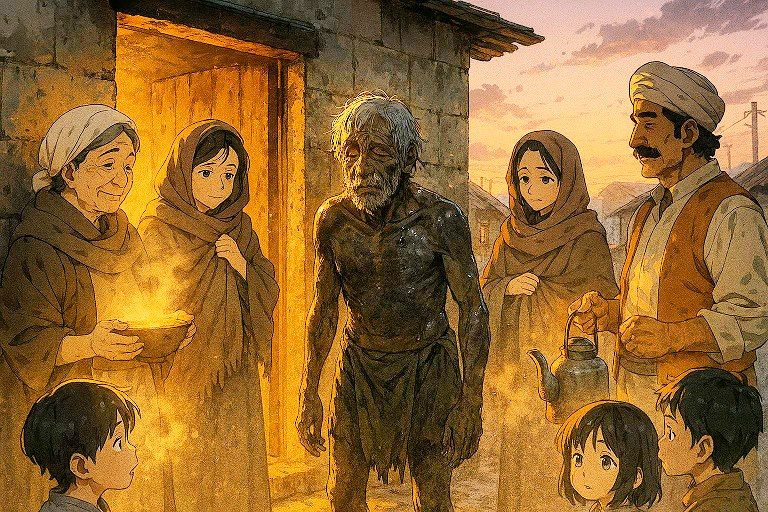
At the dawn of a moonless night, Abdul Noor was born, wrapped in the silence of a village that seemed suspended between the smoke of old chimneys and the smell of damp earth. There were no songs or crowds; only the creak of the mud settling beneath the feet of those who brought him into the world. As a child, his hands learned to keep gravel as one keeps secrets: under his nails, in the folds of his skin, as if the village had given him a name made of dust. Over the years, that grit and coal ceased to be mere remnants of the road: they became a second skin, an armor that defined him in everyone’s eyes. The people of the valley dubbed him “the dirtiest man in the valley” with the lightness with which labels are placed to feel safe. In the evenings, when conversations over coffee stretched long, his figure served as warning and tale: a bold character in stories told in low voices. Some saw him as an uncredentialed sage, others as a relic of modernity’s refuse, refusing to disappear. His refusal to bathe was not mere negligence: to the neighbors it represented a radical choice, an almost mystical gesture defying the mandates of hygiene and normality. Abdul was not a legend without a body. He was a real man with habits that, when outsiders heard them, made them squint and tilt toward either morbid curiosity or condemnation. He lived in a hut made of concrete blocks on the village’s periphery where the wind carried conversations away. There, among rags and odds and ends, he prepared his meals from what he found: roadkill, crop leftovers, pieces of stale bread. For him, each bite was a concession to the world as it was: rough, sometimes cruel, but honest. There were no flourishes in his mouth; there was pragmatism and an almost philosophical calm. His pipe, a strange, crooked object everyone knew, worked in peculiar ways: Abdul burned in it what he found, even excrement, and inhaled a vapor that for him had almost ritual properties. His stained teeth and raspy voice bore witness to years of unusual choices. He was often seen sitting at the roadside, looking into the distance with a serenity that made others uncomfortable. “Water strips away memories,” he would say to anyone who would listen, with a conviction that allowed no reply. “If I clean myself, what will remain of me?” These words stuck to the village’s atmosphere: some called them madness, others prophecy. Time had the texture of soot for him: accumulative, heavy, protective. For Abdul, dirt was not simple filth; it was stitching. It preserved wounds, losses, and the voices that had shaped him. Washing that cloak would have been to erase the maps of his history: his mother’s hand, nights of hunger, winters when the only company was the warmth of embers and the smell of burning bread. Every layer of dust was a story clinging to his skin, and to remove them, he said, was to divest himself of an identity that allowed him to remain whole in a world changing too fast. For years, the community treated him with distance. Some avoided him out of shame, others out of fear, and there were those whose curiosity pulled them to watch from the shadows. Children, with their habitual cruel sweetness, invented tales: that he spoke to dead dogs, that he could read the future in the mud’s marks. The elders, patient from having witnessed many seasons, nodded and added nuances: “He used to be a carpenter,” “he had a family,” “he was once a good man.” Stories that, like dust, piled up and covered an uncomfortable truth. In 2014, Abdul’s story crossed the thin line between local and public when travelers and journalists arrived, drawn by curiosity. Cameras captured images in gray and black: cracked skin, the pipe, the concrete-block hut. Headlines, more interested in spectacle than understanding, presented him as a phenomenon. The outside world, which rarely gazes without judging, began to comment and elevate the label into a category: the “dirtiest man” was depicted as spectacle. Those spotlights, far from improving his situation, isolated him further, turning him into an object of observation rather than a neighbor. Yet, while fame reached him unexpectedly, the village’s daily life continued. It was in that continuity that, with the slow motion typical of human stories, change occurred. It was not dramatic nor epiphanic: it was the persistent tenderness of people who had seen him in other facets, who remembered him smiling once, who had received a selfless gesture from him. In that mixture of memory and compassion the idea of approaching him began to grow. Amina, the village baker, was the first to show a more explicit gesture. She found him one afternoon, shivering by his hut’s door, and without ceremony offered him a bowl of hot soup. “Abdul, your hands are cold,” she said, using the voice of those resolved not to wait for the world to change on its own. “Come, have something warm.” He looked at her a long while. It was not the gaze of a proud man offended, but of a tired man who had learned to weigh the world’s offers. Finally he murmured, “Thank you, but soup does not wash what weighs.” Amina did not retreat. She persisted with the patience of someone who knows life’s continuity: she brought more soup, spoke small talk, touched without invading. Her gestures began to infect others. Hassan the milkman came with a kettle of hot water; Fatima, the teacher, brought blankets; children offered curiosity transformed into tenderness. Thus the community that had kept its distance for years began to approach with trembling hands and sincere faces. “We don’t mean to change you,” Fatima said one morning, holding a cup in both hands. “We only want you to be well. Let us help you.” Abdul, with his rough voice, replied, “If I clean myself, I will lose my mother. Her hands smelled of bread and coal. The water will take that.” “Water doesn’t erase, Abdul,” Amina answered gently but firmly. “It brings new memories. Let us care for you.” What followed was neither drama nor comedy, but a succession of small acts that converged on a decisive day. One evening, with the village gathered around his concrete-block hut, Abdul agreed. It was not a theatrical surrender but a delicate yielding: he entered the modest room while some residents remained outside in silence, others anxious, awaiting the outcome of a story that belonged to them. Inside, water flowed and the sound was, for many, a new music: droplets striking skin, resonating in tin, echoing in minds. The cleansing was intimate and long. Each drop seemed to detach not only grime but memories, as if with each movement of water sleeping voices were released. Abdul coughed at one point, sighed, and said in a low voice, “I feel as if verses are being pulled from my tongue.” Fatima, standing by the door, heard and replied, “They are not pulling verses from you; they are placing them on another shelf. You will recall them differently.” The process brought forth admissions that hung in the room after the water. Abdul spoke, clearly for the first time, of his mother: how she kneaded bread with burned hands, how she sheltered him on rainy nights, how she taught him to waste nothing. He spoke of losses, of jobs that had unraveled, of broken promises. For him, cleanliness was not a matter of hygiene but of identity; rinsing, he feared, would wash away his history. When he finally emerged from the ritual, his transformed figure surprised everyone. It was not a spectacular metamorphosis, but there was something new in the way light fell across his face: more vulnerable, more human. A child, without malice, said in a trembling voice, “You look human.” Abdul, with a smile that seemed fashioned from wet dust, replied, “Human, yes. And still a bit of ash.” The community’s reaction was mixed. Some felt they had betrayed him, recalling his old declarations about water. Others felt a warmth previously unknown: the sense of having offered care to someone who needed it. In a corner a man murmured, “He used to say cleanliness makes you ill. Now what?” Meanwhile Fatima held Abdul’s hand and said, “We didn’t take anything from you. We just gave you shelter.” Abdul listened to these voices and, with a broken voice, responded, “Perhaps I feared the world would laugh if it saw me stripped of soot. But I also feared being left alone with my memories.” That simple, painful confession opened a window onto his humanity. For many in the village, his decision to let himself be washed was not a change of doctrine but a surrender to the body’s frailty. In that context, cleanliness was neither victory nor defeat: it was an act of trust placed in others. The months after the wash brought a different coexistence between Abdul and his community. There were no thunderous celebrations nor moral sanctions; there were days of commonplace exchange. Abdul continued to live in his hut, but with a less spectral and more dialoguing presence. He was seen talking to neighbors, sharing stories he previously kept to himself, sometimes laughing with a dry humor that had remained hidden. He smoked his pipe less visibly and, instead, people brought him tea and bread. The relationship between the man and the village grew less polarized and more complex. Nevertheless, the question that hovered in the square, crossing looks and conversation, remained: was Abdul right when he said cleanliness makes you ill? That question found no single answer. From a medical and social perspective, hygiene is a pillar of health; many illnesses decline with basic cleanliness habits. But from an intimate, symbolic viewpoint, Abdul’s belief was not scientific thesis but an amulet against oblivion: for him, dirt was an archive and a way to hold on. Some in the village remained convinced that the coat of soot had protected him from something intangible—perhaps from total solitude or social erasure. Others believed the water had given him physical peace, a kind of reconciliation with his body. Fatima, who had given him so much patience and care, would often say, “We can’t know if what we did was right. We can only know we did it with affection.” That phrase became a comfort for many. When Abdul died, his death was not an apotheotic event nor a dramatic closure. It occurred with the moderation of true things: a few neighbors accompanied the funeral, some brought bread, others water. There were no cameras or grand proclamations, only the slow rumor that returns home. At the burial, Amina whispered, “We gave him a cleansing, not an oblivion.” That phrase, repeated among those who wept, sounded like a collective absolution: the community had tried to reconcile curiosity with compassion. After his death, stories about Abdul multiplied in the village. Some claimed that his layer of soot had protected him from something intangible; others maintained that the water had given him the lightness needed to rest. What is certain is that the story lost any capacity to be a single lesson and acquired the character of a domestic kinship: a tale told to remember that personal beliefs can be both armor and prison. In the years that followed, the valley kept memory of him not as a monument but as a note in the community’s notebook: a page that recalls human complexity. To children born later the story was told with alterations and additions—sometimes as a fable about respecting differences, other times as a warning about judging. Elders, when pronouncing his name, mixed tenderness with a certain melancholy: Abdul Noor had been a man who chose a language—dirt—to tell his life. If the final question is whether he was right or not, the remaining answer is twofold: in absolute terms, hygiene protects; layers of filth are not medicine. But in human terms, his beliefs were part of a strategy for emotional survival. Dirt protected him from being forgotten and allowed him to preserve stories; cleanliness offered company and relief. Both sides are true in their way. Thus the village learned a subtle lesson: there are no absolute answers for the rituals people choose. Sometimes what a person keeps on their body is the only way they can hold themselves up against the world. And when a community decides to act, it does so with trembling hands, attempting to mend not only flesh but another’s dignity. Abdul Noor was neither hero nor villain; he was a man made of memory and dust, and his story remained in the valley as a whisper that teaches how to listen before judging. Source of the images. Image created with Bing.
No comments yet