 @mc5punk
Short story: The Big Leap: From Mom’s House to Fifteen-Second Stardom
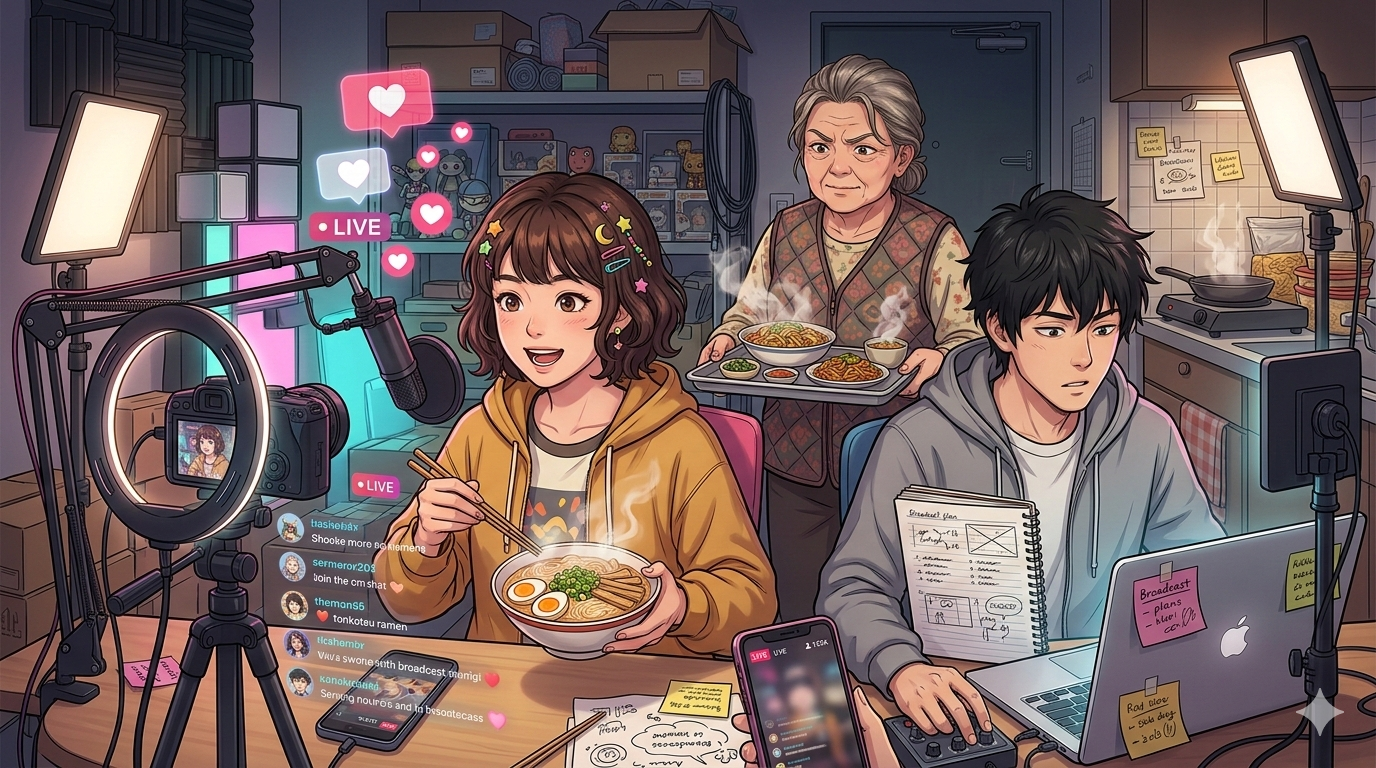
Mei left her résumé on the table like someone closing a book she no longer wanted to read. It was Tuesday: the room smelled of paper and half-cold ramen, notes were scattered in messy piles, and her phone vibrated with Douyin notifications promising views and hearts. She sat in front of the camera, turned on the ring light, and with a mix of theatricality and determination announced her new profession to the invisible world of viewers. Mei: “Guys, today I deleted the job app. I’m going to become… a professional influencer.” Li Wei, her roommate, who had finished economics school with more questions than answers, looked up from his mug of coffee as if watching a movie with improvised subtitles. Li Wei: “A professional influencer? Does that come with a contract and social insurance or just filters and a lucky break?” Mei, smiling with the confidence of someone who believed in her content plan, answered without hesitation. Mei: “Filters, luck, and a business plan with more monetization schemes than your thesis.” At that moment, Grandma Chen appeared in the doorway with a steaming tray of noodles. She had lived long enough to know that young decisions usually have two endings: a good story or an empty stomach. Grandma Chen: “What are you doing, girl? Why are you talking to the camera like it’s the boss?” Mei didn’t miss the opportunity; she turned Grandma’s interruption into a gag the algorithm would love. Mei: “Wait, Grandma, this is art. If this video goes viral, we’ll buy a new pot.” Grandma Chen raised her chopsticks with a stern look and granted the deal, half joking, half serious. Grandma Chen: “Then act cute or I’ll send you back to university.” Within days the numbers began to move. Twelve thousand followers arrived like a modest wave, accompanied by some strange direct messages and the classic authenticity question: “Are you real or a filter?” Li Wei, always with his mental calculator on, grabbed a napkin and started making projections. Li Wei: “If she gets 50,000 followers she could sell courses. If she gets 200,000, a tea brand will pay us. If she reaches a million…” Mei interrupted with the practical humor of someone offering a reliable incentive. Mei: “If she gets a million, I’ll buy you coffee for a year.” Li Wei smiled, knowing the promise of coffee was dependable fuel. Li Wei: “Then let’s go for the million!” Soon after, the figure known as “Boss” entered the scene like a character from a modern marketing manual: a big folder, catalog-ready smile, and the confident air of someone who knew the business better than the three of them combined. Boss: “Mei, you’ve got ‘it’. You need a team: a manager, an editor, someone to handle the lights… and a brand strategy.” Mei, who had moved from uncertainty to ambition as easily as she changed a filter, asked aloud what many secretly wondered. Mei: “Brand strategy? Is that like a filter with a college degree?” Boss laughed and explained with the precision of someone who had shaped many creators’ careers. Boss: “It’s much better: we call it the ‘influencer economy.’ There are agencies, academies, collaboration packages… and, of course, contracts.” Grandma Chen, practical as ever, didn’t hide her skepticism. Grandma Chen: “Does that pay better than selling noodles on the street?” Boss, calm as a seasoned executive, replied: Boss: “Sometimes yes. Sometimes they invite you to dinner and send you a box of tea with your name on it.” The house that had been a domestic refuge for years became a small creative factory. Li Wei took on the role of improvised producer and strategist: notebook in hand, noting schedules, formats, and potential sponsors. Mei handled creativity and on-camera voice; Grandma contributed natural charisma and heirloom recipes. They rehearsed challenges, tested lighting, worked on dramatic transitions, and wrote microsecond scripts designed for the algorithm. Mei practiced her opening line again and again. Mei: “Hi everyone. I’m Mei, I’m 22, and today we’re turning ramen into haute cuisine.” Grandma Chen, meanwhile, added ingredients with the hand of someone who had cooked all her life. Grandma Chen: “If this doesn’t work, I can always do a live selling my meatballs.” Workdays were long. There were nights when editing stretched until three in the morning, strategy conversations were scribbled on napkins, and decisions about accepting or rejecting an offer were debated with the same gravity once reserved for choosing a university major. Boss taught them not to accept “exposure” as payment and to ask for at least tea and a signed contract. Li Wei, who had read clauses in multiple temp jobs, insisted on checking exclusivity: they didn’t want to sell tea today and be forbidden from talking about noodles tomorrow. Li Wei: “And check exclusivity clauses. You don’t want to sell tea and then be banned from talking about noodles.” Mei joked about less corporate details. Mei: “Is there a clause that forces me to smile? Because my morning face is part of my charm.” The path was not a straight climb; the algorithms rose and fell without warning. One day you were viral; the next, invisible. But consistency paid off: a cooking live exploded with two hundred thousand viewers. Suddenly the phone wouldn’t stop ringing: brands interested, managers, messages of support, and collaboration offers. Grandma Chen, chopsticks trembling, couldn’t contain her excitement. Grandma Chen: “Look! My granddaughter is famous!” Mei, with sauce-stained hands and eyes shining, replied amid laughter and happy tears. Mei: “Grandma, I told you we’d buy a new pot.” Li Wei, calculator in hand, did the math out loud. Li Wei: “With this we can pay for the pot, the electricity, and my coffee for two years.” Success brought reorganization. The living room became a set: stacked light boxes, hidden microphones, a makeshift kitchen that looked better on camera than in reality. Grandma became a secondary star who, unintentionally, taught authenticity to an audience that preferred the real over the polished. Her live streams were so popular she soon opened her own channel; her first sponsor was a local sauce company that matched her blunt, direct tone. Grandma Chen, in her first sponsorship, looked at the camera with the seriousness she used to teach her grandchildren not to waste ingredients. Grandma Chen: “If you buy this sauce, I’ll teach you how not to burn the noodles.” The chat exploded with supportive comments and memes: “Grandma Chen for president!” some shouted. Grandma, who sought customers more than titles, laughed and kept cooking. Meanwhile, Mei learned a truth not taught in any creator academy course: digital life wasn’t instant magic, it was strategic work. There were risks: unpredictable income spikes, trolls, contracts with small print; but there were also opportunities: immediate visibility, the ability to build a personal brand from scratch, and the chance to earn fast if content connected. For many young people like Mei, that kind of return felt more attractive than the promise of a traditional career that took years to solidify. Li Wei transformed from skeptical ex-student into proud producer. He adjusted lights, scheduled streams, and negotiated with brands with the patience of someone who discovered their skill had market value. Boss, constantly on the phone, began talking about bigger plans. Boss: “Next step: an international live tour.” Grandma, practical and unafraid to try new things, asked the key question. Grandma Chen: “Does that include eating in other countries?” Mei smiled with the mix of honesty and negotiation that now helped her close deals. Mei: “If they pay for the ticket, sure.” Their relationship strengthened through everyday life: they divided tasks, reconciled schedules, and celebrated small victories with noisy meals and inside jokes. Tensions didn’t disappear: there were arguments about filming times, disagreements about the aesthetic of content, and moments of exhaustion. But the dynamic worked because each person contributed something irreplaceable: Mei’s authenticity and creativity, Li Wei’s discipline and management, and Grandma Chen’s wisdom and charisma. Over time, the influencer economy became another character in their story: agencies offering packages, academies selling viral-playback courses, and teams producing content at scale. Some peers fell into the trap of selling their voice for promises of exposure; others learned to negotiate and turn creativity into sustainable income. For Mei and her team, the balance was a mix of common business sense and domestic humor. One particularly long editing night, as the three reviewed cuts and subtitles, Mei looked at Grandma and Li Wei with gratitude. Mei: “Remember when we thought the only way out was the gray office?” Li Wei, adjusting the tripod, sighed with satisfaction. Li Wei: “Yeah. Now the office fits in one room and smells like sesame.” Boss, still managing contacts from his phone, added with professional enthusiasm: Boss: “This is just the beginning. International, collaborations, your own product line… imagine the merch.” Grandma Chen raised an eyebrow while tasting the new recipe they’d prepared for a sponsor. Grandma Chen: “If you make clothes with my face on them, I’ll sell them myself.” They laughed. It wasn’t the guaranteed security of a traditional corporate contract, but it was a way of life that let them create, adapt, and stay together in a labor market changing at the speed of a notification. So, between filters, contracts, editing nights, and piles of noodles, Mei, Li Wei, and Grandma Chen found their own path in an economy in transformation. They didn’t renounce the seriousness of work; they simply redefined it. They built a personal brand born of authenticity, humor, and daily perseverance. And although the end of their story hadn’t been written yet, each live confirmed that, at least for now, their bet on the digital world was worth it. The End — or, as they liked to say on their streams, “see you on the next live.” Source of the images. Image created with Google Gemini.
6 comments
Nice one
Thank you
"I really enjoyed this story about the digital world and family! I also write about Oromo culture and history. Let's support each other! Great work
Thanx 🙂
What a heartwarming and realistic story! The transition from a traditional career to a digital one is something many of us are navigating right now. Grandma Chen stole the show—authenticity always wins. Following you for more gems like this. Let’s keep building this community
Thank you very much for your comment, and I am glad that you liked this post. I send you a big hug 🤗