 @mc5punk
Short story: The Monday of Smoke and the Van
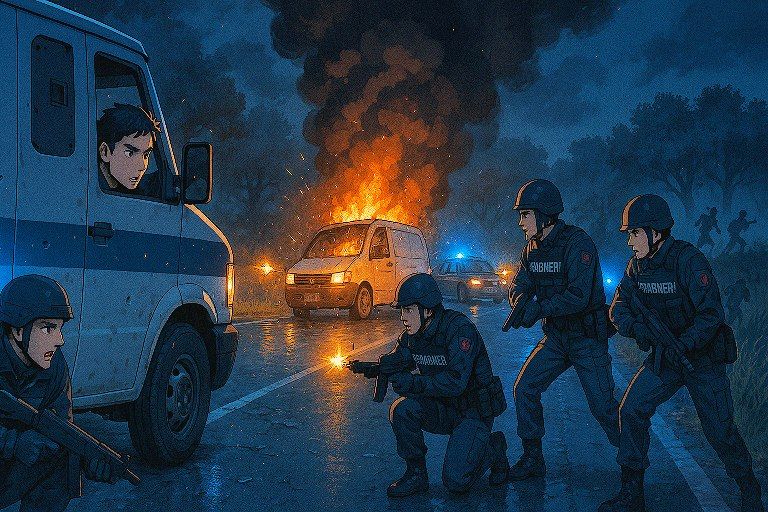
On a mild Monday dawn, the Kaia highway connecting the towns of Marento and Brindía was disrupted by the smell of gasoline and the hum of idling engines. That road, a common artery through the region, became the scene of a carefully planned heist: a team had devised a plan to intercept an armored van carrying valuables, force it to stop, and disappear before police could close in. The plan was executed with cold precision. Several vehicles positioned themselves perpendicular across the roadway; a white van blocked the service lane and two more cars sealed the route. Matteo Orsini, known to his men as “Il Falco,” issued a sharp order over the radio: —Gina, light the smoke. Giulia “Gina” Moretti, skilled driver and second-in-command, opened a can, poured fuel, and lit a rag on the van’s tarp. In seconds a tongue of flame erupted and the vehicle belched black smoke that swallowed visibility. The armored van’s driver, stunned by the blockade and the smoke, braked; the metal giant came to a halt, surrounded by chaos. From a distance, Carabinieri Officer Enzo Romano, the first officer on scene, spoke firmly into his radio: —Unit 12, this is Carabinieri. Identify yourselves and clear the road immediately. The demand hung in the air: a burst of gunfire answered from the criminal side. Glass shattered; the atmosphere filled with noise and adrenaline. Some civilians passing by were shoved aside by the gang’s men, who hurried to load briefcases of cash and valuables. Giuseppe, the armored van’s driver, took refuge behind the armored door, powerless before the violence. Commissioner Luca Ferri arrived shortly after with Lieutenant Marta Rinaldi and a small group of officers. Veteran and composed, Luca took in the scene with cold eyes: two shocked hostages, burning cars, the van consumed by flames, and shadows moving swiftly. His orders were measured and direct. —Do not fire unless necessary. Protect the civilians. Marta nodded and, radio at her ear, organized the deployment: —Three on the left flank, two in the rear. Paolo, take statements and secure fingerprints. Inspector Paolo Sessa was already separating bystanders and photographing the scene for the forensic investigation. The confrontation was short but intense. Matteo took position at the roadside like a hawk, controlling the operation: —To the van, quick! Load the briefcase and we go! Marco and Dario, two young members of the team with trembling hands and nervous faces, obeyed clumsily. The gunfire left marks on the asphalt and on bodies: Enzo was struck by shrapnel and fell wounded, but not before shouting for reinforcements: —I need backup! A civilian has been hit! Luca, maintaining composure, ordered a containment maneuver. The blue lights of police vehicles began to frame the scene as officers moved cautiously, measuring every step through the smoke and flashes. The escape unfolded across open fields. The gang did not try to flee via the main road; instead, several cars tore off toward the olive groves and pastures bordering the Kaia. Marta quickly organized the chase: she requested rural units and aerial support and ordered perimeter closures. The rain-softened terrain turned the flight into a dangerous, disorderly run, with vehicles sliding through furrows and hedgerows. After hours of pursuit, the officers managed to blunt the gang’s response. Luca received a communication that released a mix of relief and caution: —We have two detained. They were found near the San Vito farmstead, —Paolo reported—. They are wounded, but alive. Marta exhaled sharply, aware that capturing two members did not end the episode. —Detained or not, the ringleaders are still out there. This isn’t over. The names Matteo and Gina still loomed as threats: cunning, calculated, with escape routes ready. Still, apprehending Marco and Dario offered a chance to unravel the gang’s structure and contacts. In Marento’s police station, under the harsh light of an interrogation room, Luca watched Marco hunched over the chair, his shirt soiled from the fields and his lip split from a blow. His questioning was direct, designed to open cracks in the young man’s resistance. —Talk, —Luca said without raising his voice—. Who funds you? Where is the safe house? Marco spoke in a thin voice, strained: —It wasn’t… it wasn’t just this. Il Falco said it was the last big payday. We had to do it before… before they sold everything. Marta fixed her gaze and pressed: —Where is Matteo? The young man closed his eyes and murmured: —At the old Ripa factory. To the north, by the dead rail line. Dario, in an adjacent room, broke down sobbing and began to give details that astonished Inspector Paolo: meeting coordinates, contact names, and the involvement of a local businessman moving money in the shadows. Through tears he said: —We didn’t want to involve anyone else… but there were orders. Upfront payments. A third party handling logistics from the neighboring town. Those fragments set a mechanism in motion: the police were no longer dealing only with highway robbers but with a network that might have civilian and financial ties. With the information gathered, Luca drew up a precise cordon. The old Ripa factory, a cluster of rusted sheds and quiet corridors, became the target. The night following the arrests was cold; moisture clung to helmets and uniforms. At midnight, with flashlights and helmets, the team took positions. Marta instructed calmly: —We go in silently. Two through the main door, one up the stairs. Do not shoot unless you have visual confirmation. The echo of measured footsteps rang through dusty hallways. Inside, the gang had not expected the police’s reaction to be so swift; Matteo, impatient and tense, calculated escape windows. Voices, the clink of tools, and creaking sheets of metal intensified the wait. The assault on the hideout was brief and decisive. A single gunshot shattered the night; within minutes the officers sealed exits and subdued the occupants. Matteo, trapped with no way out, dropped his weapon and cried: —Don’t kill me! Luca approached with the authority of one who has seen many nights like this and answered in a restrained voice: —Surrender, Matteo. You have nowhere to run. Matteo, sweating and breathless, spoke with a mix of contempt and defeat: —I thought the road would be everything. At dawn, the sun filtering through rusted chimneys and broken beams, handcuffs closed the chapter for Matteo and Giulia: they would be transported, processed, and confronted with the legal consequences of their acts. Two members still remained at large, shadows on maps to be traced. The organization’s pieces, however, had been mortally wounded; the police had struck blows that would make the network’s operations difficult in the short term. In his office, Luca reviewed photographs, forensic reports, and the clippings documenting the operation. Paolo presented the preliminary report with the calm of one confident in his evidence: —We’ve recovered part of the haul. Toll cameras and witness statements place the business owner we’re linking. We have grounds to continue. Marta, letting fatigue fall from her shoulders, said: —This doesn’t end today. But at least we prevented them from spending that money on more violence. Luca closed his eyes for a moment, voice worn with exhaustion, then added: —We did what we had to do. Let justice take its course. Officer Enzo Romano, now discharged with a leg in a cast, watched the Kaia from the barracks window. The traces of the confrontation remained: tire marks, flecks of shrapnel lodged in the guardrail, black stains where fire had eaten rubber and paint. The region, momentarily violated, breathed again with a calm that swore to be lasting, though the episode’s memory would cling to every olive tree, stone, and curve of the Kaia. The legal process to come promised to reveal more layers of the network: businessmen, logistical contacts, and the possibility of third parties who profited from others’ risk. Matteo and Gina would face trial; Marco and Dario would stand at the crossroads between punishment and remorse. Meanwhile, the investigation would continue, threading through side streets, financial offices, and moonless nights until, step by step, control and the word justice were returned to those who had suffered the violence. The Monday of Smoke and the Van would remain in Marento and Brindía’s memory as the day violence attempted to impose its story, and where the organized, patient response of law enforcement managed, at least for now, to restore order and open the path to the truth. Source of the images. Image created with Bing.
No comments yet