 @mc5punk
more from that month
@mc5punk
more from that month
Short story: Luzón: Memory of a Storm
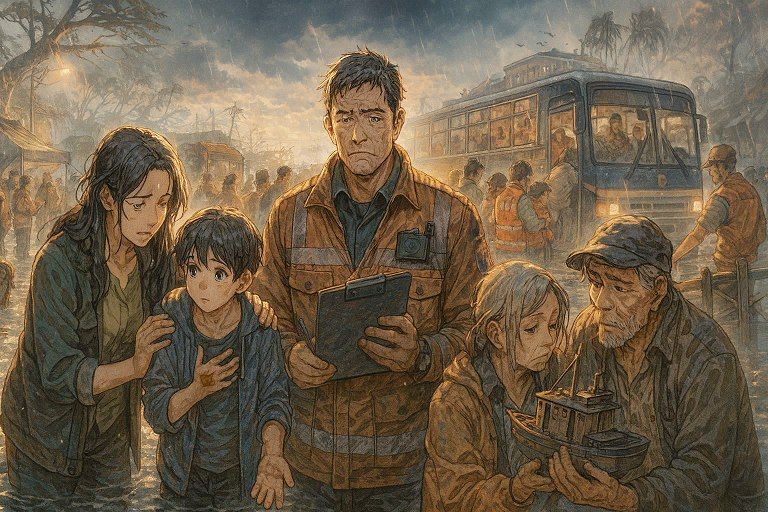
The rain arrived like a persistent memory: long drops that seemed to drag voices from other times across Luzón’s rooftops. At dawn, the Civil Defense room smelled of damp paper and cold coffee. Raffy Alejandro stood before the illuminated map, the super typhoon Fung-wong’s path etched like a scar across the screen. Every line, every operational point in his notebook already had the texture of someone he was meant to protect: names multiplying in his head as outside the world dissolved into water and wind. “Two dead,” Raffy said, his voice hoarse. “Two lives that will not return.” Marisol, head of logistics, pressed her lips together and set her pen down. Her hands—stained with ink and fatigue—had arranged mattresses, routes, and promises that did not always hold. Her eyes, however, remained practically patient. “We opened six hundred shelters,” she murmured. “A thousand displaced people have been registered, but a number is only a number. Behind it are stories that don’t fit on the lists.” At the San Fernando pier in La Unión, the sea vomited foam as if recalling old offenses. Waves pounded the dock with mechanical fury; Alberto’s boat, moored for years of work, looked like a witness. Alberto’s skin was browned and roughened by decades of salt and sun; his body carried the map of a life marked by the tide. To see the boat was to look at a tangible past, an identity that would not surrender without a fight. “I don’t want to leave her,” he whispered, as if speaking to a relic. Lina, his daughter, had the steadiness of someone raised on stories of endurance. She was nineteen and had a tenderness that tasted like promise. She held his arm with the delicacy of someone accompanying a forced farewell. “Dad, if you stay, we won’t be able to tell it later,” she said. “The boat can be fixed. You can’t.” The convoy that picked up evacuees smelled of diesel and a kind of hope organized in haste. Rony, a volunteer with quick eyes, moved people with the rhythm of someone who learned to measure time by others’ breaths. “Get on the convoy,” he ordered firmly. “There’s no time for doubts.” Alberto climbed into the vehicle with the boat still lodged in his memory. Lina clung to him as one who keeps a relic; inside, conversation was a thread tying fears to the idea of return. The road toward Pangasinan became a procession: cars loaded with memories, suitcases, and the smell of things that might never be the same. Doña Teresa, seventy-eight, pressed an old yellowing photograph to her chest. Her fingers—thin like dried leaves—held the paper with devotion that seemed to suspend time. “My grandson is in this photo,” she said. “Promise me you’ll take care of him.” Mayra, her granddaughter, had the practical calm of someone who becomes a support by habit. She tucked the photo into her purse and, with a voice trying not to crack, replied, “We’ll take care of him, Grandma. I promise.” In the operations room, Evelyn, the meteorological analyst, watched the clouds with the mixture of rigor and affection of someone who knows the geography of danger. Satellite images showed Fung-wong fraying: it had lost strength, but its bands of clouds and lateral fury reached coasts and mountains like cold hands trying to tear the land. “It has weakened,” she commented, “but the threat is no longer in the center; it’s at the edges—waves, currents, slopes giving way.” Raffy folded that observation into his plan as one might note a sorrowful line of verse: prioritize safe routes, warn mountain communities, coordinate with aviation and the navy, prepare shelters. His voice when ordering carried a hard tenderness—the sound of someone who knows the right words in a moment when words can save lives. The day unspooled in small acts that together formed a net of humanity. Volunteers setting up mattresses in schools, community cooks preparing steaming soups that smelled like home, medical teams improvising triage in gymnasiums. A child offered her blanket to another; an old woman distributed cookies with hands that were no longer strong but were generous. Miguel, an eight-year-old who arrived with eyes wide from fear, let Marisol paint a star on his palm. The tiny figure on his skin shone like a small promise. “When everything hurts,” Marisol whispered, “look at the star and breathe.” Miguel shut his eyes and allowed himself to be carried by the simplicity of the words; for a moment the storm stayed outside. Meanwhile, the north coast reported the most concrete threat: the surf was rising and waves threatened to break through dikes and barriers. A report rang out like a bell: risk of flooding in the northern sector of Pangasinan. Rony ran to the coordination table, adrenaline painting a long silhouette across the wet floor. “Flooding in the north!” he shouted. “We need immediate relocation of coastal families: buses, military units, reinforcements.” Raffy fixed his gaze on the map and ordered without hesitation. Each decision carried the weight of lives. Mayra grabbed the radio and relayed the message with a lump in her throat; Doña Teresa pressed the photograph one last time before boarding the bus. As she did, she searched the horizon and saw waves swallowing part of the pier where her family had grown up. She boarded with the certainty of fragility and the hope of not returning helpless. The afternoon was a weave of losses and small victories: two deaths recorded in incidents related to the typhoon—numbers that echoed like empty spaces. But there was also light in the scale of the evacuation: 1.4 million people moved to safe areas, six hundred shelters opened, and hundreds of hands willing to act. Every unfolded mattress was a promise against abandonment; every plate served reaffirmed that, despite the damage, the community remained a support. In the shelters, nights had a cadence of their own. Metal roofs vibrated with the rain, but inside murmurs formed a constellation of tales. Doña Teresa, using Miguel’s star as an excuse, began telling old stories—anecdotes of families, coast legends, narratives that seemed to help people recompose their lives. Children listened as if words were balm; adults, like people seeking an anchor. Evelyn updated bulletins regularly: Fung-wong had weakened, but the threat persisted. Flights were suspended, and high-seas navigation had been halted along the coast because of heavy surf. Air and maritime logistics remained on hold until forecasts allowed safe maneuvers. As hours passed, the human dimension of the tragedy emerged: names silenced, photographs held by trembling fingers, objects smelling of the past. In the square repurposed as a coordination center, Raffy held a cup of coffee that no longer warmed him. For a moment, his body seemed indispensable and yet more fragile than the notebook where he had written routes and phone numbers. “We did what we could,” he said, almost to himself, with the gravity of someone accepting human limits. “That doesn’t remove the pain.” Marisol placed her hand on his shoulder with the tenderness of one who had witnessed too many farewells, who had woven shelters with exhausted hands. “We did what had to be done,” she replied. “And we won’t stop until every person has somewhere to sleep.” As evening fell, the first scars of damage appeared like wounds on the landscape: uprooted trees, twisted railings, stretches of road washed away by the force of the water. In some sectors the coast bore the imprint of fury—holes where sand had been, broken fences, stranded boats like pieces of an incomplete puzzle. Inside shelters, life continued in small scenes of care: people sharing blankets, telling anecdotes, exchanging keys to homes left temporarily vacant. Night arrived with a wind that had not yet given up. Lights in the shelters were points of resistance in the dark. Miguel, with his star on his palm, slept beside Lina and Alberto, who despite material loss shared a silence that resembled hope. Mayra watched over her grandmother Doña Teresa, and together they retold the yellowed photograph as if each memory were a brick to rebuild something. Official figures mixed with names and faces: two confirmed deaths, 1.4 million evacuated, 600 shelters opened. Between statistics, stories of everyday resilience were woven: volunteers crossing the night to deliver water, cooks adapting recipes with scarce supplies, medical teams treating wounds and the exhaustion of sleeplessness. Evelyn, updating the bulletin once again, spoke with the calm that science offers when confronted with uncertainty: “Fung-wong is weakening, but its aftermath will be long. We will continue evacuations and keep flights suspended until further notice.” Raffy looked up and watched those around him. His hands had written routes, messages, and names; his eyes had seen both fear and devotion. “Today we lost two people,” he said, his voice contained. “But we saved thousands. That matters. Tomorrow we will work on recovery: house by house, story by story.” Marisol, eyelids heavy and heart unbending, nodded and added, “Not out of pride, but out of memory. We will rebuild to honor what remains.” The night stretched into early morning. Voices in the shelters faded to whispers; flashlights blinked and radios transmitted constant updates. Outside, the tide continued to write poems on the sand in a script few could read. Inside, people began to reclaim small pauses: an attempt at sleep, a conversation that resumed daily life. On Luzón remained the sense that something had changed forever: houses with wounds, roads needing repair, memories that would weigh on some hearts. But there also remained joined hands, shared stories, and a human fabric that, against the fury of the weather, proved resilient. Among the steadfast faces were Raffy, who bore responsibility with gravity; Marisol, who tended practical comfort; Evelyn, who put science in service of prevention; Rony, whose energy mobilized others; and hundreds, perhaps thousands, of neighbors turned into improvised rescuers. When the rain finally eased, the atmosphere was heavy with nostalgia that tasted of loss and new beginnings. Hands were already at work cleaning, assessing damage, and tending to the most vulnerable. There was crying and fatigue, but also a thread of hope: the certainty that, despite the wounds, the community knew how to sustain itself. In the Civil Defense station, Raffy closed the notebook where he had recorded the day’s actions, breathed deeply, and, looking at the city in the dim light, murmured, “Tomorrow we will rebuild. Not to erase what happened, but to honor what remains.” The storm would remain, forever, a mark on Luzón’s memory. In the Pacific typhoon belt, the season of storms does not forgive, but it does not erase the will of those who rise after disaster to give new meaning to homes, stories, and names. In that slow, patient reconstruction, nostalgia and strength intertwine: pain and care, loss and tenderness, memory and shared work—until the island beats again to the rhythm of its people. Source of the images. Image created with Bing.
No comments yet