 @mc5punk
more from that month
@mc5punk
more from that month
Short story: The community that refused to give up
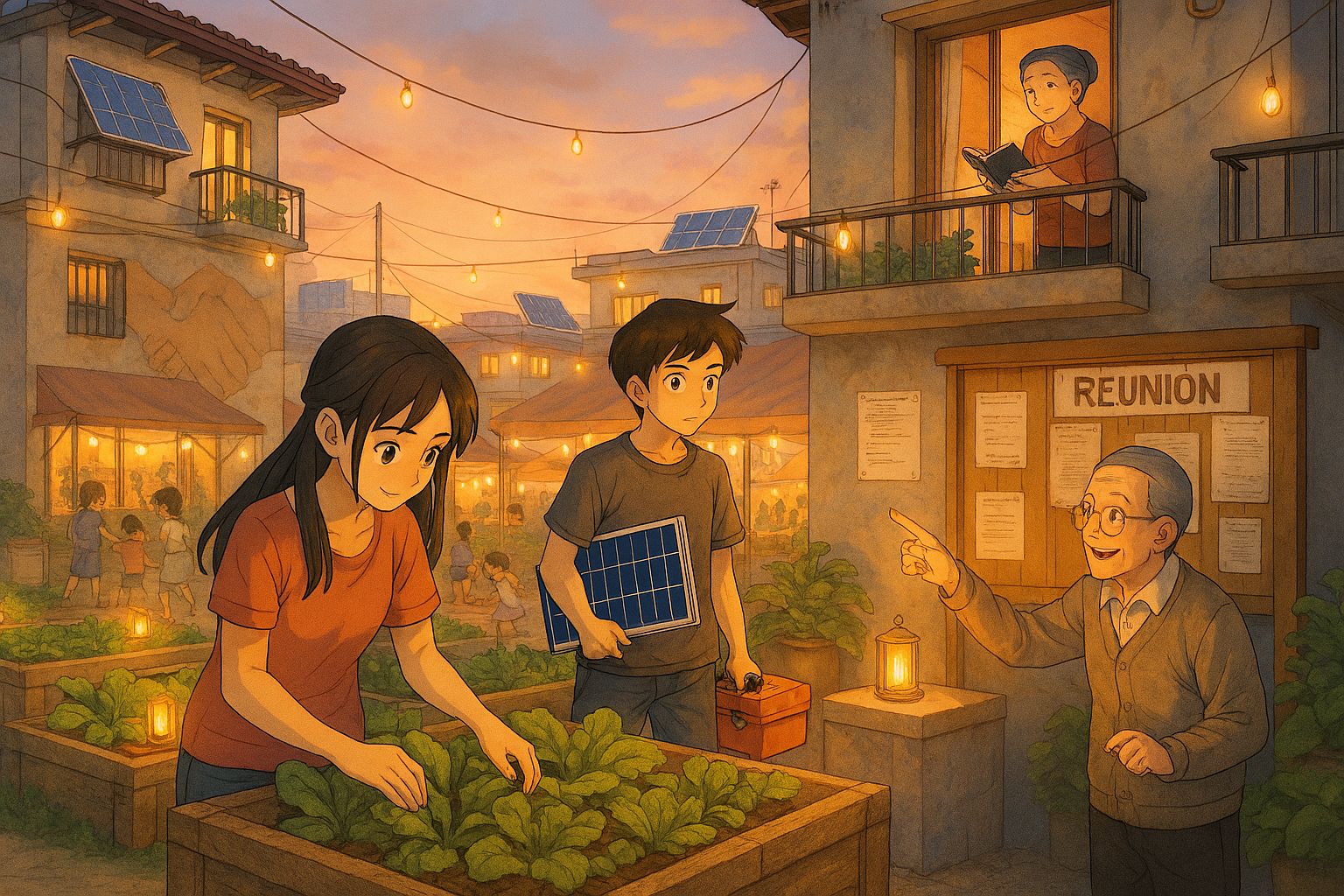
María woke before dawn out of a habit learned during months of blackouts and fractured hearts: the city had been taking electrical pauses that marked the rhythm of the days. She remained still for a moment, listening to the silence broken by her mother's breathing and the distant roar of the street. When she opened the window, the cool air hit her face; on the sidewalk, a group of young people handed out fresh bread donated by the community bakery. Doña Rosa, who every morning carried the notebook where she wrote down names and debts, murmured the list of those who still had not received water that week. In the living room, Rubén, her younger brother, carefully flipped through a notebook of notes. He was a reserved young man who had quieted his voice with life's blows, but who still kept curiosity and the energy to learn. The notebook contained lessons from a free technical course offered by an organization: basic electricity, repair of small motors, installation of solar panels. Rubén paused on a page, furrowed his brow and asked without looking up: —María, do you think with this we could get some work? —I think so —she answered cautiously—. At least it would give us tools to fix things here ourselves. If we don't try, we'll never know. María had arrived in that neighborhood five years earlier, carrying the suitcase of unemployment and rusty hope. Her mother, Carmen, knitted pieces she sold at night to help supplement the meager household income. Carmen had a calm temperament; she combined her faith with a tenacious work ethic. She liked to repeat that prudence avoids weariness, but she also kept imagined routes in her chest for getting ahead: markets, small agreements, and sales in the plazas. Turning the corner, the neighborhood square was a collection of gestures: a man tuning an old radio, children sharing marbles, a group of neighbors pasting up a poster. Professor Antonio, a retired teacher with hands hardened by years of writing on blackboards, was organizing that poster. He had called a community meeting for that afternoon: "Community Organization Committee — 5:00 p.m." Antonio believed the crisis was not only a matter of resources but the result of political decisions, lack of transparency, and poor administration. He wanted to teach his neighbors how to demand accountability, organize cooperatives, and exercise civic oversight. When María passed the square, Antonio called her from the bench. —María, come this afternoon —he said with a smile that needed no loud words—. We need hands that also think. —I’ll go, professor —she replied, feeling a knot between apprehension and curiosity—. I'll bring whatever I can. The neighborhood school turned out to be a refuge for conversations. That afternoon, the main classroom filled with misaligned chairs, folded papers, and voices from different corners of the block. Young people with projects arrived, women who cared for entire families, a retired lawyer willing to review documents, an accountant offering a few free hours, and an electrician who promised to collaborate at no cost if a community plan was organized. Stories, frustrations, and small proposals emerged among them and were stitched together with the patience of years. The young woman who proposed using the schoolyard for a garden described the modular design with precision: raised beds, simple drip irrigation, crop rotation. She also suggested the garden serve as an open classroom to teach children the cycles of food. —If everyone contributes a little soil and work —she said—, in a few months we would have vegetables for many families. Also, they would be seedbeds of knowledge for the children. Carmen, with hands that never stopped knitting, proposed that she organize raffles of embroidered pieces to buy supplies. —I can sew and raise some cash —she said firmly—. It’s not much, but it adds up. Rubén spoke with more confidence than usual: his idea was a technical workshop that would allow young people to learn repairs and maintenance of equipment, especially oriented to alternative energy. —If we learn to install panels and fix small motors —he explained—, we can offer services to the neighborhood and also to nearby communities. That would generate income and reduce dependence on expensive services. Antonio listened, nodded and sketched on a sheet the outline of what would become the initial plan: community garden, tool bank, technical workshop, legal committee to file formal complaints, and a barter network for goods and services. He also proposed that each project have rotating leaders and a monthly accountability report. —It’s not enough to complain —Antonio said—. We must turn complaints into dossiers, rage into plans, and powerlessness into work. If we organize, we’ll have a better chance of being heard. The afternoon ended with agreements and a feeling of a beginning that felt like a handkerchief thrown to the wind: something simple that could trigger changes. The retired lawyer, with a hoarse voice, offered to review the complaints about the intermittent power service. The accountant promised to keep the books. The electrician, Alfonso, prepared a materials list and estimated training times. The following days transformed the neighborhood into a workshop of practices and mistakes, small victories and frustrations. They planted the garden in the schoolyard: first they cleared rubble, then added compost, built the beds, and installed a rudimentary irrigation system with recycled bottles. The first rows of lettuce looked shy, but they grew. In the first weeks there were learning marches: how to prepare the soil, how to protect plants during dry days, how to fertilize with avocado pits and kitchen scraps. Rubén began giving basic electricity classes in the improvised workshop they set up in a small storage room. He had no formal title but had absorbed manuals and online tutorials; his enthusiasm was contagious. He taught how to assemble simple circuits, replace fuses, and later, how to install small solar panels. It was collective learning where some taught others, and no one felt they owned the knowledge. The legal committee filed its first formal complaint with the municipality about the intermittent electrical service. They prepared a file with dates, photographic evidence, testimonies, and records of the outages. It was not an epic act: it was neighbors who took turns writing, reviewing, and delivering the documentation. Initially the response was a heavy bureaucratic silence, but the action had already created an administrative trail that could not be erased by market gossip. Meanwhile, the barter network grew: one afternoon someone exchanged a liter of oil for a kilo of rice; another, an hour of radio repair for a sewing lesson. The exchange circles eased shortages and, above all, planted trust: the neighborhood began to see itself as an ecosystem where every contribution had value. Hard moments were not missing. Some promises of external aid were delayed or never arrived; several families said goodbye to young people who emigrated in search of opportunities abroad. The absences hurt and left holes in the social fabric. A neighbor, Ana, received a job offer in another city and, the night before leaving, sat with Carmen on the curb. —They offered me work, but I’m afraid to leave everything —Ana said, her voice breaking. —It’s not easy —Carmen replied—. We’ll support you from afar. If you come back, your place will be here. Departures brought letters, calls, and small remittances that with time became new inputs, different seeds, and fresh ideas arriving through screens. A cousin abroad sent manuals and small pieces of equipment; an aunt sent money to buy a small water pump. That symbolic and material capital became practical learning: the technical workshop adapted a pump for irrigation, and the garden moved to a second level of production. Over time, the community stopped being merely a group that resisted and became an agency that acted. Antonio organized permanent workshops: training in civic rights, project planning, and collective leadership. Carmen managed to organize a small monthly craft fair where she sold her embroidery and other women offered meals and knitted goods. Doña Rosa, who initially kept the list of who had no water, took on the informal coordination of care networks: visits to the elderly, medication monitoring, and organizing meals for the sick. María, who at first listened more than she spoke, began to take on responsibilities. She coordinated logistics for distributing food from the garden, created a shift schedule, and learned to negotiate with suppliers and NGOs. She began to understand that daily actions —calls, lists, joint purchases— were part of a practical politics that turned vulnerability into organization. One night, several months after the first meeting, a prolonged blackout plunged the city into darkness. Previously, such nights were lived with anxiety, panic, and a feeling of abandonment. This time, however, candles were lit without surprise. The committee activated the network of community kitchens: pots were gathered, what was available in the garden was distributed, and some volunteers cooked for those who couldn't. The retired lawyer accompanied two families to file an in-person complaint with the authorities; although the municipal response was lukewarm, the gesture of showing up with a concrete file and witnesses left a political mark: they were no longer isolated complaints but an organized community demanding answers. —We can’t remain idle —the lawyer said that night as they walked under the light of a flashlight—. If we don't act, no one will do it for us. The action was not a miraculous change: the municipality delayed and some officials made administrative gestures that did not address the core issues. But the community had gained something else: visibility and the capacity to build its own projects. An NGO that had been watching the garden and the technical initiatives offered assistance to install solar systems at the school and in some pilot homes. It was not a total solution but it broke absolute dependence on the central grid and provided learning and employment. Rubén took an active part in installing the first panels. He learned to solder mounts, calculate angles, and connect inverters. He shared his knowledge and organized small practical courses for neighborhood youth. One afternoon, while they adjusted a panel, he told María: —If this works as we hope, we could create microenterprises that offer maintenance and energy to neighboring communities. —We would be starting to write another story —she answered—. Not the story of what we lack, but of what we can do. Antonio’s workshops expanded: in addition to technical and agricultural instruction, classes were added on civic literacy, how to write formal petitions, how to read contracts, and basic accounting. The accountant brought examples and taught simple bookkeeping. Transparency became a rule: each project had minutes, a responsible person, and a plan. Conflicts diminished and trust in collective capacities strengthened. The path was not straight. There were tensions over resource allocation, differing priorities, and accumulated fatigue. Some discussions grew sharp: one group insisted on prioritizing the garden and food production; another pushed for panels and technical workshops. Antonio, with his experience, moderated patiently. —Remember the priority is to sustain the community —he said in a tense meeting—. Let's not fight for protagonism. Here everyone contributes and everyone benefits. The community learned to live with doubt and hope at the same time. Children played between rows of lettuce, learning to see the soil as a resource and not just a plot of land. Candlelit nights stopped being nights of abandonment and became informal assemblies where the plan for the next week was made. The square gained new life: stalls, open-air classes, and a mural painted by young people depicting joined hands. Months passed. The garden already produced enough to feed many families and to sell at the monthly fair; with those earnings they bought materials for the technical workshop and paid small compensations to those who managed daily logistics. Formal complaints to the municipality began to show movement: some promises of review became technical visits and, although comprehensive solutions took longer, there was now a channel of dialogue that had not existed before. One afternoon, after a day's work, María walked down the main street. She saw Rubén talking with a group of young people about panel maintenance, Carmen selling an embroidered piece at the fair, Doña Rosa greeting from her chair, and Antonio observing the square with the tranquil look of someone who knows that patience and constancy bear fruit. Children ran among beds of vegetables and an elderly woman sold lemonade to raise funds. María stopped for a moment and closed her eyes. She remembered the nights when uncertainty weighed like a stone on her chest. Now that stone was still present, but there was a fabric around it that made its weight less lethal: support networks, concrete projects, and practices that accumulated collective memory. The struggle had mutated: it was no longer exclusively a test of individual endurance but a deliberate, organized effort open to learning. At her table that night, they ate with the radio on. News of a government initiative arrived with promises and figures —distant and hard to trust— but the community had learned not to place all its hopes in announcements. Their confidence lay in daily work, in the small victories that turned precariousness into agency. Before blowing out the candle, María spoke softly, almost as a ritual: —Today we did more than I thought possible. —And tomorrow we’ll do more —Rubén replied, half-asleep, with the voice of someone who had recovered a little of his future. The city continued to breathe, fragile and resilient. Outside, blackouts persisted and political tensions remained. But inside, in that neighborhood, people slept with the certainty that, although everything would be done in due time, time now had allies: hands learning, voices organizing, and a community that refused to remain still. Source of the images. Image created with Bing.
No comments yet