 @mc5punk
Short story: A Wing of Hope
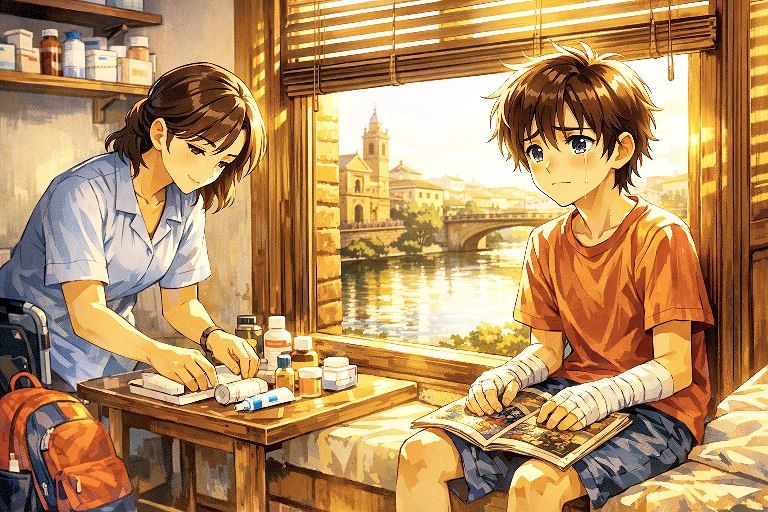
In the heart of Seville, in the neighborhood that breathes history and river curves, lived Marcos. He was twelve years old and had the gaze of someone who had learned to count time in small acts of care. His skin, fragile like butterfly wings, tore at the slightest friction; each day was a lesson in caution and endurance. Since he was a baby, the family’s routine revolved around dressings, bandages and ointments; those attentions, repeated to the point of fatigue, had woven the relationship between him and his mother, Aurora, into a blend of tenderness and constant vigilance. Aurora, a former nurse with patient hands, had turned their home into a sanctuary for treatment: a table with neatly arranged bottles, gauzes folded with precision, a chair that had learned to hold in the middle of the most painful gesture. Every morning she touched her son with the gentleness of someone who knows that strength can be a form of delicacy. Each dawn the light passed through the blinds and tore the room’s darkness; Aurora entered quietly and, with a voice that tried to be light so as not to translate the weight of fear into words, she would say: "Good morning, my love. It’s time for the treatment." Marcos opened his eyes and, although his hands trembled, he offered a smile. That smile was his shield; with it he tried to return calm to the one who was breaking at seeing him suffer. "Mom, today I’ll go to school after the treatment. I want to see Mateo," Marcos would say with a mix of desire and calculation: school was a territory he wanted to inhabit, but only within the limits his body allowed. Aurora, while unfolding gauzes and applying ointments, answered with the contained tenderness she had long learned: "You know it breaks my heart to see you in pain, but you are strong. We’ll do it slowly." Her hands moved with precision; each bandage was a promise. Marcos, who did not want to burden his mother’s anguish, asked in a voice that sought normalcy: "Promise me you’ll try not to cry in front of me." "Promise," Aurora replied, and the two words floated like a pact in the room. The treatment was an hour of painful rituals: dressings removed leaving marks, ointments that stung when applied to open wounds, and the held breath of both as the scene repeated without notable variation. Marcos endured the pain looking toward the window, where the schoolyard was sketched like a distant landscape of freedom. School was, for him, a mix of refuge and limit. Mateo, his best friend, knew the rules of care and assumed them with the naturalness of someone who believes friendship turns problems into something shared. In recess, Mateo waited with a comic book wrapped in plastic, a gesture that spoke to acceptance more than any word. "Marcos! I brought you a comic," Mateo announced with the overflowing joy of someone bringing a treasure. "Thank you. Shall we play at recess?" Marcos asked, measuring each movement, protecting his skin with the slowness of someone who manages contact. Mateo noticed the bandages and, with a child’s awareness not to impose, replied in a low voice: "If you want, we can sit in the shade. You don't have to run." "You’re enough," Marcos said. That simple phrase contained a deep truth: normality is not always measured by the intensity of activity, but by the company that makes the everyday less dangerous. Sergio, his teacher, then approached with a folder in his hand, attentive and serene. "I've spoken with the counselor. We’re going to adapt activities so you can participate without risk," Sergio said with professional determination and affection. "Thank you, sir. Sometimes I don’t want them to treat me differently," Marcos admitted with the sincerity of a child who fears the gaze that defines him. "Treating differently is not excluding. It’s caring for you so you can live," Sergio answered. In those words there was an educational proposal: inclusion understood as adjustment, not condescension. While everyday life sought balance between care and small victories, a letter written by Marcos took a path he hadn’t expected: it reached the hands of representatives in the European Parliament. What it recounted — a daily one-hour treatment, the impossibility of living without restrictions, the desire that therapies already approved in other countries be available in Spain — moved people and sparked response. Clara, a member of parliament, was one of those who listened and decided to raise her voice on behalf of that boy from Seville. In a special session, in front of microphones and cameras, she held his story as if holding Marcos’s hand in public: "I have heard from a boy in Seville who told me how his day begins: a one-hour treatment before other children have breakfast. He asked me that the treatments already approved in other countries also reach us here." The chamber filled with a contained murmur; the words resonated beyond the time of the speech. "If his skin were ours, for a single day, we would do everything to change things. This is not a request for privilege: it is a request for humanity," Clara added, appealing to a moral necessity that transcends administrative calculation. Her voice contained no theatricality, but the conviction of someone who saw in a child’s correspondence the opportunity to translate empathy into policy. At the same time, in laboratories and research centers, scientific voices reflected on the real possibility of intervention. Elena, a biomedical researcher, spent hours among results and protocols. For her, science was not only data: it was the promise of relieving lives if society decided to match will with resources. "This case shows that science can make a difference. We need political will so that advances reach those who need them," Elena told a colleague during a break, pointing out that findings were no longer enough without concrete decisions on funding and access. "The costs are enormous, but the decision is not only economic; it’s ethical," her colleague replied. "Exactly. We cannot measure life in money when we are talking about childhood," Elena concluded. Her words returned to the core of the debate: prioritizing resources in the face of human urgency. The community did not wait passively; it organized. Neighbors, friends and activists took to the neighborhood squares and streets with banners demanding healthcare justice: "Health for everyone," "Children first." The protest was peaceful but firm. Aurora, with a face hardened by sleepless nights and a voice sharpened by the need to speak, held her son’s hand under that public light that both exposes and protects. Mateo climbed onto an improvised podium and said with the memory of intact friendship: "Marcos is our friend. We’re not asking him to live without pain; we’re asking that he have access to the best medicine offers." His words were picked up by other voices and amplified by the whole neighborhood’s presence. Aurora, from the front, spoke with the force of someone who had witnessed every wound: "I will not fight systems; I will fight with my voice. Marcos deserves that opportunity." Weeks turned into months. Social mobilization, combined with political echo and scientific pressure, began to yield results in the form of formal debates and proposals. In a meeting room where decisions are made among papers and signatures, Clara presented a resolution aimed at speeding up access to therapies already approved in other European countries. It wasn’t the definitive solution — costs remained an obstacle and logistics a web of challenges — but it marked a different direction. "We have managed to have the admission of therapies that have demonstrated efficacy in Europe reviewed. This is not the end; it’s the start of a change," Clara declared aloud, and in that sentence a collective relief was felt, as if hope had finally found a door with hinges. Aurora, eyes wet and gratitude written in a smile she no longer tried to hide, hugged Marcos with the strength of someone who had seen words turn into action. "You did well to tell your day to those who could listen," she told him, emotion held but visible. "If my skin were yours, would you do the same?" Marcos asked with the innocence of someone seeking confirmation that empathy will not be fleeting. "We did. And we will keep doing it," Clara replied, taking the boy’s hand in a gesture that sought to close the distance between politics and affection. Months later, in the same room where so many mornings had repeated like a ritual, the light returned the same way, but now new papers lay on the table: signs that a novel treatment might arrive, access plans, lists of protocols and administrative steps already initiated. The treatment remained tough; ointments still burned and bandages still left maps on the skin, but the horizon had changed. Marcos, with the calm that the possibility of an alternative brings, opened the comic Mateo had given him and said in a low voice: "It’s not just a treatment... it’s that at last we feel someone is listening to us." Aurora looked at him as one who reorganizes priorities and answered with the certainty that collective struggle gave her: "And so long as there are voices that do not stay silent, the promise of a better life will be possible." Thus, in a neighborhood of Seville, the life of one boy set the pulse of a community and set processes in motion that went beyond the individual: Marcos’s story did not end in an instant cure, but showed that pain can be turned into a reason to change structures, that science needs the push of society and political will, and that hope, when accompanied by action, opens paths where there were only obstacles before. The End. Source of the images. Image created with Bing.
No comments yet