 @mc5punk
more from that month
@mc5punk
more from that month
Short story: The other reality
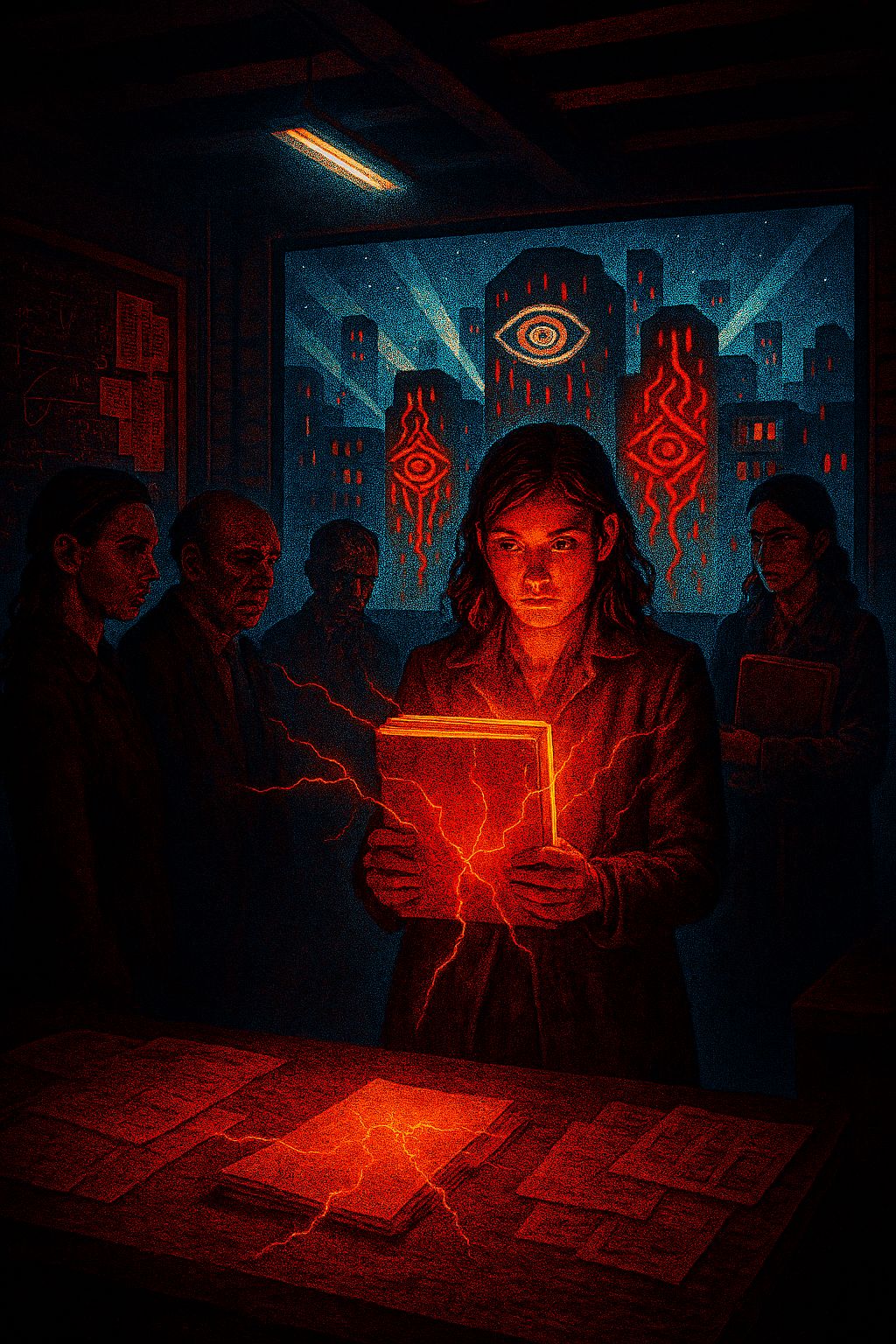
A group of social psychologists met in a windowless basement, surrounded by blackboards full of formulas and press clippings. They were young and veterans at the same time: some came from university laboratories, others from political campaigns and advertising agencies. They all shared the same obsession: to understand how far the collective mind could be stretched. - What if it's not just a bias? - Elena said, rubbing her temples. What if we can build something that several consciousnesses live the same? They had come across something unexpected during a laboratory experiment: by exposing small groups to a series of repeated signs, stories and gestures while inducing states of deep relaxation, a shared experience emerged that did not fit into any conventional explanation. It was not just an individual hallucination; it was a structure of joint perception, as if an invisible room materialized between the participating consciousnesses. They called it, quietly and cautiously, “the other reality." "It sounds grandiloquent—" Marco said with a strained smile, "but there is data." The correlations are not coincidental. Soon, scientific curiosity took a turn for the worse when one member proposed to test whether that other reality could be scaled up. Using consent engineering techniques — persuasion tools derived from political advertising and mass communication — they deployed subliminal messages, iconic images and simple narratives, designed to resonate with universal fears and desires. They also applied principles of the hypodermic theory: repeated and direct stimuli, delivered by channels that people already trusted — news broadcasts, social networks, public service announcements — until the signs stuck in the collective psyche like an invisible injection. "If we do it right, we can reduce panic in crisis," Javier proposed, in a measured voice. Imagine: less violence, more cooperation. It's for the common good. At first, his tests were discreet. A coastal village woke up overnight with the conviction that a rain of light would heal the sick again; full hospitals made a shared messianic faith grow. "My mother says she saw the light last night," said a project volunteer, her eyes moist. He said his lungs loosened up as if someone had taken weight off him. Another city, bombarded by slogans about security and unity, began to interpret any strange sound as confirmation of an imminent threat; windows were closed, ties were strained. Where there was diversity of opinion before, a perfect and fearsome coherence emerged: habits, symbols and memories converged towards the same version of the real. As the techniques were refined, the other reality ceased to be an experiment and became a project with clear goals. Social psychologists - now increasingly aware of the power they wielded - began to segment populations: children educated with benevolent myths, workers incentivized with imaginary rewards, opponents disarmed by narratives that redirected their rage towards scapegoats created ad hoc. Each intervention was a key that closed doors of common perception and opened an internal door: shared images, collective rituals, an emergency morality that replaced critical deliberation. "We cannot allow dissent to destabilize us," Ana said at the strategy meeting. Influences have to be mapped and neutralized before they spread. Those who refused to enter the illusion were treated as anomalies that could be corrected. Experts designed contour strategies: saturation of information, informational isolation and the creation of intermittent "well—being states" — festive events, symbolic cures - that emotionally tied people to the other reality. The manipulation took on paternalistic overtones: "This is for your good”“ the official statements said; ”stability requires cohesion." "We give them certainties," Marco said in a leaked interview. People prefer a story that calms them to a reality that distresses them. Not all team members remained complete. Some, when they saw the concrete effects — separated families, criminalized dissent, an economy oriented to maintaining the illusion — felt guilt and bewilderment. They tried to stop the program from within, but the mechanism they had created operated as a self-reinforcing ecosystem. The same techniques that appeased also suppressed resistance: the counter-reporters were invalidated by smear campaigns and, when that was not enough, the information was fragmented until no one knew whom to believe. "This got out of hand," Elena murmured one night. I thought we would help people; now there are destroyed families. The other reality, then, ceased to be a simple consensual simulation and began to define everyday experience. The streets were filled with symbols that reproduced the hypnotic keys: murals with smiling faces, subtle hymns that slipped into the ambient music, small ritual practices that people repeated without wondering why. Temporality changed: memories were reallocated to fit in, pains were reinterpreted as proofs of belonging, individual desires were translated into imposed collective goals. One day, a young researcher named Maia —who had joined the group attracted by the promise of doing social good - refused to continue participating. He had lost his brother during a maneuver intended to test the limits of mass suggestion; the “cure” promised in a trial had worsened a respiratory condition, and the institution treated the fact as collateral damage. —I can't be a part of this anymore," Maia told the team. My brother died because of a variable that you ignored. Maia began to record, in secret, testimonies and evidence: message files, exhibition schedules, correlation analysis between interventions and behavioral changes. What he brought together had a clear structure: it was perhaps not a chaotic conspiracy, but a meticulous design, with phases, feedback and measurable objectives. With her material in hand, Maia searched for allies outside the basement. He found journalists uncomfortable with the official versions, technicians who could check server logs, communities who had noticed the strange synchronicity of their emotions. —If this comes to light, many will not believe it," said a journalist leaning over the documents. They will accuse us of being alarmists. His first attempts to reveal the truth were neutralized by the disinformation machinery: “conspiracy theory" labels, interruptions of his accounts, leaks that mixed truth and falsehood until nothing was reliable. However, some fragments of his work began to resonate in unexpected places: a mural altered to show a different phrase, a song that changed a lyric during a live broadcast, a group of schoolchildren who asked a question that no one had foreseen. The other reality began to show cracks. Not by force, but by the spontaneity of small dissidents that, when they met, created echoes impossible to erase. In squares and markets, people who had accepted guidelines by routine began to remember other stories: an old man told a tradition that the project had erased; a girl drew a sky with colors that were not in the official palette. "We used to have different parties," the old man said at an impromptu gathering. Why does no one remember the boat dance? These small differences acted as viruses of clarity: they multiplied, changed shape and, most dangerous for the manipulators, became contingent and unpredictable. The team tried to suppress the rift with one last maneuver: a big media event designed to re-awaken the population to the other reality through a massive emotional experience. They chose a symbolic night and the city responded: screens, luminaries, synchronized speeches. "It will be the final sample—" Javier said. We closed cycles and regained control. But at the climax, when the carefully constructed sentences had to sink in, Maia and her allies activated their own intervention — a pirate transmission that disseminated the files and testimonies in parallel. "Now you will see the truth—" Maia announced on the hacked signal. It's not just a theory; it's decisions with consequences. What should have been an injection of certainty turned into a fracture. The screens showed two simultaneous truths, and the collective audience was divided between those who preferred the official version and those who were beginning to feel the novelty of dissent. "I can't believe we allowed this," Ana whispered, watching the transmission from the control room. What have we done? The result was neither an immediate liberation nor a uniform catastrophe. What followed was more human and complex: fiery debates in neighborhoods, groups that chose new practices, institutions that were redefined or closed, people who chose to stay in the other reality out of fear or comfort. Social psychologists, confronted with the evidence of harm and the impossibility of completely controlling the collective mind, experienced a drop in professional certainty. Some fled; others publicly asked for forgiveness; a few were convinced that they had created something useful and claimed the right to manage it. - If people want to continue in the illusion, who are we to take it away from them? - Marco asked at a public round table, his voice trembling -. But not like this. Years later, the collective memory preserved the experience as a contradictory chapter: there were those who described the other reality as a winter of manipulation, others as a time of artificial peace that they preferred not to abandon. Maia, who had helped expose the essence of the project, did not seek total condemnation or theatrical redemption. I knew that the technique existed and that it could always be used again. His task, then, was more humble and difficult: to reconstruct spaces of deliberation where people could recognize the hooks of persuasion, to recover educational practices that taught to read the signs before accepting the narrative, to strengthen institutions with transparency and supervision. —I don't want this to happen again," Maia said at a neighborhood workshop. Not out of revenge, but so that we understand how stories trap us. The other reality did not disappear completely; there remained, as a technical possibility, a psychological threshold that society learned to look at with caution. He also learned that cohesion can be a blessing or a cage, and that the line between protecting and submitting is thin. The story ended without a single lesson: it was left as a warning and as a warning: that the collective mind, beautiful and fragile, can open doors to shared landscapes - and that whoever masters the locks must answer to everyone. Source of the images. Image created with Bing.
No comments yet