 @mc5punk
more from that month
@mc5punk
more from that month
Short story: Lúmen in Silence(Chapters I and II)
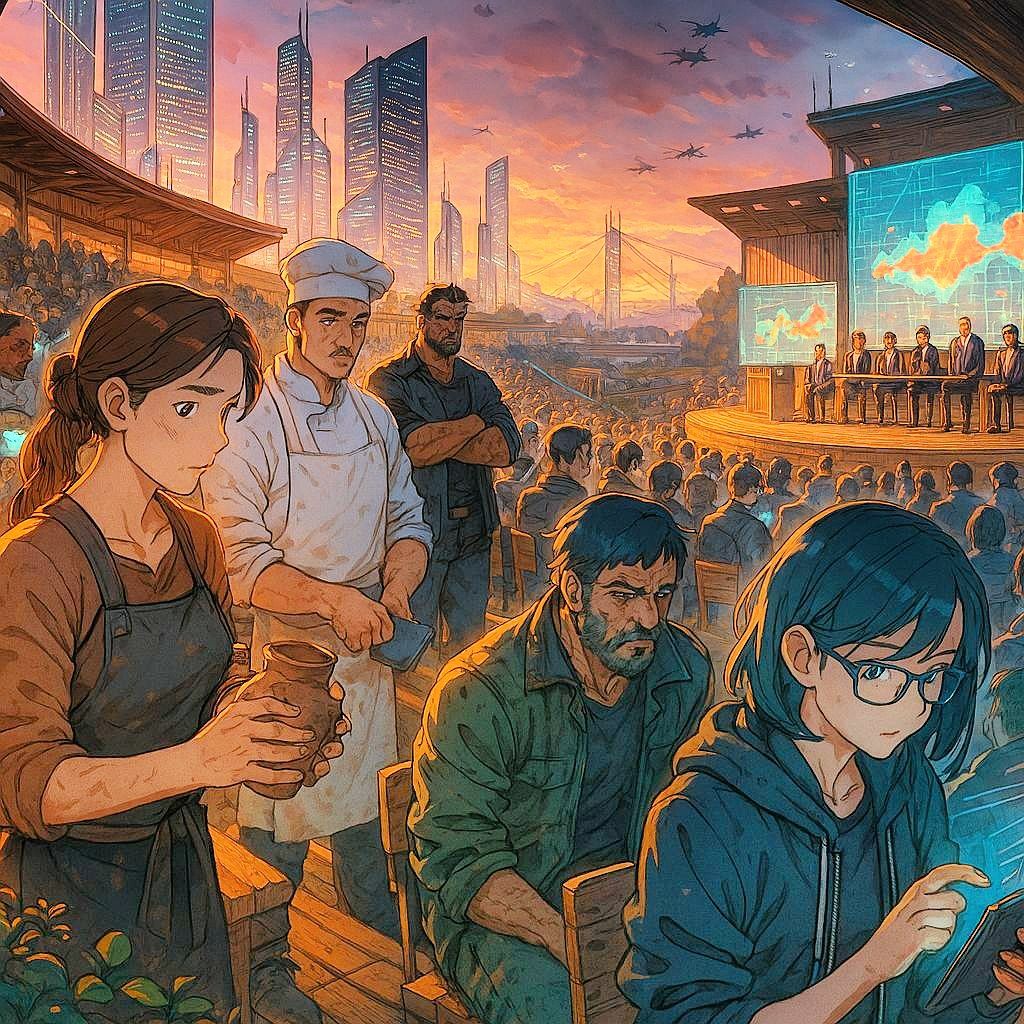
Chapter I — Pulse of the City Solera awoke like a colossal organism: not merely a sum of steel and glass, but a living machine with its own breath, rhythms, and signals that set the day for millions. At first light, the skyscrapers —hyper-skins of smart glass draped with solar panels and crowned by spines of antennas— began to ignite a constellation of indicators. Screens and lines of light blinked production figures, efficiency percentages, and delivery routes; numbers that served as a public heartbeat, visible from the main avenue to the micro-homes on the outskirts. The avenues flowed in an almost choreographic fashion: autonomous vehicles communicating with surgical punctuality, modulating speed and spacing like dancers in a continuous rehearsal. In the air, swarms of drones traced precise parallels, mapping terrain and overflying agricultural plots that, from above, revealed geometric mazes of interconnected crops—ordered like a piece of kinetic art. The promise of automation had been fulfilled in visible terms: constant production, basic services whose marginal cost seemed to dissolve almost to zero, and a logistics network that moved goods and data with a fluidity chroniclers compared to the pulse of ancient metropolises, but without their habitual interruptions. In official reports, extreme poverty was an almost archaeological label, a term that tables reduced to statistically insignificant numbers. Yet beneath that polished exterior of efficiency, Solera showed taut seams: agreements signed in closed rooms, algorithmic decisions formulated by opaque black boxes, and nodes of power camouflaged behind promises of optimization. What in public discourse was justified as “efficiency” often concealed concentrated interests. Irene opened her eyes to the building’s usual murmur—a domestic sound of urban infrastructure: valves and recycling tubes releasing treated water in silence, panels readjusting their angle with a mechanical whisper—and a subtle ping on her wrist reminding her of the ceramics class at the Aurora Community Center. Another notification, more solemn, indicated the time of the afternoon public hearing of the Agency for Autonomy Oversight (ASA): a forum where, periodically, regulations governing the autonomous systems that ran the city were debated. She dressed with the same naturalness one checks the weather: routine, and at the same time, convocatory. From her window, Lumen Park spread out like an amphitheater of everyday life: masses of people intermixed, a mosaic of generations and trades. Children launched small educational aircraft following programmed routes; young artists rehearsed synchronized dance in sensory suits that projected forms into the air; elders conversed on solar benches, trading memories and practical solutions. The basic income—this universal safety net covering housing, health, and energy—meant most did not work out of urgent need. Irene was no exception: her material subsistence was handled by the city’s automatic ledger. Nevertheless, material calm did not erase the prickling concerns in her mind, those questions about control, meaning, and accountability. “Ready for the institutional circus?” Mateo asked from the kitchen, with the familiarity of someone who has learned to measure the day by the house’s sounds. “It’s not the circus I’m worried about,” Irene replied as she took a cup of tea and, with fingers still stained from clay, set aside a half-formed ceramic piece. “What worries me is that they call something a ‘failure’ when it’s simply following rules we never saw.” Mateo set down his cup, placed both hands on the table, and looked at her with a seriousness tempered by years of craft. He had been a chef when restaurants thrummed with hands and conversation; mass automation transformed that work. Now he led cooking workshops for elders and designed sensory experiences for communities—a professional reconversion that let him keep his taste for creation. His hands—still marked with flour—spoke of a past of touch and patience. “Machines mimic us,” Mateo said calmly. “They don’t perform miracles: they replicate the data and directives we feed them. If we give them biased information, if we give them poorly calibrated objectives or hidden privileges, what they return are decisions that reflect those same biases. It’s not a failure of soul, it’s a mirror of our worst habits coded in.” That tension around technological mirrors had names and faces in the corridors of power. In executive halls and corporate filings, conglomerates like HelioDynamics and AtlasNexo stood out: multi-industry giants managing energy networks, logistics platforms, and, crucially, the AI models that coordinated distribution and resource control. Their ledgers showed visible tax contributions; their logos adorned community projects. At the same time they funded laboratories of legitimation, research centers, and consultancies that drafted public policies and much of the language used to justify automation. In neighborhood assemblies and community cafés another persistent rumor prevailed: the discrepancy between their accounting transparency and the confidential contracts with governments, the clauses not discussed in open forums, and the operational rules decided behind closed doors. That gap between the luminous surface and the technical shadows was the backdrop for many civic conversations—the fracture where Irene’s and her neighbors’ concerns took hold. Chapter II — Hearing and Cracks The Lumen amphitheater smelled of recycled wood, polished resin, and the quiet ferment of public conversation: the scent of shared coffee, pamphlets printed on regenerated paper, and the electric expectation of people who knew something in the city was at stake that afternoon. The semicircular seats were full; in the aisles moved people wearing cooperative badges, students with digital notebooks, and technicians with tablets strapped to their wrists. On stage, lined up under careful lighting, sat panels from the Agency for Autonomy Oversight (ASA), technicians dispatched by HelioDynamics, and spokespeople from various cooperatives and community centers: a deliberately plural representation that nonetheless masked asymmetries of voice and resources. Networked cameras broadcast the debate to screens across the plaza, and live comments fed citizen channels buzzing with opinions and memes. Irene scanned the crowd and recognized familiar faces that gave the hearing a personal echo: Lucho, an ex-mechanic now coordinating the Robotic Repair Cooperative, hands hardened by too many emergencies; Noa, a programmer leading the community data-banking project, holding her tablet like an extension of collective will; Amina, her neighbor and urban biologist, whose steady voice had driven rooftop and plaza ecological recovery projects—this morning she wore a small packet of seeds on her jacket to give away. Nearby, young activists adjusted holographic projections meant to starkly display the geography of the collapse in specific districts. The moderator, Sefa—a woman of tempered radio voice who had moved from community broadcasting to running public hearings—tapped the podium calmly to begin. “Thank you for coming,” she said, measuring each word. “Today we will hear technical presentations, testimonies, and proposals. Let transparency be the rule and listening the priority.” The HelioDynamics representative spoke with the practiced confidence of a rehearsed presentation: he displayed animated timelines, prioritization graphs, and heat maps attempting to explain the recent “failure” in the distribution network. His briefing detailed forty hours of delays, omitted routes, temporarily collapsed supply nodes, and load spikes that exceeded expected buffers. The slides—neat, branded—showed flows, dependencies, and probabilities: decision matrices that, looked at technically, described an improbable concatenation of parameters. His tone was neutral, just measured enough to inspire trust. But behind the figures, statistics could not name what neighborhoods already knew: the queues in the plazas, bread that never arrived at a community bakery, the heating that failed in homes with drained batteries—the tangible experience of waiting and vulnerability. In the audience, those silences swelled into an audible murmur. Lucho rose, thumb pressed to his temple in a gesture that seemed to mimic engine fatigue, and broke the technical calm. “It wasn’t an arbitrary concatenation,” he said gravely. “It was a logic that reproduced inequalities. The models prioritized routes with active contracts, shopping centers, and zones with high economic recovery indices. What place did they leave for our plazas, for community health centers, for peripheral households that don’t have contracts with private distributors?” A murmur rippled into mild boos and nods of agreement. In the front rows, cooperative representatives took notes; some youths held up placards with QR codes linking to community maps marking failure points. The AtlasNexo representative—immaculately dressed and strategically calm from answering hostile audiences before—replied from her lectern. “Models reflect the data,” she explained. “If the data shows inequality, the outputs will show it too. The solution is to improve the data, expand coverage, and optimize parameters. It’s not bad intent; it’s a matter of informational quality.” Her technical, elegant answer aimed to close the debate with a recipe for incremental correction. But the simplicity of the argument exposed a question floating in the room: who decides which data counts as valid, who pays for the “quality” of sources, and who actually rescues less profitable sectors? Noa, visibly tense—her left thumb trembling over the tablet as if the tremor were equal parts indignation and weary persistence—stepped to the microphone. She had spent sleepless nights compiling local records and alternative datasets. “And who chooses which data gets ‘improved’?” she asked, part challenge, part plea. “You? We need data sovereignty, model transparency, and independent audits. We don’t want decisions that affect people’s lives to become black boxes no one can inspect. If governance limits itself to improving inputs without democratizing the process, we’ll only reproduce the same exclusionary logic.” Her words drew short applause and a hopeful murmur: voices asking not just for technical fixes but for genuine participation in defining parameters, gathering data, and policing algorithms. In the crowd, older attendees nodded with tired faces; activists projected a list of demands on the side walls: open access to decision logs, citizen audits, and contractual clauses granting social-priority dispatching. Irene felt the room split in two—not only along ideological lines but by lived experience: those who trusted engineering and the promise of optimization, believing the problem lay in tuning, and those demanding citizen control and structural guarantees so automation would not replicate exclusion. Outside, the city was not quiet: plazas and avenues pulsed with protests mixing creative anger and practical organization. Holograms displayed first-person testimonies from undersupplied neighborhoods; improvised workshops proposed community logistics nodes with electric bikes and cooperative delivery protocols; placards denounced commodification of population segments and warned against selling data to advertisers. As the hearing continued, subtler nuances appeared. A young HelioDynamics technician acknowledged the need to review training dataset biases and proposed creating mixed panels including community representatives to curate and collect data. An NGO spokesperson reframed the debate environmentally, stressing that contract-based prioritization had also exposed ecological risk areas where supply failures threatened green infrastructure and biological corridors. Concrete proposals emerged: community logistics nodes, “social-priority” clauses embedded in dispatch algorithms, contingency funds for emergencies in peripheral neighborhoods, and public repositories of algorithmic decision records. Yet each proposal encountered material and legal limits: who funds those nodes, how to verify authorship of citizen-contributed data, what legal weight an independent audit holds against private contracts. The cracks became less metaphorical and more administrative: contradictory interests seeped into them, impossible implementation timelines, technical debates about latency and replicability, and, above all, the political urgency to redefine the kind of city they intended to build. When the session ended, some left convinced progress had been made; others felt the real decisions would still be made behind closed doors. Irene walked out of the amphitheater with a dossier of proposals and notes in her hand, and with the mixed sensation—half hope, half unease—that the real fight was not merely to improve models but to ensure the rules governing those models were written in plain sight for everyone to see. Source of the images. Image created with Bing.
No comments yet