 @mc5punk
Short story: The Necrópolis Window
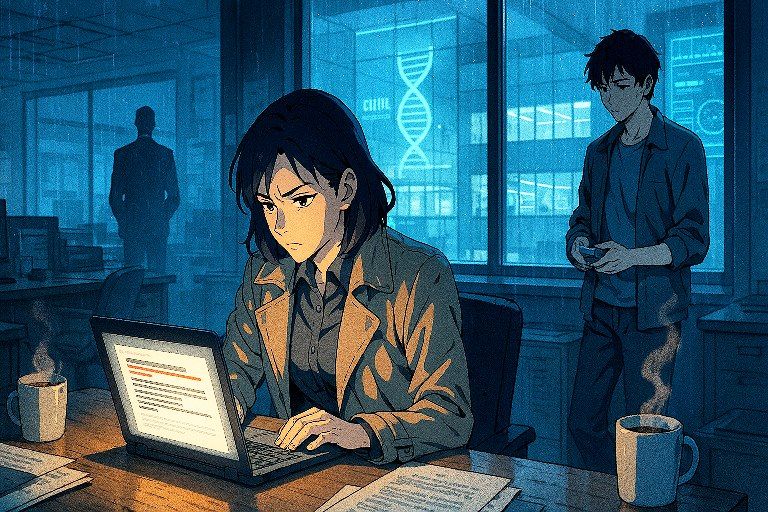
The leak arrived as an anonymous email to La Aurora’s newsroom on a cold, rainy morning. The scent of paper and freshly brewed coffee mixed with the damp clinging to the windows. Marina Solís opened the attached file with trembling hands: a technical report with numbers and a reference to a high-impact scientific publication. Lines flashed across her screen like a verdict: variants in CHRNB3 associated with a reduction in daily cigarette consumption between 21% and 78%; an initial analysis covering nearly 38,000 smokers and validation in more than 300,000 people from Europe and Asia. Amid the text, a section had been redacted, as if someone had tried to strip the study of a vital heartbeat: "secondary analysis — moderate users vs. severe dependence." Marina felt that the story was more than just a scoop. It was a portal: the promise of a treatment capable of changing the fate of millions and, at the same time, the possibility that that discovery could be turned into an object of profit, exclusion, and manipulation. Her profession told her to go beyond the headline; her conviction pushed her to find the study’s author. The author himself received her in an office at the Necrópolis Institute of Genetics that smelled of disinfectant and static electricity. Elías Roque, director of research, was a middle-aged man with the look of someone who had spent sleepless nights decoding sequences and dreaming of solutions. He led Marina down corridors lit by screens, surrounded by data matrices that shone like star maps. In a measured voice he told her what she feared: the truth no longer belonged solely to the scientists. Copies of the study had left the institute, and Helios Biotech, a pharmaceutical consortium with capital across multiple markets, had access to the key files. Their plan: to patent a molecule capable of modulating the gene’s expression and position it as a revolutionary drug against nicotine dependence. Elías explained coldly that the CHRNB3 variants did not change the likelihood of starting to smoke; what they did was modulate daily consumption. For some, that statistical difference meant fewer cigarettes per day; for industry, a profitable pharmacological target. For Elías, however, the dilemma was moral: allowing a molecule developed from data from vulnerable populations to become an exclusive product without addressing insufficient consents or the potential discrimination of those lacking the variant would be a betrayal of responsible research. Álex Duarte entered the story as a common face: a former smoker, a programmer, raised in a neighborhood where smoking began as a rite at an early age. His voice carried the mix of disbelief and relief of someone who discovers part of their behavior has roots in biology. "I started at fourteen," he said; the number was not just an anecdote, it was the thread that connected him to the statistic. For him, the finding meant two things at once: on one hand, the real possibility of treatments that might have made quitting easier; on the other, the fear that genetics could become a cause for exclusion. He imagined insurers denying coverage to those without the protective variant, outrageously priced treatments available only to those who could pay, or market segmentation based on genetic profiles. That scenario put him on guard: science, in the wrong hands, could turn vulnerability into merchandise. While the scientists and affected people sorted their positions, strategies were being woven in boardrooms and closed bars. Mr. Kade, the executive face of Helios Biotech, spoke with the calm of someone who knows the value of patience and the price of exclusivity. In his world, the CHRNB3 variants were intangible assets with the potential to generate millions. "Society will buy the cure if we sell it as a social good," he said in a closed meeting. The argument leaked strategy: a premium initial launch, control of information, and later expansion into emerging markets. They discussed buying consciences, offering positions to key scientists, and silencing those who stood in the way. For them, ethics was negotiable; opportunity was not. From across the ocean, Dr. Hannelore Kwon watched with alarm. Hannelore, a clinical researcher trained in European settings, scrutinized the data she had received and detected irregularities that could not be ignored: informed consents that did not explain commercial uses, vulnerable populations not properly informed, and subsamples whose provenance was ambiguous in terms of explicit permissions. Her messages to Marina and Elías carried urgency. She accepted the statistical robustness of the finding but understood that scientific solidity did not exempt one from ethical responsibilities. "We cannot commercialize without reparations," she wrote in an encrypted email; in other words, science required justice for participants first. Pressure escalated when a judicial order — or the threat of one — arrived at the newsroom. Inspector Ramos appeared with a warrant seeking to seize equipment and files, alleging an investigation into data falsification. Editor Sofía Vega refused to hand over material without a clear court order: the corporation’s invisible hand seemed to exert indirect influence. La Aurora’s lawyers mobilized while Marina weighed the stakes: if the documents vanished, the story would be buried; if they were released, many lives would be exposed and the architecture of power shaken. Faced with escalating threats and the possibility of co-optation, Marina and Elías decided that total transparency was their only defense. They gathered what they could: raw data, emails with incomplete consents, internal notes, and testimonies. Hannelore added the final piece from Europe and Álex agreed to make his experience public. Elías drafted a report that not only described the finding — a reduction in consumption between 21% and 78% associated with CHRNB3 variants, replicated in cohorts across Europe and Asia — but also documented ethical gaps and risks of exploitation. Marina worked through nights on a series of reports that combined journalistic rigor with the moral urgency of a revelation that could reconfigure entire markets. Publication triggered immediate reactions. Protests broke out: patient advocacy groups, organizations defending ethical biomedical research, and citizens worried about the commodification of genetic data took to the streets. Social media ignited with debates ranging from the possibility of new drugs to concerns about using genetics as a lever for exclusion. In the city square, Álex took a microphone and, with a steady voice, said what he had felt many nights: "What’s in my DNA is not a product." His line landed like a moral lash against those who argued innovation should meet no restraint beyond the market. Helios Biotech tried to control the narrative. In public interviews, Mr. Kade claimed the company only sought to "save lives" and that its intentions were altruistic. His words rang hollow against the disclosed evidence: incomplete consents, internal emails outlining commercial strategies, and a network of influence aimed at regulatory capture. Political and social pressure pushed for public hearings where scientists, industry representatives, activists, and regulators debated the ethical edge of the finding. The public hearing was a theater where arguments and responsibilities were measured. Elías presented the data with a firm, precise voice, outlining the methodology: large cohorts, replications in diverse populations, robust statistical analysis. He emphasized that the variants did not prevent initiation of smoking but modulated its intensity; thus the finding opened a promising pharmacological path. Yet his intervention did not dwell solely on potential efficacy: he produced documentary evidence of deficient consents and the omission of subgroups with adverse responses. He showed that science, lacking regulatory frameworks and fair agreements with communities, could become the instrumental arm of ethically questionable business. Consequences were gradual and complex. There were no instant solutions nor absolute winners. Media exposure and legal scrutiny forced the reconfiguration of data banks and consent protocols: clear clauses on commercial use were required, community oversight mechanisms were established, and benefit-sharing agreements with participants became mandatory. Investigations were opened against Helios Biotech for alleged coercive practices and attempts to influence regulatory processes. Its executives faced public and private questioning that eroded reputation and halted ambitious monopolization plans. Elías resigned from industry advisory boards and committees that he judged compromised by conflicts of interest. He chose to lead a public genomic data consortium that pledged ethical principles: transparency, informed consent, community governance, and equitable access to therapeutic benefits. Marina was recognized for her journalistic work; she received awards and praise, but she also understood that recognition did not erase the sense that the battle had only just begun. Science would continue to open windows, and society had to remain vigilant about who crossed them and for what purpose. In the city, Álex found his place in tobacco education campaigns. He gave talks in schools, participated in community forums, and worked with support groups for addiction. One afternoon, he paused on a bridge and watched the flow of people who had no idea that somewhere in the genome a statistic existed that might have changed their lives. He had been smoke-free for years. He offered Marina words of thanks: not only for bringing the truth to light but for returning the community the power to decide. Marina, tired but satisfied, knew the report had not closed chapters but opened deeper debates. The window the research had opened onto cigarette addiction allowed glimpses of potentially transformative drugs, but it also exposed the fragility of moral frameworks in the face of market drive. The lesson of the leak was twofold: genetics offered powerful tools to relieve human suffering, but applying those tools required governance that placed dignity and equity above profit. The secret of addiction stopped being a secret. It became public, imperfect, and contested. And although science continued its march, society learned to watch with suspicion anyone who tried to close the window with bills in their hands. The story did not end in total victory nor in an irrevocable defeat: it was a wake-up call that when biology enters the market, ethics must assume the role of guardian. Source of the images. Image created with Bing.
No comments yet