 @mc5punk
more from that month
@mc5punk
more from that month
Short story: The island of voices
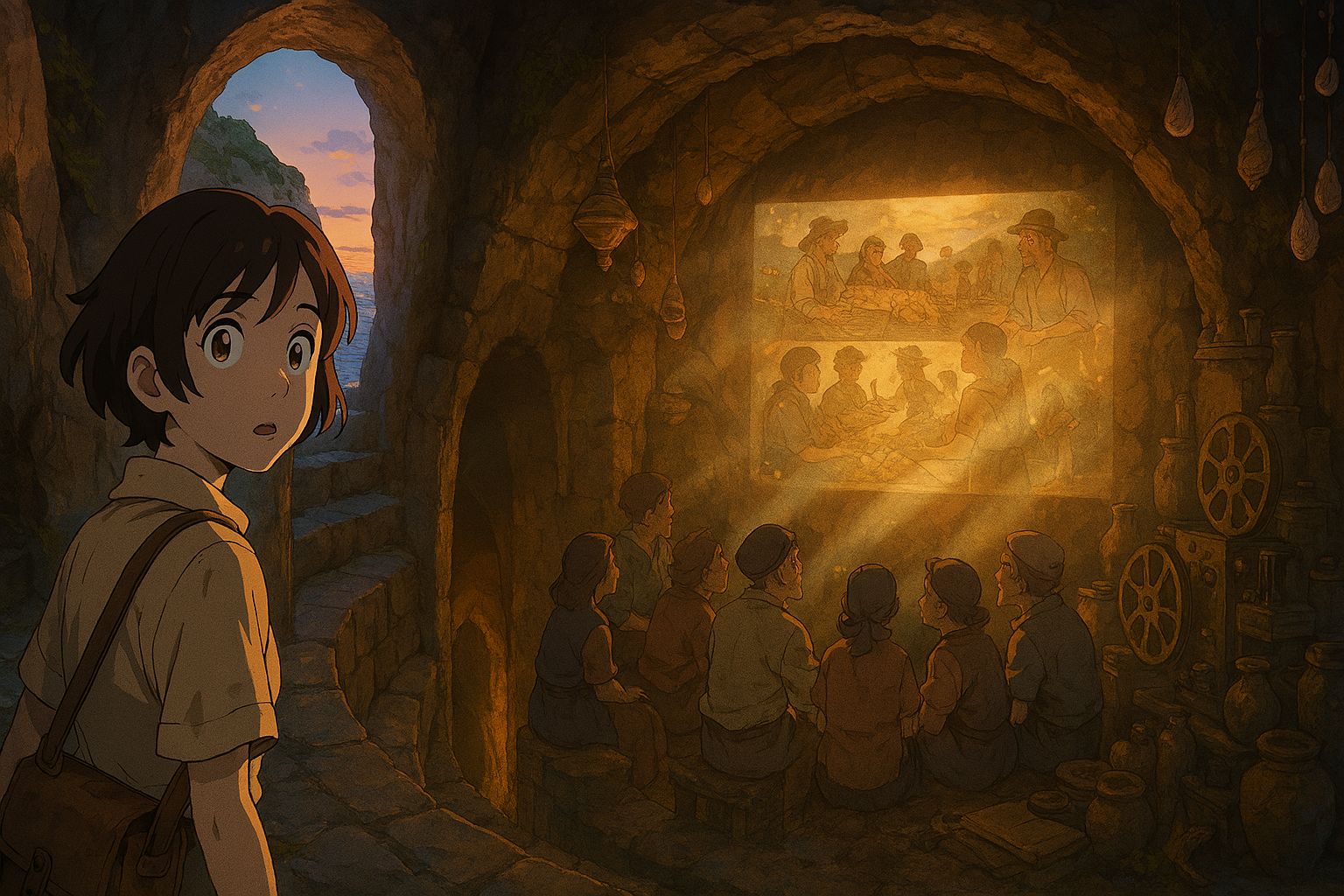
The tide had receded almost a kilometer when Sofia saw the crack for the first time. At first glance it was just another crack in the coast: lined with algae, filtered of salt and with moisture stuck to the stones. However, in the dull light of twilight he discovered a trace carved into the edge of the rock, a series of lines that intertwined like sheet music. Something in that sign attracted her with a force that she did not know how to refuse. She left her bag on the shore, walked on the cold sand and climbed through the crack without thinking too much about the time or the return. "Don't be late," her landlord had told her that afternoon, with the habit of one who knows the vagaries of the sea. The tide is rising fast around here. "I'll be back before dawn," Sofia replied, more to convince herself than to reassure her. The entrance led to some stone stairs that plunged into the gloom. Each step was polished by years of feet that did not always have the same intention. The air, moist and fresh, brought with it ancient smells: wax, resin and old ink; a murmur that seemed torn from forgotten songs accompanied his steps. In the background, a rusty nailed wooden door opened into a wide, rectangular chamber, the height of which made it possible to accommodate a crowd sitting in a circle. The walls were lined with objects that spoke of a life not read about in books: conch shells with finger marks, scrolls rolled up and tied with strands, daggers whose steel was inlaid with symbols and, in one corner, a collection of brass projectors with patina. Sofia moved forward carefully. His fingers brushed one of the projectors. The mechanism, perhaps because of the gesture, was activated with a soft snap. An old tape began to turn; a warm light cast on the stone in the background a sequence of images and sounds. They were not cold photographs: they were living stories — faces in the foreground, mouths singing verses, hands working the land. The screening told about everyday events: a shared harvest, a ceremony where the community sealed agreements with songs, the resolution of a water dispute through a pact narrated around a bonfire. Each scene brought with it layers: gestures, silences, the response of the listeners. When she heard the door behind her open, Sofia turned around. A group of people had entered in silence. Their faces were variegated: young people, old people with deep wrinkles, calloused hands of those who worked the sea or the land. The first to approach was a woman with a firm voice and clear eyes who seemed to know the signs of curiosity. —We've been waiting for you—" he said with a mixture of surprise and reassurance. The crack does not always bring those who are looking for tourism. Sofia felt, for a second, that her heart was signing up to the rhythm of the projector. —I've never heard of you guys," he stammered. Who are they? "We call ourselves the Custodians—" the woman replied. Guardians, if you prefer. We keep stories that do not fit in a single file. An old man stepped forward and added, in a voice that seemed to have been memorized for centuries: -The history that is taught in universities is useful, but incomplete. We take care of multiplying it and taking care of the ways in which it stays alive. She explained to them that she was an editor in the capital and that she had come to the island looking for silence and distance. She had been, in her work, the link that turned manuscripts into unique, polished and saleable versions; the monotonality of those official truths had exhausted her. He told them about his certainty with questions and the emptiness he felt when reading stories that seemed to close with a definitive point. —We don't write dots here," one of the narrators said, smiling. We learned to leave commas. The chamber exhibited objects and techniques; the community kept reels, sheet music, chants and codes to assemble stories. It wasn't just about accumulating memory: there was a procedure for making a voice withstand time. “You learn to listen to it from the body”" explained a young man who handled a reel with expert hands. ”One does not reproduce the phrase, one lives it; one keeps the gesture, the breath, the way in which the word was offered." Thus, a song about a shared ration of fish in times of scarcity was not just the lyrics: it was the way of breaking bread, the look between the hands that conjured fairness, the way the audience responded in chorus. Sofia spent the first night awake, reading, listening, marveling. At dawn, when he went out to the beach, the light seemed different; the island had a different texture. She met Mateo, a local historian who had lived in the archipelago since childhood. Mateo had grown up with stories whispered by his grandmother and with rumors of tunnels. When the two began to compare notes, they realized that what she had found was not mere folklore: the projectors recorded social practices of conflict resolution, barter networks, migration patterns and women's agreements of autonomy that did not appear in official chronicles. "The stories here are not used to embellish the past," Mateo said as he unrolled a sheet music. They are survival manuals. Life in the Custodians' shelter was organized as a workshop. In the mornings they fixed projectors, restored tapes and transcribed rhythms; in the afternoons they practiced vocalization and rehearsed how to introduce a story into a community without stripping it of its context. Each gesture had a purpose: to explain, but above all to teach listening. The Custodians did not function with rigid hierarchies; their authority was competence. The older ones taught how to fit a fragment into their contextual network, the young ones worked on techniques to register tones and silences, and the older women transmitted ritual practices that held the stories in the body. The first external visitors were curious: anthropologists, students, documentarians. Many came looking for a find to justify on their resume; they left transformed. The experience of seeing the same scene narrated by several voices — a harvest, for example - forced listeners to abandon the expectation of a pure version and to assume the complexity of multiple intertwined interests. The oral transmission showed how the collective memory was woven with silences, intentional omissions, exaggerations and contradictory testimonies that, far from being invalidated, complemented each other. The notoriety, however, also caught the attention of those who had the most to lose. An influential publishing consortium, owner of catalogues and media space in the capital, looked at the island with trepidation. For them, the idea of history being polyphonic — and therefore difficult to pack into a canonical book — threatened their business: fewer certainties meant fewer sales of “the truths” signed by experts and more space for an industry of community stories that did not guarantee millionaire contracts. The first formal offer was on terms that the community knew well: money, promises of prestige and the possibility of “saving” the archive. But the salvation offered by the consortium involved turning fragments into isolated merchandise, destroying their contextual fabric. "If we sell everything, we will lose it," Sofia warned at the meeting where the proposal was discussed. They sell packaged certainties; they won't be able to resist complexity. "Open the window, not the door—" Mateo proposed. Teach them the method, let them learn to listen, but don't give them the possibility to tear off pieces and sell them. They decided to accept a controlled openness: to show the process, to offer the methodology, but to hide materials whose value lay precisely in their ability to be reproduced only within a network of practices. The inaugural public screening was organized in the central square of the island. The Custodians arranged fragments that showed the multiplicity of voices — the same harvest seen by farmers, by women weavers and by a traveler. There was no attempt to unify the narratives; the deliberate editing sought to make visible the conversation that was established between versions. The screening sparked a national movement of debates: the legitimacy of orality as a historical source was discussed in cafes, universities and radio programs. The attacks were immediate: "untidy folklore,“ some critics said; ”worthless anecdotes," others condemned in columns. But the Custodians responded with rigorous methodology: each file was accompanied by metadata that recorded who spoke, when, in what context and with what possible biases. The criteria for collating testimonies and for reconstructing sequences of events from multiple voices were made public. The tension escalated when the publishing consortium tried to buy exclusive rights. They offered considerable sums and a massive distribution plan. The offer was firmly rejected. What followed was a smear and pressure campaign. Partial leaks, malicious articles and, finally, acts of symbolic and physical violence. One morning, the municipal archive where digital replicas of the materials were kept was set on fire. The copies were lost in flames despite the redundancies. No one was injured, but the message was clear: there were interests determined to stop the opening. The wound was deep; the community understood that protection could not be limited to secrecy or resistance. A strategic rethinking was necessary: how to make history live through collective participation. The Custodians reinforced their method of distributed orality. They organized tours of villages and neighborhoods, teaching communities how to register their own versions, collate them and preserve them in decentralized networks. The principle was simple and ancient: if the voice is multiplied, it cannot be monopolized. The sessions became live workshops where the teaching consisted of passing on the story while explaining its context and its relationship with other versions. Songs, cast hymns, dramatizations and debate polls emerged as tools so that memory would not be reduced to digital copies susceptible to manipulation. Sofia acted as a bridge between the publishing world and community practice. He designed collaborative publication protocols that combined academic rigor with community ethics: texts accompanied by recordings, field notes, transcripts and markers that pointed out omissions and contradictions. Mateo delved deeper into field research, following the routes along which these stories circulated: trade roads, marriage routes, seasonal migrations. His maps did not draw borders, but connections. "Our task is not to replace files," Mateo said at a conference. It is to complement them. To show that the absence of a voice in books does not imply its non-existence. Some of the fiercest critics agreed to be invited to listening sessions. One of them, a reputable historian who had publicly declared that the Custodians were “a nostalgic spectacle,” presented himself with rigidity and distance. The main narrator asked her to remain silent during one session. When he finished, the man's voice was broken. He had heard a story about a barter network that had sustained a people during a drought, and in that story he had heard economic logics and social agreements that his written sources did not record. —I cannot deny that there is something here that my archives did not see—" the historian admitted, with a humility that surprised many. Orality offers us other types of evidence. Over time, the controversy settled into practices. Universities began to incorporate combined methods into their programs, recognizing the need to document and contextualize orality. Some publishing houses that initially rejected the proposal were approached to collaborate on projects that respected community principles. The island was transformed into a teaching center: workshops, seminars and artistic and academic residencies proliferated. It was not about turning the place into a tourist attraction; it was about keeping a living workshop where stories were practiced, discussed and renewed. Sofía and Mateo coordinated the first series of collective publications. They were not anthologies that aspired to a final truth; they were folders in which each testimony came with its context, with the voices that had said it, with its contradictions and with the questions that it opened. This format forced readers to participate: to doubt, to compare and to rethink certainties. The project gained recognition and, with it, the possibility of influencing more open publishing practices. The resistance still persisted: there were publishers who tried to reproduce fragments by taking them out of context, and certain circles of power continued to resent the loss of their interpretative monopoly. But the logic of multiplicity had already taken hold. New communities began to develop their living archives: workshops in neighborhoods, school projects where students collected local stories and presented them in mixed formats, story exchange networks that functioned as mutual verification communities. In the central square of the island, one summer evening, the Custodians organized a large screening that combined music, testimonies and dramatization. The screen showed a sequence: the harvest seen by different eyes, the pact sealed with songs, a marriage told by three different voices. The audience was moving in the seat, laughing, arguing, correcting. When the session ended, people did not applaud for the novelty: they applauded because they had learned something essential: history is not an inert object but a shared act. - Do you remember the crack? - Mateo asked, in a low voice, as they watched the square empty -. I remember it as the place where I learned to listen," Sofia replied. And also as the place where people started to repair their memory. The following years confirmed the careful openness that The Custodians had practiced. While the island did not change the world overnight, it created a network of practices that allowed history to be kept alive in multiple voices. Workshops in other regions emerged and were articulated in a network of local archives that shared protocols and learnings. The old interpretative monopoly lost ground to the practice of distributed memory. Sofia returned to the city sometimes, but her home had changed: it was the island, her voices and the job of listening. He learned to balance his editorial training with the humility of someone who recognizes that a sentence is not the whole of a life. Matthew continued to trace routes and theories, but from a perspective that valued both written and oral evidence. The Custodians grew, not as a static institution, but as a community that multiplied responsibilities: teaching, guarding and, above all, putting into practice the simplest and most difficult rule at the same time — listening with respect. In the last scene, the camera zooms away from the square illuminated by projections: young people tune instruments, old people hum old and new melodies, and old scores are mixed with invented rhythms. The crack in the rock is still there, inconspicuous, like an invitation. The story continues: not as a closed certainty, but as a fabric that is put back together every time someone decides, collectively, to tell. Source of the images. Image created with Bing.
No comments yet