 @mc5punk
Short story: The Dragon of the Night: Cloth, Drums, and Betrayal
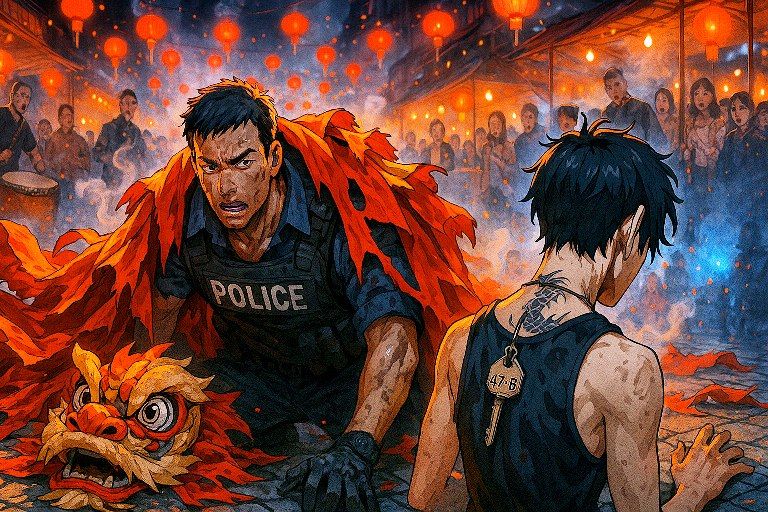
The night of Chinese New Year descended over Bangkok like a burning curtain. Red lanterns hung from eaves and stalls, casting long shadows across the cobblestones. Drums marked a primitive heartbeat that seeped into the city’s lungs; the smell of incense and fried food mixed with the river’s humidity. The plaza in front of the temple had become a sea of faces: families, vendors, tourists and worshippers forming layers of expectation around the central aisle where the dragon dance would pass. Under the painted scale fabric, Agent Somchai felt the heat of the human bodies holding him up. His hands, perfectly synchronized with his partner who carried the head, gripped the frame as if his life depended on it—because at that moment it did. A tiny earpiece transmitted Inspector Naruemon’s instructions: “Two steps, turn. Keep the line. Cover the south flank.” The voice was brief, cut by noise and signal, but steady. Somchai repeated the order in his head and let the choreography dictate his step. A few meters away, a thin, watchful man observed from the shadow of a lantern stall. Kenta was the kind of person who had learned to disappear by using the crowd as an ally. He had been lucky before: escapes that slid like oil through the police’s hands. That night he intended only to check a metal box, test a lock, pick something up and leave. But Kenta did not know that the structure of the celebration had been transformed into the law’s disguise. Mei-Lin, a sharp-eyed, jittery-handed journalist, moved through the crowd with her camera hanging from her neck. She had smelled a story in the festival program: a dragon dance sponsored by a private company whose name sounded familiar. Lin, Somchai’s partner on the undercover surveillance team, blended in with the vendors; she carried a thermos of tea and a notebook where she recorded movement patterns. Aunt Anong, a lantern seller for three decades, watched the plaza with the intuition of someone who had read too many nights: “I don’t like his eyes,” she said, and her words fell like a barely perceptible omen. The dance began with an explosion of rhythm. The dragon stretched, curved, and slid between spectators’ legs like an ancient beast renewing its pact with the city. Somchai let himself be carried by the crowd’s breath and by the muscle memory of the choreography, repeating Naruemon’s order like a mantra. They advanced toward the south corner, where Aunt Anong’s stall served as a microcosm of lanterns and boxes. Kenta stood there, his hand resting on a metal box as if checking its temperature. Somchai saw him in the gaze that pierced the mask and in the framing of the dragon’s head. A whisper came through the earpiece: “Target in sight. Maintain formation.” Somchai heard it with held breath and answered inwardly that the signal had not yet been given. Outside the dance, Inspector Naruemon watched the perimeter with binoculars. He had the calm of someone who had planned chess moves in the dark: “Somchai, hold. Wait for my word.” At the station, Captain Prasert, expression stone, watched the live feed: every movement catalogued, every exit planned. They were aware of Kenta’s reputation: three failed arrests, each like a ghost that evaporated among unraveling evidence. Tension tightened like a drawn string. The drums rose in intensity, and at the border between theatre and police operation, intentions blurred. Kenta noticed the dragon behind him. He did not know if it was part of the ritual or a sign of danger; instinct pushed him to move cautiously. He stepped aside, touched the key hanging at his throat with his thumb, and looked around. Somchai felt the final command through his radio: “Now.” It was an electric pulse. The dragon advanced with steel precision, and when the structure fell over Kenta, Somchai emerged from the side opening and grabbed the man’s sleeve. The crowd screamed in confusion; some thought it was another acrobatic trick, others sensed that something had gone wrong. “Stop!” Somchai shouted, his voice trying to cut through the confusion. Kenta reacted with the speed of someone whose craft was escape: he threw an elbow, pushed Somchai away and pulled out a knife. The blade flashed under the lantern light like a silver tongue. “Back off!” a bystander yelled, stepping back. “Get out of the way!” The choreography froze in a second of panic. The dragon collapsed; its fabric tangled around spectators’ ankles and the mask hit the cobbles like a severed head. Somchai, now without the dance’s support, landed on top of Kenta; the man tried to wriggle free but Somchai’s hand gripped his nape. “Don’t move,” Somchai panted. “You’re under arrest.” Kenta spat dirt into the air, mouth rough. “I’m not who you think I am. I’ve got nothing!” Then, softer, as if confessing to a ghost: “I won’t talk without protection.” The radio fizzed and the inspector’s voice cut the night: “We need to hold him and move him to a secure location. No leaks.” Captain Prasert’s face, as he pushed through the crowd, was rock-hard. “Prasert in command. Control the situation. No photos, nobody close.” Mei-Lin had recorded the dragon’s fall and, despite orders to keep back, her journalistic curiosity pushed her to bring her camera closer. Amid the commotion she saw Kenta’s key—an old key stamped 47-B—and a prominent scar on his left hand that contradicted the image of a petty thief. At the station the interrogation room smelled of burnt coffee and paper. Kenta sat handcuffed, his gaze tired but defiant. “Who do you work for?” Naruemon asked without raising his voice. “I’m not talking,” Kenta replied stubbornly. “They’ll kill me if I do.” “Who?” Lin demanded, eyes fixed. “We’re not asking for a story: names, places, times.” Kenta hesitated. His eyes opened a moment, revealing raw fear and resigned calculation. That's when Captain Prasert dropped a measured phrase: “We have a key with the same mark. You know lying won’t help.” Kenta flinched. He finally stammered, “There’s a warehouse. Outskirts. I have a receipt”—he produced a crumpled paper with a name and address: Q. Huang. The word was a lit match in a dark room; looks snapped between men. Mei-Lin remembered seeing a man talking to Kenta at the dock two weeks earlier. That memory, together with synthetic fibers found on the detained man’s injured hand, began to form a broader picture: this was not mere street theft; it involved logistics and fine electronics. At dawn, Somchai and Naruemon drove out to the warehouse. The daytime made the metal structure colder: rolled doors, company labels, the smell of lubricant. With crowbars and caution they forced the entry. Inside, boxes stacked to the ceiling, industrial plastics and sacks. In a corner a trunk bore a padlock marked 47-B—the same mark. “Here,” Somchai whispered, shining a light on the lock. “This is what we were after.” Naruemon, gloved, broke the seal. Inside were not jewels or movie-style cash but folders, fake passports with clean faces, and a metal box containing sealed rolls that revealed microchips and sensitive components when opened. “These aren’t ready-for-retail parts,” Lin said, checking labels. “This is technology worth as much as the silence that protects it.” Police found shipping records and labels that outwardly matched donations and festival supplies. From there a pattern emerged: culture used as a cover to transport parts for identity forgery and surveillance gear, or devices capable of enabling financial fraud. As the team traced accounts and documents, one name surfaced strongly: Siripong Vechakul, a philanthropic businessman and visible donor to cultural events. In municipal files he appeared as this year’s festival sponsor. For Mei-Lin, the connection was immediate: “If someone uses cultural events to move goods, the sponsor who funds logistics is a prime candidate.” Her quiet words resonated in the command. Tracking Siripong led to a logistics firm contracted to move cultural material between ports. Night surveillance captured a thin man with a dragon tattoo on the nape of his neck moving without drawing much attention: Lert. His nickname was known in low circles. The day police moved to arrest Lert they executed with surgical precision. “Lert,” Naruemon said as they cuffed him. “You have the right to remain silent.” Lert grunted, then spoke with the coldness of someone who had breathed fear his whole life. “I just did my job,” he said. “I moved loads. I didn’t ask questions. I’m not the boss.” “Who’s above you?” Somchai asked, stepping forward without theatrics. Lert looked at Somchai and then at the floor. His voice, when it came, sounded like a man realizing the noose tightening. “Siripong has contacts. Boxes go in as donations, leave in cultural containers. If this comes out, you choke on what you find. You don’t know who you’re messing with.” Subsequent interrogations revealed bank transfers to shell companies, delivery routes aligned with festival dates, and encrypted messages scheduling shipments. When Somchai scanned the files he saw many shipments timed for high-attendance events—perfect windows to disguise ins and outs. Pressed by evidence and the promise of a reduced sentence, Kenta eventually talked. Through sobs he explained he had been a lookout: “They paid me little, but at least I had a roof. I only watched the boxes. If something looked odd I’d note it and send a message. They told me: ‘Don’t ask questions.’ I’m a pawn.” “Who’s the contact?” Lin asked. “The man with the tattoo?” “Yes,” Kenta said. “He had a dragon tattoo on his nape. He told me where to leave boxes. He paid me with trips and cash.” The image of a dragon tattooed on a nape—repeated in documents and detainees’ mouths—became the night’s grim metaphor: tradition transformed into a contraband symbol. Over the next days the network unraveled. They documented container routes carrying components destined for companies that made identity-forging devices and surreptitious surveillance gear; lists of people requesting fake passports; and bank accounts used for laundering. Siripong Vechakul was arrested at his mansion. His defenders claimed a “misunderstanding” and a chain of subcontractors used without his full knowledge, but documents and transfers did not support that narrative. In a tense interview Somchai stared at Siripong. “Why use cultural events?” he asked bluntly. Siripong, wearing a pristine shirt, maintained composure like an actor perfecting a role. “Big operations need good stories,” he said with a glacial smile. “This was logistics. I fund festivals. I don’t control every container.” “And Lert?” Naruemon pushed. “Did you know him?” Siripong laughed shortly, a sound that did not reach sincerity. “Guys like Lert turn up on routes. If I dealt with him, it was through intermediaries.” His gaze sought lawyers clustered nearby. The prosecution assembled a case that—complex as it was—proved strong: shell companies, bribery patterns disguised as services, and physical evidence from the depots. Kenta, Lert, Siripong, and several links in the chain faced charges including smuggling, identity forgery and participation in criminal networks. Not all implicated parties went immediately to jail: parts of the network dissolved back into darkness via accounts and routes still under investigation. Meanwhile the police team received internal recognition. In the station Captain Prasert offered muted praise. “Good work,” he said—relief and warning braided in his tone—“but this is only the tip. There will be loose ends.” Somchai looked at the dragon mask on the table; his hands still smelled of cloth and sweat. Lin handed him a steaming cup of tea without words. Mei-Lin, exhausted but satisfied, organized her photos: the fall of the dragon, the 47-B key, boxes of microchips. Her reporting would be hard-hitting and precise: showing how tradition had been manipulated as cover for illegal business. The published series sparked debate across the city. Many felt betrayed: how could a cultural symbol become a facade for such sophisticated crime? Others asked whether the police had crossed ethical lines by using a tradition in an undercover operation. Forums filled with arguments about ethics and security; using culture as a smokescreen raised sores. In following days the festival resumed under stricter oversight and with a cautious air. The plaza filled again, but some attendees viewed the dragon’s silk with new eyes. Aunt Anong hung a new lantern at her stall; when she lit it, an orange glow warmed the wrinkles of her face. Her hands, accustomed to lighting thousands of lamps, trembled just a little. A tourist asked why her lantern shone differently. She answered with the simplicity that masked decades of life: “The city breathes better. But you must always watch what breathes in the night.” Kenta accepted his share of guilt and, for his cooperation, received a reduced sentence. Behind the courtroom glass Somchai watched the proceedings with the bittersweet taste of victory: justice served, yes, but images and memories that would not fade. Mei-Lin, for her part, published the series of articles detailing the operation, the evidence, and the way tradition had been turned into a mask. Her pieces did more than recount facts: they questioned the boundary between the sacred and the instrumentalized. At the station Naruemon held a small debrief. There was pride and fatigue. “What you did was risky,” Captain Prasert said. “But it worked. Still, we’ll need protocols for future operations at cultural events.” Somchai, who had felt the cloth compressing his own body, replied, “I wouldn’t do it again without guarantees. Using tradition may be necessary, but we must protect it. Anyone can use it as a shield.” Lin nodded. “And protect the people who take part in it. The street performer in the dance was lucky; others might not be.” The city continued its rhythm. Subsequent celebrations featured tighter controls; perhaps less magic, but fewer traps for darkness. The dragon danced again in the plaza, now with clearer surveillance on its edges. People sang, ate, and lit lanterns. Mei-Lin reviewed her photographs one last time before archiving them. The images would remain, a sharp reminder that shadow sometimes hides beneath silk. On a mild night Somchai returned to Aunt Anong’s stall. She offered him a small lantern as a gift. He took it, lit it and held it. “You did well inside the dragon,” she said softly. Source of the images. Image created with Bing.
No comments yet