 @mc5punk
more from that month
@mc5punk
more from that month
Short story: The Eye That Was Not Erased
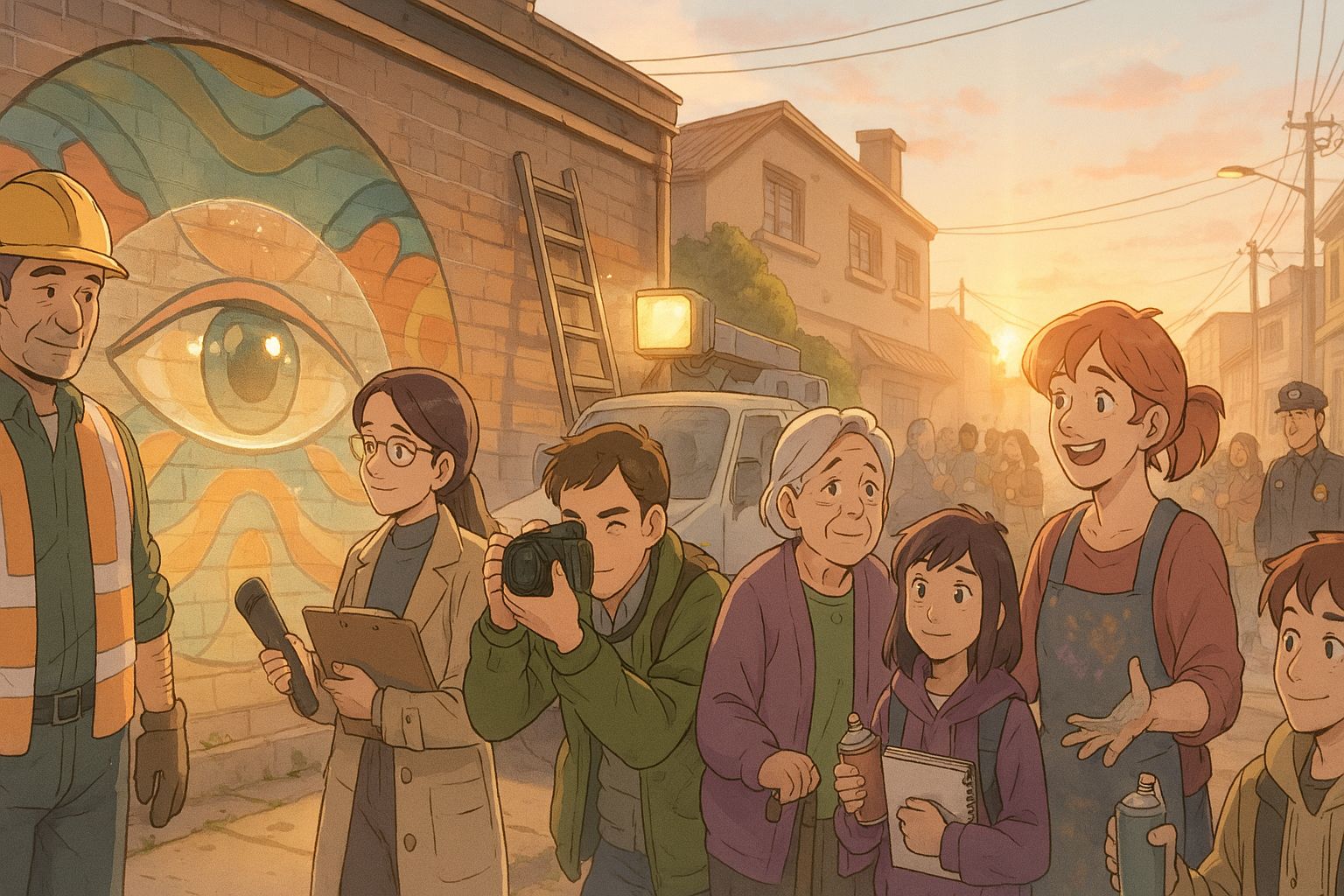
The municipal truck had unfolded its rectangular light across the wall as if marking the start of an inescapable ceremony. It was dawn, the hour when the streets still belonged to the night and decisions seemed easier to impose. Martín leaned the ladder against the wall with hands trained in the routine of transforming façades: paint, level, homogenize. Beneath the fresh coat, an eye appeared, barely visible. It was not large or flamboyant: its shapes were simple, a focused pupil, a contour that had withstood rain, sun, hands that brushed it, and the passage of neighbors. For many, just another stroke; for others, a sign with memory. Clara held the flashlight and let the beam outline the drawing. An inspector of heritage, her body seemed made of patience and determination. In her work she had learned to listen to walls: to read layers, dates and names that the administration often preferred to sweep under the carpet of modernity. That pupil spoke to her before anyone could issue an order. “Don’t cover it,” she said in a measured voice. “Leave it. We need to document it.” Martín looked at her with the fatigue of someone who had spent months applying new palettes to old façades. On his radio he carried the municipal instruction: unify the image of certain streets, start the new administration with “renewed streets.” That slogan, repeated until it acquired the appearance of an unquestionable truth, had reached him in his superior’s voice. Still, Clara’s words opened a crack in his certainty. Diego, the volunteer restorer who had shown up without protocol the day before, crouched in front of the eye. His hands, stained with old paints and a posture betrayed by hours of meticulous work, recognized the patina. He took out his camera and began taking photographs: wide shots, details, raking light to reveal technique and support. It was a ritual that spoke of slowing down what haste wanted to extinguish. The projector’s light did more than illuminate: it summoned. From still-sleepy balconies and quietly closing portals, people came closer. Luz, the art teacher from the corner school, arrived with hurried steps and chalk-stained hands as if carrying fragments of all the classes she had taught. Seeing the eye, she stopped, her eyes widening with memory. “I remember it,” she said. “It was part of a campaign against violence years ago. It was a symbol of community vigilance, of looking out for one another.” Doña Emilia, with her cane and a voice loaded with decades of stories, leaned on the sidewalk railing and offered her own warm, simple recollection. “My granddaughter used to say the eye watched over us when we walked at night,” she said. “Sometimes an image is enough to make some people feel safer.” The words circulated like a rumor, altering weights and priorities. Martín, who had arrived with the authority of one who executes orders, noticed how the community’s presence changed the nature of his task. When someone reminded him of the directive, his reply carried the tone of obedience: “We have to apply the paint. It’s what we were asked to do.” Clara did not insist on confrontation. Instead she proposed a method. “Document it first,” she suggested. “If it has value, it should be evaluated. This is not sentimentality; it’s procedure.” At that exact moment, two shadows separated from the darkness and, with hands still shaking from the adrenaline of nocturnal transgression, Ana and Tomás emerged clutching dented cans in a bag. They were teenagers who had come to paint a mural on a side wall, innocent and guilty at once of the night’s tension. “We weren’t going to erase it,” Ana said, with the frankness of someone surprised to be discovered. “We were going to paint next to it. If it’s valuable, we’ll respect it.” Tomás, looking at the scene with the mixture of pride and modesty of someone learning to be part of something larger, added, “We have sketches. We can collaborate on something that keeps the eye as the center, not erase it.” The youths’ presence changed the intervention’s logic. It was no longer just workers carrying out an order against an act of urban resistance; the scene turned into a crossing of generations and meanings. Diego, in a voice softened by technical patience, explained what would be necessary to preserve the fragment: document the painting, extract small samples if needed, consolidate the original paint layer and protect it with a transparent varnish that would integrate the piece into the new coating without crushing it. “It can be done,” Diego said, “but it must be done carefully. It’s not just covering or painting over. There are materials, drying times, chemical compatibilities. We’ll need at least a few weeks if we want to do it properly.” The suggestion, which implied a time expenditure the administration would prefer to avoid, nevertheless found resonance among the neighbors who had gradually formed an informal semicircle. Doña Emilia recalled names; Luz proposed workshops at the school; Ana and Tomás showed sketches in which the eye was a concentric center surrounded by scenes of neighborhood solidarity. Martín, moved by the evidence that this represented more than an urban stain, laughed softly and asked, “Who’s paying for this?” The question was practical but did not deny the symbolic reach. Clara accepted it without fuss. “The municipality has funds for restoration if justified. Besides, it could be a joint intervention: municipality, community and volunteers trained by Diego. If we submit a plan, there are possibilities.” The presence of the police authority, in the person of Inspector Ríos, initially brought a tense note. He had arrived by routine, prepared to enforce order when unauthorized interventions were detected. However, the constellation of neighbors, the art teacher and the two youth with sketches caused him to change his tempo. Ríos, whose career had been spent issuing fines and patrolling, set his flashlight on the railing and stepped closer, listening. “If it helps protect the neighborhood’s integrity and facilitates safe work,” he said after a few minutes of thought, “I can coordinate night patrols so they can work without risk. It’s not my role to decide what is preserved, but to ensure there is no vandalism or danger.” This unexpectedly conciliatory stance allowed the conversation to take the shape of a provisional agreement. Martín called his boss on the radio and reported that they needed time to evaluate the work. The response, from the one who issues orders, was a longer-than-usual pause: they authorized the evaluation and requested a report with photos and a proposal. The night dissolved into tasks of different kinds: Diego and his technical team documented details; Ana and Tomás, no longer feeling pursued but part of the proposal, sketched colors and forms that could dialogue with the eye; Clara drafted an initial heritage sheet; Luz organized a proposal for school workshops; Doña Emilia contacted people who had participated in the original campaign and suggested names and dates. The municipal radio turned from an administrative thread into a line of collaboration between citizens and officials. With the first rays of sun came concrete decisions. The municipality agreed to fund an intervention that would preserve the eye and integrate it into a larger mural, and to cover initial conservation costs. It was decided to install an explanatory plaque with the approximate date of the original painting and the memory of the anti-violence campaign that gave it meaning. Diego designed the technical plan: surface dry-cleaning, chemical consolidation of the painted layer, application of a compatible fixative and, after a stabilization period, incorporation of the new paints proposed by the young artists. The following days took on the rhythm of a community workshop. Mornings were devoted to technical consolidation: Diego and two contracted restorers cared for the fragility of the original eye; in the afternoons, neighbors and students participated in creating the mural that would surround it. The hands of Ana and Tomás, who had once barely progressed beyond sketches, learned mixing and composition techniques as teacher Luz led mini-workshops on color and message. Doña Emilia, with her long memory, narrated to the younger participants the neighborhood’s stories and the volunteer days she remembered with pride. The plaque installed at the end was not a mere commemorative act; it was a written pact: “Here is preserved a symbol of vigilance and community care. Joint project of residents, artists and authorities. Year X — restoration 20XX.” The dates, signatures and explanation turned the act of protection into an act of transparency: the community had not only saved an image, it had made it collective heritage. Inspector Ríos, who had initially shown rigidity, became an unexpected ally. He supervised the mural’s inaugural day with a softer expression. Martín, for his part, no longer saw his job merely as carrying out orders: he had witnessed the application of public policy shaped by listening and participation. Clara won time and recognition for having pushed for assessment; Diego recovered the feeling that his work transcended the technical; Ana and Tomás gained confidence and a commission that integrated them into neighborhood life. As the mural grew around the eye, the origin’s memory expanded. At the center remained the original pupil, consolidated and protected beneath a transparent surface that kept it visible but safe. Around it, scenes of coexistence, children playing, helping hands, markets and small daily rituals formed a tapestry that did not aim for perfection but for truth: the truth of a community choosing to remember and engage. The intervention did not erase history; it enriched it. People who had once walked by without noticing stopped to read the plaque; students who had taken workshops brought the experience into the classroom and made it a school project; the municipality included the initiative in its catalog of participatory interventions as an example of good practice. The eye, which might have been erased in one hurried night, became an engine of inclusion and learning. The smell of fresh paint and the neighbors’ coffee lingered in the barrio for weeks. There were disagreements, of course: not everyone agreed on the mural’s final form, and some considered the plaque unnecessary. But those disputes were part of the community process: tensions discussed in assemblies, agreements reached by vote and dialogue, suggestions incorporated in later touch-ups. In the end, when the last tarp was taken down and the last brush cleaned, the wall told a different story than the administration had intended the night the municipal truck lit the mural. It was not the story of an authority erasing the uncomfortable; it was the story of a neighborhood that talked to itself and chose to preserve what had looked at it. In the nearby square, a simple inauguration was held: brief speeches, coffee, children running, and the plaque gleaming with the project’s name. Ana and Tomás, with their hands still stained, signed as part of the collective who had moved from clandestinity to collaboration. The experience left practical traces: the procedure was documented, a municipal protocol was created to evaluate urban interventions of possible social value, and a small network of volunteer restorers formed, ready to act when something similar occurred. But above all it left a less tangible impression: the sense that looking before erasing can turn conflict into opportunity. In the months that followed, the mural aged with the city: it flaked in one spot, was retouched in another; children temporarily affixed drawings in a corner; a neighbor organized readings at the base of the wall. The eye continued to be a sign that did not watch punitively but reminded people of the neighborhood’s capacity to care. And whenever someone passed by, out of habit or curiosity, the eye’s gaze and the plaque silently told a small novel: the story of a night when haste almost erased memory and prudence, listening and collective will chose to preserve it. Source of the images. Image created with Bing.
No comments yet