 @mc5punk
Short story: The Plaza of Eladio: Snow, Noise, and Doubts
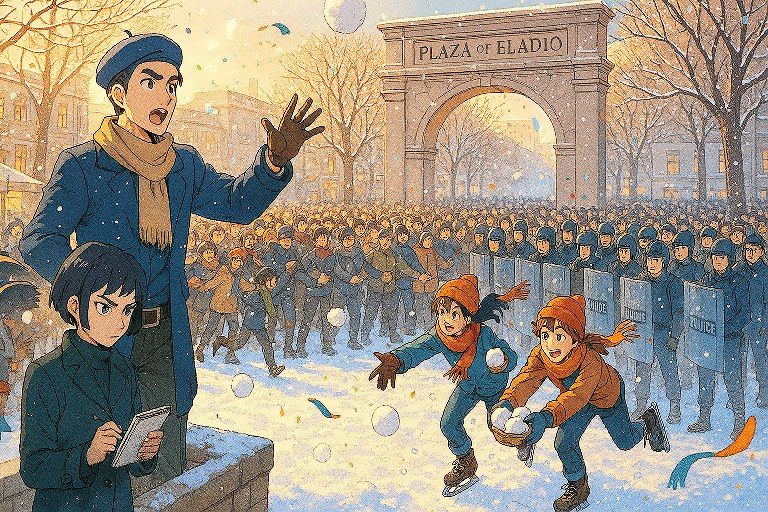
In the square known as the Plaza of Eladio, a wide space lined with cafés and flanked by trees whose branches stretched like fingers combing the sky, a gathering that promised to be the friendliest of the winter season took shape. What began as a social-media call for a snowball fight — the post read “bring gloves, bring coats, bring a sense of humor” — drew hundreds of people: teenagers with colorful scarves, couples hunting the perfect romantic shot, and long-time neighbors carrying thermoses of coffee and curiosity. The plaza filled with laughter, music, and the crisp sound of snow underfoot; yet that afternoon of games and laughter would soon become a scene of friction, public debate, and consequences. Chapter 1 — The Icy Call Bruno had uploaded a video in which he promised what he called “the friendliest war of the winter.” His theatrical tone was enough to spark many people’s curiosity. The plaza filled with people ready to play. Lila arrived intending to write a chronicle that would be both sharp and revealing: she wanted the detail that would turn an innocuous event into a story. Mara and Simón moved among the groups handing out numbered snowballs and performing little choreographies that provoked laughs, making the scene feel more like a festival than a confrontation. —Mara: —Formation, Simón! If we get a bad photo, it's the photographer’s fault. —Simón: —Relax, sister, today we are artists and meteorologists. The mix of music, camera flashes, and jumps in the snow created an atmosphere of contagious lightness; no one, or almost no one, suspected that the arrival of law enforcement would be the spark to change the tone. Chapter 2 — The Intervention The noise and concentration of people did not go unnoticed at the precinct. From there, Lieutenant Duarte decided to send a contingent of officers with a clear mission: “control the situation and prevent damage.” They arrived in formation, showing no overt aggression; their helmets gleamed like disciplined lanterns in the winter light. The officers came with orders to observe and deter, not to confront. —Lieutenant Duarte (over the radio): —Keep your distance and do not provoke. Just monitor and secure the perimeter. —Officer 3: —And if they throw balls at us? —one asked, adjusting his glove. —Lieutenant Duarte: —We will protect ourselves with the fiscal calm we deserve. The lieutenant’s words, though calm, did not dampen the reaction of part of the crowd. For some attendees, the police presence was comedic; for others, an unacceptable intrusion. A sector of the crowd began to joke; another raised signs. Without a clear leader, a group decided to make the police the target of their jokes. A casual toss became a targeted throw, and the boundary between prank and aggression began to blur. Chapter 3 — The Friction The first impact on police gear changed the festive mood. A snowball struck an officer’s shield; another hit his hat. Bruno, who had imagined his call as an innocent celebration, tried to contain the escalation: he climbed a small rise and raised his hands, asking for calm. —Bruno: —People, don’t start with that, this was for fun! But the crowd’s dynamics and the instant amplification through social networks transformed the gesture into something else: the “Anonymous Mob” found intensity in confrontation. Groups that had been laughing now shouted slogans; the joke turned into protest, and the protest into aggression. Lila, witness and reporter, decided her role would be not only to describe but also to intervene with her journalistic voice. —Participant in the crowd: —Get out, get out! —he shouted— Don’t tell us how to play! —Lila: —If the precinct wants to talk, let them talk. If they want to stop things, let them do it with words, not force. Cameras captured contradictory angles: to some, the police seemed oversized; to others, the crowd were the aggressors. The visual conflict fed on the fragmentation of testimony. Chapter 4 — The Politics of the Igloo Lieutenant Duarte ordered a regroup and set measures in motion to identify those who had thrown objects violently. From that moment, the plaza became a kind of improvised courtroom where accusations were exchanged and the meaning of what had happened was debated. Some defended that the police’s preventive intervention had been correct; others argued that mere presence had escalated a situation that could have remained playful. —Lieutenant Duarte: —This is no longer a game. We must separate fun from crime. —Lila (writing quickly): —Crime, fun, protest… who decides the difference? The discussion spilled beyond the plaza into cafés, feeds, and opinion columns. The winter confrontation soon acquired political hues: voices calling for responsibility mixed with others denouncing a sort of criminalization of popular festivity. Chapter 5 — Dialogues in the Snow Amid the noise, Mara and Simón became unexpected helpers. They steadied a young man who had been shoved and started to cry, and proposed an initiative that proved effective in its simplicity: a symbolic truce consisting of forming a human chain between the police and the crowd. The idea, theatrical and practical at once, was accepted by many. —Bruno: —If we hold hands, nobody will be able to throw. —Simón: —Besides, we’ll get a beautiful photo for Instagram. The image of linked hands separating the sides worked as a de-escalation gesture. Some officers, with tired faces and the day’s dust on their boots, lowered their shields. The humanization of positions, at least temporarily, softened tempers. Lila, observing with an eye both critical and warm, was already shaping the line that would accompany her piece: controversy sells, but the story that matters is the one that leaves people talking to one another. Chapter 6 — Investigation and Rumors After the episode, the precinct announced the opening of an investigation aimed at identifying those who had assaulted officers. The official statement, couched in legal terms, fueled a deeper debate: was it preferable to prosecute the aggressors or more urgent to understand the social causes behind playful violence? Diverse interpretations circulated: some neighbors demanded clear sanctions for anyone who had thrown with intent to injure; others insisted that most attendees had not come to cause harm. —Neighbor: —If someone throws a ball intending to injure, yes, it’s a crime. —Remorseful participant: —But no one came to hurt anyone for real, we came for laughs. Rumors multiplied; the plaza became the epicenter of a debate about limits, authority, and public space. Chapter 7 — The Plaza’s Judgment Weeks later, the Plaza of Eladio filled again, though with fewer people and a cautious air. There were signs calling for responsibility and others celebrating winter rebellion; some bore flowers, others slogans. Lila published her long feature: she did not try to indict heroes or villains, but to describe how desires, limits, and social conditions rubbed up against each other that snowy afternoon until they produced greater friction. The administrative process that followed the investigation resulted in the identification and sanctioning of some participants; for others, the consequence was collective introspection. For a time, the plaza became a thermometer of the relationship between citizens and law enforcement. Epilogue — Between Laughter and Consequences The snowball fight remained in memory as a strange and multifaceted episode: at times fun, at times problematic, and ultimately politically charged. Bruno reorganized future gatherings with permits, clear coordination, and coexistence measures; Mara and Simón opened a “responsible play” workshop for young people; Lieutenant Duarte promoted internal guidelines for less intrusive, more mediation-oriented interventions. In a final conversation, brief but heavy with meaning, the protagonists summed up what they had learned. —Bruno: —We learned something, didn’t we? —Lieutenant Duarte: —We did. You, not to mistake play for aggression. Us, to enter without being provocateurs. —Lila (closing her notebook): —And I learned that controversy sells, but the story that matters is the one that leaves people talking to each other. The Plaza of Eladio remained a plaza: a place where, day after day, the borders between laughter, protest, and law were drawn and redrawn. As snow fell in light layers and memories were packed into wet gloves, the community found, amid noise and calm, new ways to coexist and to remember that even the most innocent games can reveal deep tensions that demand dialogue and responsibility. Source of the images. Image created with Bing.
No comments yet