 @mc5punk
more from that month
@mc5punk
more from that month
Short story: The Discount Scam
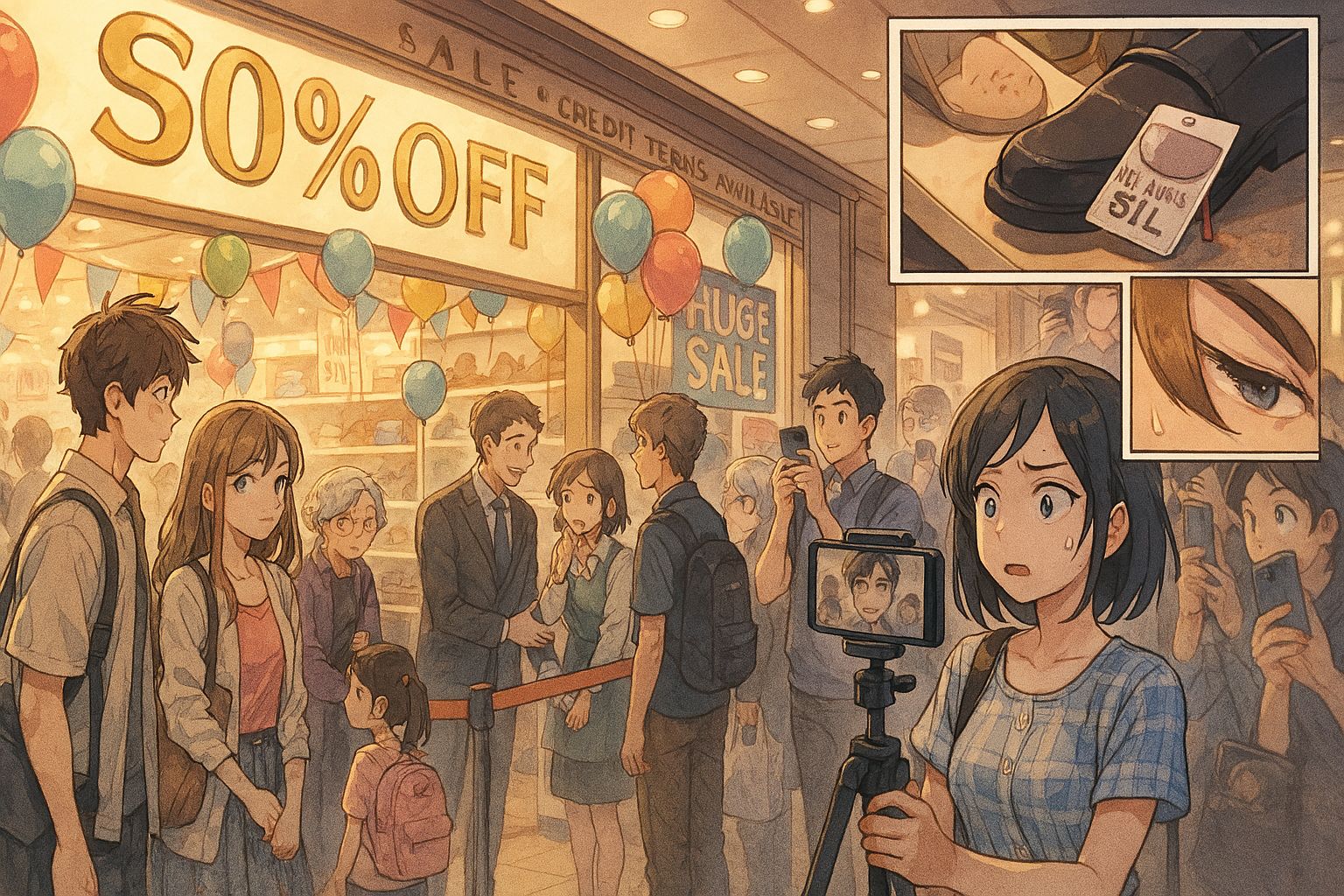
A new store opened in the shopping mall promising to bring fashion closer to those seeking quality at a good price. A large, imposing sign with golden letters and the name of a well-known brand advertised clothing and footwear at 50% off with convenient credit payment options. The opening was staged as an event: balloons, music and promoters handing out flyers that assured “authenticity guaranteed.” On the morning of the grand opening, the entrance filled up. Families, couples, workers and elderly people formed a line that wrapped around the corner; some chatted excitedly, others did quick mental calculations about how much they could save. Marta and her friend Lucía arrived early. Marta was thinking about Martín, her son, who needed new shoes for school; Lucía, always practical, inspected materials with a critical eye. “Half off and on credit,” Marta said. “We can take advantage and buy the school shoes.” “Watch the stitching,” Lucía replied. “Cheap isn’t always good.” Inside, the display windows seemed to fulfill the promise: shiny shoes, coats neatly hung on racks, tags with familiar logos. The salespeople, neatly uniformed, greeted customers politely. The store manager, Raúl, a man with an easy smile and persuasive pitch, walked the floor offering fittings and payment plans. Near the register, Laura, a young cashier focused on doing her job well, carefully packed orders; she didn’t yet know the shadows that threatened the store’s credibility. “Don’t worry, ma’am,” Raúl told Doña Carmen, an older customer who had arrived by taxi. “We have payment options; you can pay in three installments with no interest.” Happy, Doña Carmen bought a pair of shoes thinking about comfort and feeling confident she’d made a good investment. Andrés and Paula, a couple preparing outfits for a friend’s wedding, chose a jacket and a dress; Diego, a student, bought several T-shirts with hopes of updating his look without spending much. Luis, another clerk, persuaded Andrés to take a jacket “like new” on credit. “Try it on, it fits you perfectly,” Luis insisted. “And the warranty?” Paula asked. “Full warranty,” Luis assured her. “We take care of the customer here.” Sales soared. The credit system made purchases easy; many left with bags heavier than their doubts. The store became a buzz: “the one with brand X discounts,” and people flocked, attracted by the idea of quality at half price. But certainty began to crack. A customer noticed that the stitching on a jacket didn’t match that of authentic garments; another detected an off smell in the leather. A few days later, a shopper posted comparison photos on social media: misaligned tags, off-center lettering, roughly finished soles. At first the comments were isolated, then they multiplied. A local influencer known as Raúlito decided to investigate and posted a video examining pieces bought at the store and comparing them with authentic items. “Look at this,” Raúlito said to the camera. “The tags are different, there are visible glue marks, there are repairs. This isn’t the usual quality.” The video went viral in the community. Local media picked up the story and consumer protection authorities began receiving complaints. The store’s once shiny image started to tarnish. Customers returned demanding exchanges or refunds. Raúl, who had been confident, began giving inconsistent answers: first he denied any wrongdoing, then said they were “seconds,” and later admitted that part of the inventory came from unauthorized suppliers. “We believed they were legitimate,” Raúl told a reporter in a trembling voice. “The boxes came with labels, invoices… we had no reason to suspect.” Indignation became collective. Many had bought on credit and now found themselves obliged to pay installments for products that failed to meet promises. Marta thought of Martín and the shoes that were already showing wear. Doña Carmen felt cheated; Andrés lost trust in the jacket he intended to wear to an interview and regretted not checking the garment more closely before the important occasion. Employees like Laura felt trapped between loyalty to their jobs and the shame of having—unwittingly—participated in a fraud. “I didn’t know anything,” Laura told Lucía in the back room, her voice breaking. “If I had known, I wouldn’t have worked here.” “File a complaint,” Lucía advised. “This isn’t your fault.” Authorities carried out inspections and expert assessments. The results confirmed what many suspected: a significant portion of the inventory consisted of counterfeits. Investigators found counterfeit tags, low-quality materials and suppliers operating outside official channels. The store was temporarily closed while merchandise was seized, fines imposed and criminal investigations opened against those who had managed importation and distribution of the fake goods. The mall, worried about its reputation, activated procedures to cooperate with authorities and review its tenant approval processes. Miguel, the complex’s administrator, gave public statements acknowledging the oversight and promising stricter controls. “We failed in our oversight,” Miguel said. “We will review our processes and support those affected.” At the human level, small and painful stories intertwined. Marta remembered the nights she spent going over school notes with Martín; now she vowed to find a solution to replace the shoes that had already deteriorated. Doña Carmen, hurt at first, persisted in her claims and ultimately obtained a refund after weeks of paperwork and follow-up. Andrés and Paula recovered part of their money, but the discomfort remained. Some buyers filed class-action complaints; others pursued administrative routes to cancel credit payments. Meanwhile, Raúl was interrogated by authorities. His expression shifted from confident to remorseful; he explained he had acted under pressure from partners and suppliers who promised “new and legitimate” merchandise at irresistible prices. The investigation exposed a network of intermediaries importing lots for resellers without verifying authenticity. The case sparked a public debate about commercial practices, regulation and responsibility. Consumer organizations offered workshops and talks at the mall; in one of these sessions Raúlito taught how to recognize tags, seams and materials, aiming to turn the experience into community learning. Miguel coordinated an information campaign and tightened contract clauses for new tenants: supplier certifications, periodic audits and proof of supply chain. For employees who had worked hard in the store, the closure was also a loss of income and, for some, a stain on their résumé. Laura received support from neighbors and customers who understood her position; some encouraged her to start her own venture and offered recommendations. Other workers faced legal procedures depending on their degree of involvement in the fraud. The scandal left marks but also lessons. Many consumers became more cautious, learning to verify tags and distrust excessively good offers without documentation. The mall strengthened its protocols and, over time, regained public trust through transparency and concrete actions. The store, shuttered and sanctioned, closed permanently; its brief existence left seized boxes, legal cases and a long list of affected customers. On an autumn afternoon, in front of the mall now free of the initial bustle, Marta met Doña Carmen. The two exchanged smiles of relief and resignation. “We learned, didn’t we?” Doña Carmen said. “Now I buy only where I trust.” “Yes,” Marta replied. “And I’m teaching Martín to look beyond the price.” The city, moved by the episode, incorporated a collective memory that served as both warning and encouragement for stronger oversight. What began as a promise of accessible fashion ended up as a lesson about commercial ethics, civic vigilance and the importance of balancing price with trust. Although justice took its time, many customers recovered their money and the community emerged better informed and more cautious for the next offer that seemed too good to be true. Source of the images. Image created with Bing.
No comments yet