 @mc5punk
more from that month
@mc5punk
more from that month
Short story: Shadows over the Republic
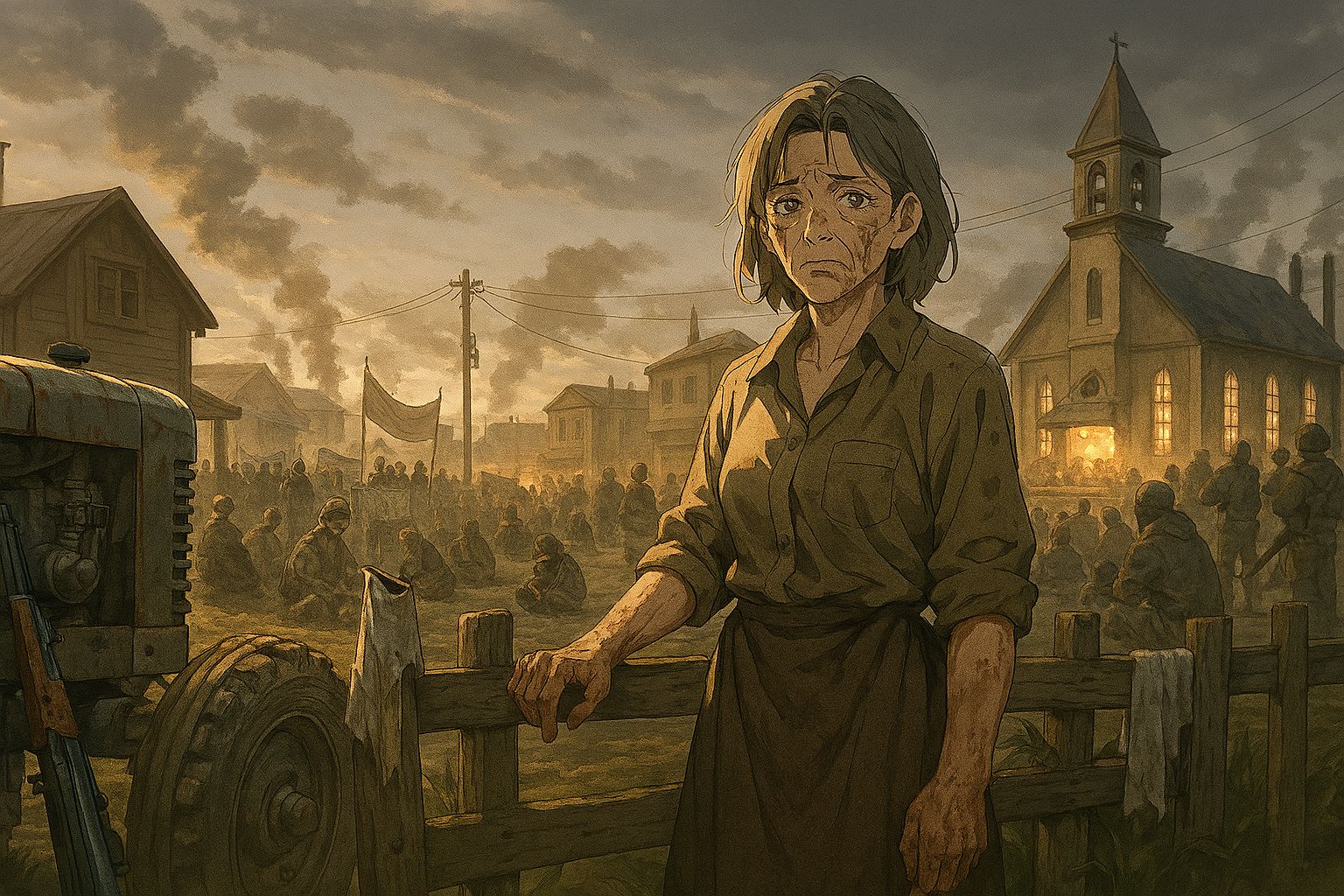
The Republic was crumbling beneath an ash-gray sky. Instability in France caused by its rulers’ resignation left an administrative and moral vacuum that rumor filled with the voracious speed of drought tearing the soil. That gap was felt in every postponed decision, in every public service that faltered, in hospital corridors and in the empty chambers where resolutions were once made. Institutions, disoriented, lost their capacity to contain just when the nation needed it most. In that parched ground uncertainty grew: the currency of fear began to circulate, and with it, mistrust. I. The Farm and the Fury of the Land On the agricultural plain of Beauce, the Renaults’ life was the story of generations that had made the land a pact: sow, tend, harvest, pass on. Marie Renault, 48, had the furrows of unforgiving work in her skin. Her home smelled of hay and machinery, and in the barn photos of her father and the promise—fragile but precise—of a future assured by farming still hung. The announcement of subsidy suspension by the transitional government was, for her, a silent earthquake. It wasn’t only money: it was the security of sowing, buying seed, fertilizer, the bills that wait indifferently for the calendar. Pierre, her 22-year-old son, drove the tractor like someone holding a flag while feeling the homeland slip from his hands. For Pierre, the countryside was identity, and his reaction was visceral: call out, take to the streets, make the damage visible. The town’s central square became a mirror where residents—tractor, trailers, and placards in tow—revealed their rawest side. The group “Terre Vive” organized demonstrations that grew quickly: marches to the prefectures, road blockades, and assemblies in public places. Discontent was expressed forcefully and, at times, violently: tires burned, clashes with police, stones smashing corporate windows. Where technical negotiations once took place there were now shouts and slogans. Marie and Pierre argued in low voices as they prepared to go out. Pierre: “We can’t wait to be eaten alive. Today we go to the square and make them see that without us they don’t eat.” Marie: “Son, taking to the street won’t fix what’s broken with one blow. But I’ll go with you if you promise to listen before acting.” That mother–son pact of patience and courage would be the thread that kept them together in a scenario that at times seemed designed to break them. II. The City and the Erosion of Coexistence In the cities, the crisis took another contagious form. The rulers’ resignations and the transitional government’s inability to communicate and manage eroded trust in the public sphere. Neighborhoods long known for interethnic and multireligious coexistence began to show cracks: a quarrel between neighbors became a confrontation; a shortage of supplies sparked complaints that soon turned into accusations. Social media, saturated equally with information and disinformation, acted as an accelerator: context-free images, manipulated videos, and tendentious narratives circulated at the speed of outrage. Media polarization amplified extremes; some outlets repeated partial versions while others stoked the fuel of resentment. In that climate, emergent local leaders tried to make sense of what was happening. Malik Diop, 26, a community activist of Senegalese descent, became one such figure. He knew the streets and the community kitchens: he understood that hunger and fear go hand in hand, and that a purely police response is insufficient to stop escalation. Malik organized soup kitchens in churches, gymnasiums, and schools; he called vigils and neighborhood councils. His presence was practical: hot meals, blankets, and at the same time a clear message that the community could protect itself without resorting to violence. Malik, in the church turned dining hall, spoke with anyone he needed to speak to. Malik: “We are not here to preach. We are here to feed and to listen. If we listen to one another, we will avoid the third war: the one of us against us.” Lucie Martin, a 20-year-old university student, joined with energy. She organized vigils and outreach to counter disinformation. At night, when the radio began to spew alarmist messages, Lucie and a group of young people walked the neighborhoods, posted flyers promoting calm, and urged people to attend mediation meetings. III. The Press, the Chronicle, and Responsibility Claire Durand, a 34-year-old freelance journalist, became a committed witness to the disorder. Claire did not seek sensationalism: she knew that turning human tragedies into easy headlines only deepens the wounds. Her work was exhausting: cross-checking accounts, verifying videos, speaking with farmers, religious leaders, police, radicalized youths, and elderly people traumatized by memories of other times. Her reports tried to reconstruct the complexity of each event. For her, narrating also meant protecting against rumor. Claire approached Captain Jean Moreau in the square, intending to understand from the voice of the one tasked with imposing order. Claire: “Captain, people need to know why actions are taken this way. Are you afraid this could get out of hand?” Moreau, who bore the mark of sleepless nights and weighty decisions on his face, answered softly: Moreau: “I fear that my men and I will be used as an excuse to clamp down. My duty is to maintain order, but my conscience obliges me to contain, not crush.” IV. Security Forces: Dilemmas and Frictions The security forces were exhausted and divided. Commander Rousseau, the hardline representative, pushed for decisive measures: police charges, curfews, systematic dispersal of demonstrations. For Rousseau, the risk was clear: if authority was not reasserted, disorder would become the norm. But Jean Moreau embodied the quiet dissent: for him, the police role at that moment should lean toward containment and mediation rather than disproportionate use of force. That tension between command and conscience revealed how fractured the state apparatus had become. Rousseau (by phone): “Jean, keep control. If you yield ground, anarchy will set in. We need clear actions.” Moreau: “Control is not repression. If we act only with force, we will feed more resentment. I will try for balance, but I cannot promise to obey orders that break the peace.” V. Religion and Mediation: Helping Hands in Gyms and Libraries Under the shelter of civil institutions, mediation attempts arose. Sister Anaïs, a nun coordinating a local NGO, and Imam Youssef, leader of a neighborhood mosque, became agents seeking not prominence but minimal agreements. In gymnasiums converted into mediation centers, religious representatives, activists, and agricultural collective leaders discussed practical measures: food distribution, safe corridors for goods transport, mixed civilian patrols, and protocols against informational provocations. Sister Anaïs: “If we don’t put food on tables and security in the streets, words will be little. I propose mixed committees to distribute necessities and watch that there are no provocations.” Imam Youssef: “It is not enough to preach peace. You must build it every day: we speak with our people and with the farmers. If they feel heard, many will not fall into the trap of hatred.” These initiatives were, in many cases, the difference between containment and escalation. Where committees worked with transparency and efficiency, tensions were eased. Where coordination was lacking, vacuums were filled with rumors and violence. VI. Disinformation and Provocations: The Viral Spark A manipulated video showing an attack on a mosque circulated through networks and messaging chains. It was not real, but the content’s viral power did harm. Within hours, calls for ‘defense’ and counter-demonstrations multiplied. Claire confirmed the images had been edited; Malik, informed, organized municipal vigils to cut calls for revenge off at the root. Claire (by phone): “They have manipulated images. People believe there was an attack on the mosque and there are already calls to take to the streets.” Malik: “I’m organizing immediate vigils. We will give no room to those who want to fan the flame. Today, in every neighborhood, lights and silence: vigils to interrupt the narrative of violence.” VII. The Great March: Brake and Hope In response to the economic crisis, "Terre Vive" organized a large national demonstration. Thousands came to the city—farmers, supporters, onlookers, and radical groups that saw opportunity in the situation. That day was a kind of stress test for the Republic: the crowd, rhetoric, cameras, and the tension between order and protest. Pierre, injured by a thrown stone, became the face of violence that might have overflowed; Marie, from an improvised platform, spoke with the voice of someone who knows the cost of every seed. Marie (on the platform): “We do not want destruction. We want to go back to work. Is it too much to ask to be able to feed our families without being despised for it?” Pierre (in the crowd, shirt stained): “They are trampling us! If they don’t listen, they will take our hands for the last time!” Marie held him, and her answer was that of a mother who shuns revenge: Marie: “No, Pierre. I will not turn your wound into hatred. If I let you fall into that, we will both be lost.” It was Malik who, with a megaphone, asked for a pause that changed the pace of the day: Malik: “Stop! Five minutes of silence. Let’s sit, listen to those who come from the fields. Let’s not give the violent their pleasure.” The crowd, for an instant, obeyed. Thousands sat. That image—thousands of bodies in silence—was captured by cameras and, in many squares, opened channels for negotiation. Claire moved quickly to mediate between protest delegations and representatives of the transitional government. Claire (to a regional adviser): “We need regional tables now. Not as a gesture, but with concrete measures: temporary subsidies, protection for minorities, and mixed security committees.” Adviser: “I’ll try. I don’t promise miracles, but I’ll open channels. If we can calm the streets, we’ll buy time to reach an agreement.” VIII. Negotiations and Temporary Commitments Most solutions were provisional and practical. Regional tables were agreed upon with participation from agricultural federations, local authorities, religious leaders, and civil organizations. Agreed points included: temporary reactivation of key subsidies for the next season, creation of citizen oversight committees for aid distribution, implementation of safe corridors for product transport, and establishment of mixed patrols—made up of neighbors and security forces—to prevent provocations. Terre Vive representative: “We demand that subsidies return or that there be real alternatives. Without that, our families won’t survive.” Sister Anaïs: “We can start with temporary deliveries and a restructuring plan, but we need citizen oversight to prevent waste and corruption.” Imam Youssef: “And guarantees for vulnerable communities: safe corridors, mixed patrols, and transparency in distribution.” Those agreements did not extinguish all the flames. Isolated outbreaks of violence continued, acts of vandalism and episodes of youth extremism that tried to exploit the vacuum. However, in many localities the agreed measures helped hold back the tide: community kitchens stabilized food supplies; mixed patrols reduced provocations; transparency committees made subsidy distribution less opaque. IX. Personal Wounds, Everyday Acts The story became tangible in bodies and small decisions. Pierre, his shoulder bandaged, returned to the farm and lived with the unease of not knowing whether the agreement would last. Marie went back to plowing, with fewer inputs but the same determination. Malik persisted with his community pots and in coordinating vigils. Sister Anaïs and Imam Youssef pushed for the creation of an interfaith council that functioned as a permanent forum to prevent tensions. Moreau, burdened by the conflict between order and compassion, requested a transfer: he preferred not to be marked by decisions that might stain his sense of duty. Marie (looking at the land as she returned): “I will sow again. And if necessary, I will return to the square. But not with hatred.” Pierre (leaning in the greenhouse doorway): “Mother, I will fight for the land without losing you.” Malik (in the church/dining hall): “While there is a fire in a pot, there will be reasons to meet and resist without destroying each other.” X. The Press and Memory: Recording to Learn Claire published reports that aimed to go beyond the emotional shock of the moment: she interviewed peasants, truck drivers whose routes had been interrupted, families displaced by the clashes, and officials trying to piece together a battered apparatus. Her pieces, read by thousands, avoided Manichaeism and showed the web of interests and fears that fed the crisis. The press, when it acted with rigor, helped curb the spread of false news and made visible local agreements that, without that record, would have gone unnoticed. Claire (to her editor): “I am not after sensational headlines. We need pieces that explain causes, that put names to decisions, and that avoid turning human tragedies into spectacle.” XI. The Scars and the Unfinished Lesson When that chapter closed—although it did not close all conflict—the nation remained wounded and fragile. Negotiations offered temporary relief, but many questions remained open: how to reform a subsidy system to make it sustainable and fair? How to rebuild trust among diverse communities? What institutional mechanisms would prevent disinformation from igniting fires again? The answers required time, dialogue, and political will; also an organized citizenry. XII. Epilogue: A Sad, Discouraging End The commitments that seemed to ignite hope proved more fragile than imagined. Temporary subsidies arrived late and in insufficient amounts; part of the aid was lost in paperwork and diversion. Promised transparency was undermined by lack of resources and by the inertia of an administration that did not become capable of crisis management. In neighborhoods where mixed committees had worked, patience wore thin: lines grew, community kitchens dwindled, and the faces that once gathered to watch in silence began to look at their neighbors with mistrust. Disinformation, far from running out, found new narratives. Radical groups, both rural and urban, reactivated old networks and recruited young people disillusioned by unmet promises. The temptation of violence became for many a rational response: better to take what is missing by force than to wait for agreements that never come. Small skirmishes turned into periodic assaults; local checkpoints militarized; mixed patrols atomized into informal militias that answered to communal loyalties rather than the law. One autumn night, a coordinated attack on a convoy carrying humanitarian aid left several dead and dozens wounded. Among the victims were elderly people who had come to receive sacks of flour, a young church volunteer, and a driver who was merely doing his job. The image of the burning truck ran across televisions and networks, and indignation was no longer enough: a thirst for revenge emerged. Marie received the news with hands that could not find comfort. Pierre, who had swapped his bandage for an improvised rifle borrowed at the village border, returned with the dull look of someone who has seen the line crossed. That night on the farm, conversation turned mute; words, when they came, were short and offered no promises for the future. Marie: “They killed people who had nothing to do with this. Is this what we fought for?” Pierre: “So they stop ignoring us. If people won’t listen, we will find someone to protect us.” In the city, Malik saw his dining hall empty out. The young people he had taught to cook began slipping away to groups that offered weapons and a belonging that seemed more effective than the pots. Lucie received threats for denouncing recruitment centers opening up; the university where she studied canceled classes for discipline and security reasons, and her activism became dangerous. Malik (in the empty church): “I have no more rice. I have no more strength. I don't know whom to ask for help when those who should give it disappear.” The gendarmerie, divided and overstretched, was unable to contain the fragmentation. Moreau, who had requested a transfer, watched from afar as his city fell into factional logic. Rousseau took drastic measures: curfews and forceful operations that, in execution, violated rights and fed resentments. The escalation left more dead and displaced; entire families abandoned whole villages in nights of smoke and crying. Claire, exhausted, no longer found words that could serve as a bridge. Her notebooks filled with names that weighed like stones: disappeared people, ambush victims, children who had left school. She published reports that no one wanted to read calmly; pages were consumed in a news cycle that demanded blood and forgot context. One morning she received the call: the newsroom was closing the investigative section due to cuts and the insecurity that prevented travel. Claire put her notes in a box and went out into the street with the feeling that the story was slipping from her hands. The citizen committees that had tried to sustain coexistence dissolved under the pressure of fear and co-optation. In many localities, mixed patrols became local militias imposing their own rules; roads were controlled by illegal toll points and by armed men deciding who could pass. Markets emptied; warehouses closed; everyday life shrank until it became survival. The mosque that had opened its doors to offer food was looted one night. Graffiti on a synagogue turned into arson. Families who once shared neighborhoods and schools now exchanged looks of suspicion and, in many cases, hatred turned into action. The Republic, which once promised equal treatment under the law, was carved into territories of fear. Moreau, witness to how violence ended up dictating the agenda, returned one night to the guard post where as a young man he had promised to protect his community. He could not bear to see comrades carry out orders he found unbearable. In the early hours, seeing a column of displaced people fleeing an exchange, he took off his cap and left it on the table. He was afraid to look at his reflection. In Paris and the large cities, public life froze for fear of attacks and reprisals. The transitional government—without real command capacity or sufficient legitimacy—fragmented into factions negotiating power and territories in closed rooms while the sound of weapons grew outside. Promises of reforms remained on unsigned papers; institutions devoted more effort to protecting archives and headquarters than to protecting citizens. The interfaith council, which had been an oasis of dialogue, was reduced to an empty table with cold coffee cups and the trace of an impossible consensus. Sister Anaïs and Imam Youssef, exhausted, received threats. They were forced to close the centers where they cared for the displaced. When Malik was detained one night for trying to distribute food in a neighborhood controlled by an armed group, his release was only possible after a ransom payment and a feverish campaign by friends and volunteers. The moral cost was high: many who had once trusted him felt their impotence pushing them toward harsher options. The statistics began to rise with the coldness of data: rising unemployment, massive internal displacement, declines in agricultural production, and proliferation of crimes and hate crimes. Schools closed for long periods; hospitals operated sporadically; international aid, mired in bureaucracy and restrictions, arrived late and struggled to operate in fragmented zones. On the Renaults’ farm, the harvest began to rot in silos without buyers. The silence of the countryside changed tone: it was no longer the tense calm before the storm, but the loneliness of those left behind waiting without hope. Marie, every morning, watered the furrows with hands that seemed not to belong to her. Pierre, aligned with local groups, returned to the square this time wearing different boots and a hardened gaze; his ideals had become border certainties. One night, a column of armed men arrived at the farm gate. They turned on lights to signal control and demanded tributes: sacks, fuel, men for patrols. Marie refused, and paid with the life of the one she loved most: Pierre fell on the threshold, struck by a stray bullet in the confusion that followed. When the news spread, there was no protest to drown the pain; there was more silence, more fear. The country slowly lost its civic innocence. Young generations who dreamed of changing reality no longer believed in politics; alternatives seemed to lie in joining factions that offered identity and survival. Lucie, who had organized vigils for peace, watched her project disintegrate as close friends joined cells promising revenge. Her voice, once hopeful, broke in half-spoken conversations and closing doors. In the end, the few spaces of encounter that remained open—a church with lights off, a square with empty benches—smelled of bitter nostalgia. Faces crossing those streets were harder, used to calculating risks. The stories Claire once wanted to tell remained as loose files in a box: records of people who lost homes and names no one wanted to keep saying. The Republic, split into pieces of fear and territory, surrendered to a routine of smoldering violence. There were no great final battles or redemption speeches: only small accumulated tragedies that ended up redefining what was possible. The country that once could still dream of rebuilding its social fabric entered a phase where hope becomes memory and daily survival the new mandate. In that desolate landscape, the shadows were no longer a warning; they were the only constant presence. Source of the images. Image created with Bing.
2 comments
A masterfully told and deeply unsettling story. The narrative serves as a crucial allegory for our time, highlighting that a republic's greatest vulnerability isn't always external, but the internal decay of trust, functional institutions, and a shared reality.
Thanks a lot for sharing your comment, it is quite appreciated.