 @mc5punk
more from that month
@mc5punk
more from that month
Short story: The Snow Lynx
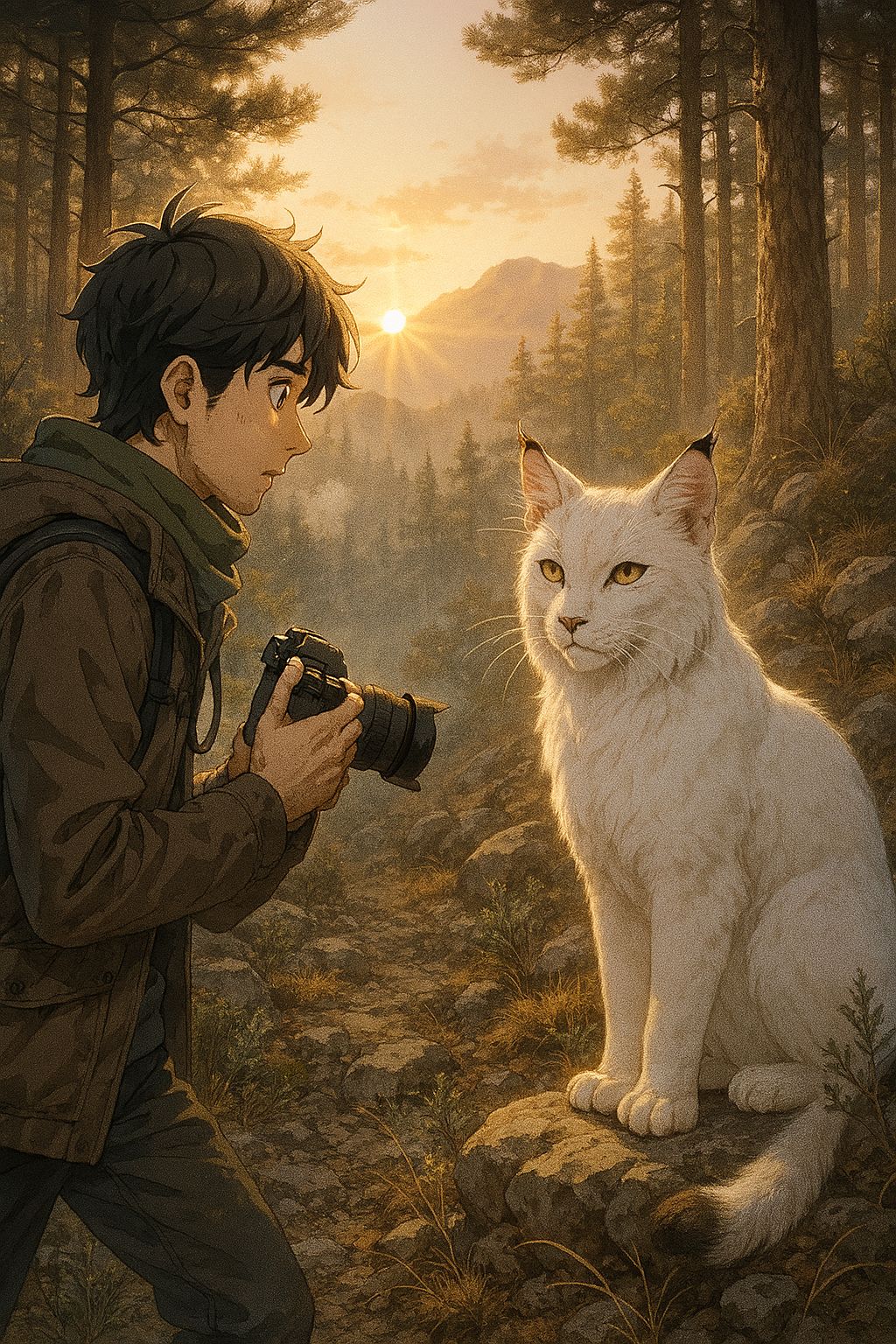
The Jaén mountains wore a contained mood that October morning, as if the peaks themselves had grown cautious. The air smelled of dry rosemary and fallen leaves, and the first light of day raked the tops of the pines with golden fingers. Ángel Hidalgo walked slowly along a scarcely marked trail, his camera hanging from his neck and a backpack with gear snug against his back. He was twenty-nine, had been passionate about photography since his teens, and carried with him a habit that had become almost a trait of character: he preferred to see before speaking, to learn from light rather than impose his gaze. He often went out into the countryside in the hours when the world seems most authentic: that span when light and shadow negotiate the shapes of things. He did not chase fame or recognition; he sought moments—those that cling to memory and that someone, someday, can look at as proof that life never ceases to surprise. He had grown up in a nearby village and knew the sierra as one knows an elderly relative: with respect, sometimes with confusion, and always with the conviction that secrets lived there that cities could not imagine. It happened on one of those calm walks. Among low scrub and moss-covered rocks, something caught his eye: a pale patch that did not fit the autumn landscape. At first he thought it was a reflection, an effect of light on a stone. But the patch moved with the contained calm of a predator, and suddenly Ángel knew he was not looking at an atmospheric trick but at a living, awake, watchful being. He stood still, braced the camera on the improvised tripod of his legs, and held his breath. The animal lifted its head and for an instant they studied each other: man and lynx, face to face in the old democracy of the forest. Ángel experienced a surge of fascination that pierced his ribs, an emotion not only aesthetic but almost tribal, as if the whiteness of the coat recognized some distant ancestor in him. He felt the outer world recede; only his heartbeat and the animal’s calm presence remained. It was a mixture of astonishment, gratitude, and a sharp happiness that hurt from its intensity. “What are you?” he murmured, not expecting an answer. “Where do you come from?” The lynx offered no words, of course; it answered through the calm of its movements: the whiskers quivered for a moment, the intense dark eyes examined him as if measuring the intruder’s intent. Ángel, who had spent years practicing patience in front of wildlife, for a moment forgot technique. He did not adjust exposure or change lenses: he simply observed and let the sensations settle. Soon he regained focus. He pressed the shutter, captured frames and recorded a short video in which the animal’s contained musculature, silent gait, the shape of its tail and the slightly darker tips of its fur were distinguishable. When the images replayed on his camera screen, reality confirmed itself: it was not a lynx with typical coloration. The coat was a pearly white, uniform and delicate, here and there splashed with darker strokes that marked the continuity of its lineage. Leucism, he thought immediately: a partial loss of pigmentation that did not erase the species’ identity but presented it in an unusual aspect. Fascination transformed into the responsibility that those who witness something fragile often feel: the need to protect rather than exhibit. Ángel knew the sierra was popular with curious visitors and adventurers, and that news in the wrong hands could endanger the animal. So he put the camera away with the calm of someone guarding a secret. He returned to the village with the images and his soul still warmed by the experience. He called Marta, the field coordinator of the Proyecto Lince, with hands that trembled slightly. “Marta, I have material here,” he said. “What kind of material?” she asked, professional and restrained. “Photos and video. I’ll send them right now, but… I can’t give the exact location,” Ángel replied. “We need to protect it.” “Perfect,” Marta answered. “Do everything privately and don’t share it on social media. If it’s what I think, we must act cautiously.” The following hours were full of contained activity: discreet conversations, specialists reviewing the images, metadata checks. When the verdict arrived it was as brief as it was explosive: the animal showed characteristics compatible with leucism and, according to preliminary analyses and field experience, it appeared to be the first documented case in the Lynx pardinus species. The news was not broadcast with fanfare; it filtered quietly among experts who, feeling the magnitude of the find, lowered the volume to increase protection. The confirmation did not turn Ángel into a media hero; it left him with a mix of humble pride and reverent fear. Journalists, scientists, colleagues and family called. His brother phoned at dawn, unable to contain disbelief. “A white lynx?” his brother said, his voice halfway between teasing and admiration. “Are you sure?” “Yes,” Ángel replied. “It’s not the light. It’s leucism. The photos speak for themselves.” Marta and her team deployed a surveillance plan: they installed camera traps at strategic points without revealing coordinates, took minimal environmental samples to avoid disturbing the animal, and reinforced coordination with local environmental officers. The location was kept strictly confidential. The priority was the lynx’s safety, not notoriety. Meanwhile, Ángel reviewed the frames over and over in his small house. In the room’s half-light the images recycled the emotion and the melancholy: a lynx that seemed arrived from another latitude, a creature that contradicted the peninsula’s usual color memory. He studied the perfect curve of the ears, the subtle play between shadow and whiteness, the way October light kissed the coat’s smoothness. Each detail spoke to him of a fragility not visible in numbers but evident in the singularity of an individual. Scientific questions arose: what did that mutation mean for the animal’s survival? Would it have more difficulty hiding from predators or hunting? Was it an isolated case or the tip of an unknown genetic iceberg? Questions came with proposals for monitoring, but Ángel—no biologist by training—suddenly felt like the keeper of something beyond his interpretive capacity. He felt he had borrowed something from time itself: the lynx’s gaze had inscribed him in a story that did not fully belong to him. In the following weeks, technical visits increased. Marta and her team spent long hours in the sierra, checking cameras, gathering traces and documenting movements without disturbing the sensitive area. Communications were quiet and movements discreet. The press, informed through official channels, was restrained by the ethical commitment of the project’s leaders: public dissemination would be minimal and responsible, and the location would remain secret. “You did the right thing not publishing it,” Marta told Ángel at one meeting, looking at images on her tablet. “This must be handled with great caution.” “I acted on instinct,” he confessed. “It seemed like something we shouldn’t turn into a spectacle.” “Here the most valuable thing is organized silence,” Marta replied. “Our job is protection; people should know the news, yes, but without putting the animal at risk.” Despite the discretion, the news crossed into broader perception of the sierra. People spoke of a unique lynx, of a historic find for conservation; public conversations revolved around ecosystem fragility and the long, patient work of those who care for them. For Ángel, the attention felt less like a reward and more like a reminder: wildlife recovers step by step, and each new individual is a victory demanding ongoing effort. At night, alone, Ángel found himself thinking often about the animal. He replayed the meeting in his head: the immediacy of fascination, the sense of ancestral recognition, the vertigo of knowing he’d witnessed something unrepeatable. Sometimes he imagined the lynx moving between crags, hunting with the same skill as other lynxes, using its whiteness to slip through sunlit clearings where no one would see it. Other times the whiteness seemed like a cloak that made it more vulnerable, as if the world had made a generous gesture that also exposed it to risk. After a few weeks, camera traps recorded new signs: unclear tracks, blurry images of the pale figure among shadows. It was not easy to follow its trail; the animal seemed able to move through the sierra with prodigious discretion. Then, one day, it stopped appearing. Perhaps it had moved deeper into remote slopes, perhaps it crossed a valley in search of prey or a mate; no one could say for sure. For conservationists, its temporary disappearance was not necessarily bad news: a moving lynx is a living lynx. Ángel returned to his routine with the gentle weight of someone who carries an experience that changed him. He backed up the photographs on several hard drives, printed copies he only showed to a few trusted hands, and now and then rewatched the videos as one rereads a letter from a loved one. He kept going to the field, with an expanded awareness that every human decision there could help or harm. The sierra continued its steady pulse: wind, birdsong, deer footsteps at dawn. The Proyecto Lince continued its silent, systematic work: censuses, reproduction programs, habitat protection. The Iberian lynx population, which had moved from the brink of extinction to a vulnerable status thanks to persistent efforts, continued to grow in numbers and in hope. The discovery of that leucistic specimen added, more than numbers, a story that demanded prudence and wonder. For Ángel, the experience left an indelible mark. Each time he looked at the photographs he felt again the fascination that pierced him the first time he saw the animal: an impact that did not soften with time but transformed into a vigilant quiet. He had learned that the most fragile beauty demands sustained care, and that witnessing does not make one an owner. In his everyday silence Ángel had learned to be a custodian: of images, of secrets and, above all, of the memory of an encounter that seemed to belong to another era. On a certain cold October twilight, the sierra offered an inviolable gift—a white lynx that crossed his path—and taught him the only dignified response: to protect the wonder with the calm and discipline that life in its most dazzling and, at the same time, vulnerable form requires. Source of the images. Image created with Bing.
No comments yet