 @mc5punk
Short story: Mannequin in Line
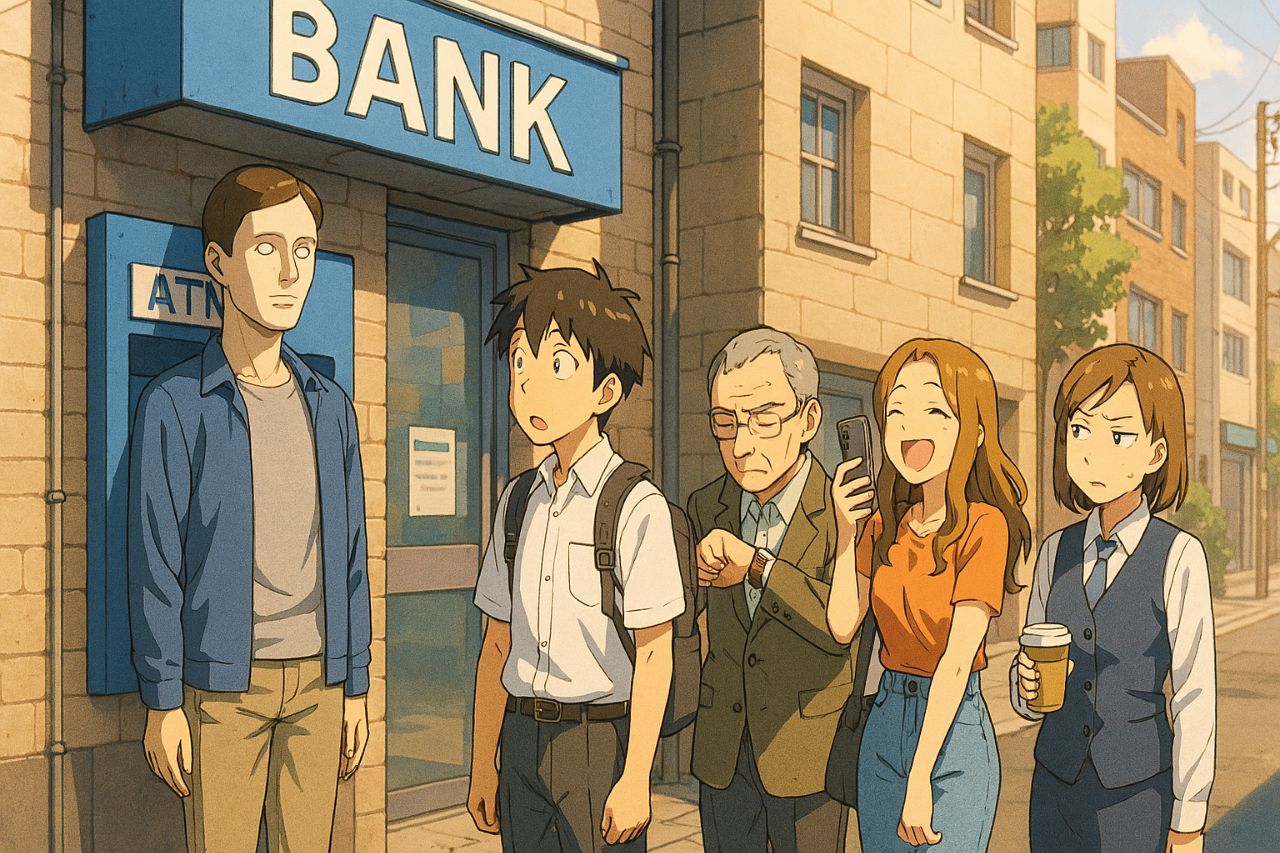
That morning began with the quiet routine of an ordinary neighborhood: some neighbors in a hurry, shops lifting their shutters, and the steady murmur of the city. In front of an ATM, however, something disruptive and slightly absurd had been placed with precise intent: a mannequin dressed in everyday clothes — a gray T‑shirt, a blue jacket, and neutral trousers — planted as if it were a person mid-transaction. Its posture was impeccable; its expression, a stony calm. There were no obvious signs of a prank except for the absolute immobility of the one who seemed to lead the line. María, an observant student carrying a backpack full of notes, was one of the first to notice the scene. She stopped, tilted her head, and for a moment thought that perhaps the person at the front of the line had arrived late. Beside her, Don Julián, a retired man with classic manners and an inquisitive gaze, checked his watch and grumbled with that blend of irony and patience that age often brings. “Bah, young people… always late,” Don Julián murmured more to himself than to anyone else. “They need to learn patience.” A few meters away, Lucía, an influencer who never left home without her phone, had already recognized the potential: her instinct was to turn the everyday into content. With the professional look she reserved for her stories, she turned off the flash and searched for the perfect framing. “Guys, this looks perfect for a story. ‘Express line at the ATM, #goodservice,’” she said, putting on the practiced face she cultivated. Gradually, almost by social inertia, a line formed behind the mannequin. The scene acquired the strange normality of everyday phenomena: no one asked if the person at the front was being served, no one checked whether they were breathing. People waited with total naturalness, as if the motionless figure were simply someone engrossed in the ATM screen. From the bank doorway, Carlos, a distracted employee enjoying his morning coffee, watched the line with curiosity. Between sips, he thought perhaps it was an artistic initiative. “Is there a line? Or are you queuing for aesthetics?” he laughed, amused by the situation. María, driven by curiosity, stepped a little closer. She lifted her hand gently and touched the figure’s shoulder as if not to disturb a private moment. “Excuse me, sir…” she whispered cautiously. “Are you okay?” There was no response; the immobility continued. The lack of reaction from the “first” began to sow small doubts that, crossed with social laziness, dissolved quickly. Don Julián, however, could not avoid an exclamation mixing astonishment and sarcasm. “What a lack of manners! In my day, someone at least answered ‘yes’ or ‘no,’” he said, taking a step back, stunned by the apparent, unmoving rudeness. Meanwhile, Lucía did not miss the opportunity to capture the moment. Excited whispers escaped amid contained chuckles. “It’s perfect! If this goes viral, everyone will copy it tomorrow. ‘Trend: Be motionless in public.’ Can you imagine, mom?” she said, already picturing views and comments. Minutes passed with a mix of normality and comedy. Some people tried to slip ahead discreetly and were stopped by the impassive presence that looked at them as if asking why there was so much hurry. The mannequin, reliable in its stillness, kept the illusion long enough for several users to feel complicit in a silent joke. Carlos, intrigued by the collective behavior, decided to approach the ATM to confirm whether it was in use. He stopped in his tracks when he saw the scene and could only exclaim, half amused, half confused: “Miss, the ATM is free. Or so we thought…” He paused as he realized what he was facing. “But that guy doesn’t move?” The revelation was brief but contagious: María couldn’t contain her laughter and pointed with a sense of complicity. “He’s not a guy! He’s a mannequin, Carlos.” Don Julián, whose disbelief had not yet turned to humor, asked a question mixing astonishment and social critique. “A what? Now they make replicas of people to save on staff?” he asked. Lucía, already recording, added a layer of spectacle. “‘Exclusive discovery! The line has entered statue mode,’” she said, placing a laughing sticker over the video. “This will be great material.” The news spread like a smile: those who discovered it couldn’t help but laugh; others frowned, clearly annoyed at the minutes wasted. A woman, exasperated by what she considered a waste of time, couldn’t hold back. “I lost five minutes because of a mannequin with more presence than my ex!” she exclaimed, and her irritation sparked a wave of laughter and sympathy. A man waiting behind made a resigned joke: “Well, at least it didn’t ask for my PIN.” The scene, absurd as it was, became an improvised communal act. Those who discovered the truth felt proud to announce it; those who hadn’t noticed remained happy in their routine bubble. That inert figure, unintentionally, served a social function more effective than many machines: it provoked conversation, momentary connection, and free entertainment for passersby. Finally, Carlos, in good humor, decided to crown the situation with a symbolic gesture. He took a label and stuck it on the mannequin’s chest, as if awarding recognition. “Employee of the month: immovable,” he said, smiling as the surrounding crowd appreciated the joke. Lucía uploaded the video almost immediately. While her screen showed counters climbing, she voiced aloud a reflection for the viewers she imagined already waiting. “If anyone asks me about the line, I’ll say it was a performance about modern patience.” The anecdote quickly became neighborhood conversation. Don Julián, always ready to extract a lesson from the everyday, allowed himself a moment of practical philosophy. “Maybe this reminds us that sometimes we wait without thinking. At least now I have a good story for the neighborhood gathering!” he said, satisfied with the improvised moral. María, still smiling at the prank, looked at the figure one last time and softly reflected on how simple it had been to spark that transformation of the day. “And to think all we needed was a bit of plastic and a decent shirt.” When someone finally decided to remove the ATM’s guardian, the action was met with applause and selfies. The mannequin —taken away with the same discretion with which it had been placed— left amid jokes and photographs; its passing remained in collective memory and the viral views that would circulate online for the rest of the day. It had achieved what few everyday acts do: made a group of strangers share a laugh, a critique, and a story to tell. “Next trend: ‘Stand in line behind a mannequin and see how many people learn to look,’” Lucía said, winking at her phone while tagging her followers. Don Julián, already pondering another idea, walked away murmuring with mock solemnity: “What if next time we put two? So at least they get two turns.” The city resumed its rhythm, but with a small fissure of humor in its fabric: a story that began as a joke and ended as a reminder. And so, while the video’s views climbed and laughter spread, the implicit lesson remained for anyone willing to notice: sometimes routine makes us look without seeing; at other times, even a mannequin can teach us not to take life—too seriously. Source of the images. Image created with Bing.
No comments yet