 @mc5punk
Short story: The House of Flavor
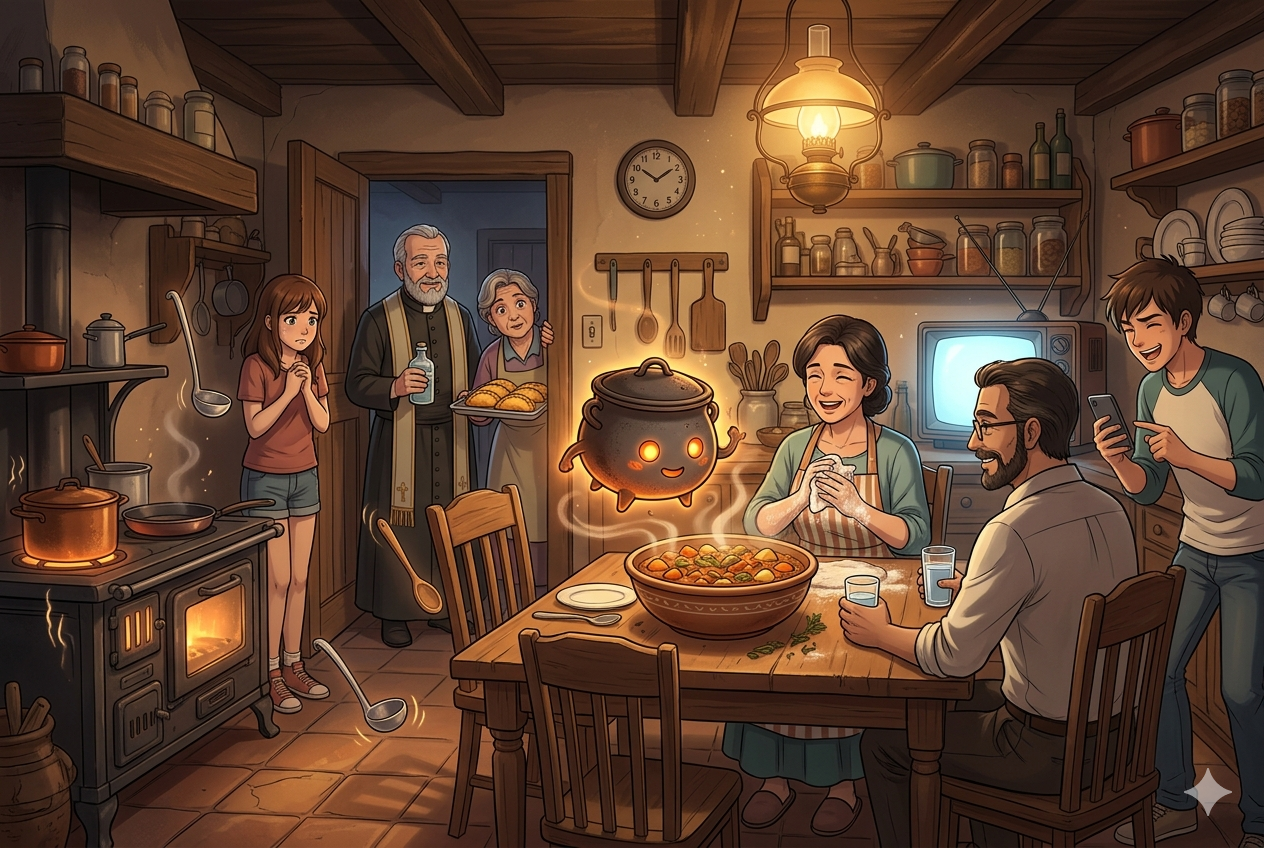
The Ramiro family had bought the old house in the Algarrobo neighborhood with the hope of a fresh start: high walls, windows that breathed light, and a spacious kitchen that promised gatherings around Doña Carmen’s stews. At first, the house responded with that domestic comfort only places with history can offer: floors marked by old footsteps, a kitchen hood that creaked with character, and an iron stove that, when it cooled, seemed to sigh like an old animal. Nobody, however, imagined the kitchen would soon become the focus of things that defied any explanation. One afternoon, after a tiring day of moving, Doña Carmen lit the stove to heat water and make tea. While she checked the knob and sniffed the salt, she noticed a pot fallen by the baseboard, upside down on the tiled floor. She nudged it with her foot and let out a contained exclamation. “This pot was always upright, didn’t you touch it, Ernesto?” she asked softly, suspicion threaded through her voice. Don Ernesto, who had gone for the salt and been dazed by the bustle, looked up with the calm of someone who still believed in rational explanations even when the world pushed him toward something else. “I only went for the salt. I swear I didn’t move it,” he answered, rubbing his hands as if the gesture could dispel uncertainty. Mateo, the eldest son and the family’s perpetual opportunist, held his phone on, staring at the screen like a hunter who smelled a viral story. “If this goes on social media, I’ll get rich. Aren’t you going to say something, Lucía?” he said with a mix of nerves and jest. Lucía, nineteen years younger than him and with nerves stretched to the edge of anxiety, had no appetite for jokes. “Are you serious, Mateo? This isn’t funny. Last night I heard something banging at three,” she replied, and her voice trembled. The following days confirmed that this wasn’t an isolated incident. The utensils began to show a will of their own: ladles that tilted as if someone invisible handled them; cauldrons that slid across the table and fell, as if a gentle, mocking force pushed them; plates that rolled slowly, tracing trajectories that seemed rehearsed. Most disturbing was the stove: even when off, it shuddered suddenly, like an internal pulse wanting to mark unknown measures. Those tremors were brief, suddenly violent, leaving a trail of tension that eroded the family’s calm. One morning, while Doña Carmen picked up a strainer that had fallen the previous afternoon, she exclaimed, part practical, part incredulous: “Look at this! It fell by itself. Who would do that?” Mateo, unable to contain his irony even in tense moments, muttered: “Maybe the house is rehearsing for its Broadway debut.” Lucía hugged her jacket tighter and said, her voice broken: “Don’t laugh, this scares me.” Don Ernesto tried to hold on to reason for them. “It could be mice or vibrations, old fool, let’s calm down,” he suggested, using a nickname that carried years of habit and tried to minimize the strange. The arrival of Violeta, the neighbor naturally nosy, added color and spice to the affair. Violeta didn’t knock: she opened the door impatiently, tray of empanadas in hand as both offering and social-investigation tool. “Oh, how exciting! A ghost with taste? Can I cook for it?” she asked already inside the kitchen, a rumor notebook peeking from her bag. Doña Carmen, worn thin, replied dryly: “If the ghost washes its plate, yes.” Violeta, unoffended, began to inspect: she tapped walls, sniffed drawers, reached into the pantry and looked under the table planks. Her curiosity didn’t soothe the mystery; it might have intensified it. That same afternoon they noticed the house seemed to respond to the intrusion with more pronounced whims: the stove gave a longer tremor, a cup rolled toward the cupboard and stopped at the edge, as if someone had left it there on purpose to impress. The conversation escalated until they decided to call a priest. Father Raúl arrived with a blend of respect and practical skepticism: simple vestments, a bottle of holy water, a Bible under his arm, and a calm voice of someone who’d seen and blessed many houses but had rarely had to deal with flying pots. In the kitchen he recited prayers and traced signs with blessed water along the walls. While he prayed, a saucepan shot off the shelf and clattered at his feet, cutting the prayer short. The priest, not expecting a spectacle, leaned toward the pan and, holding his composure despite the surprise, said loudly: “Was that… an answer? Lord, if so, speak now!” Mateo, who didn’t miss an opportunity to be sarcastic, whispered: “If God is listening, tell him to turn your prayer volume down.” Doña Carmen let out a laugh mixed with a sob: “Padre, I don’t know whether to laugh or cry,” she murmured. “This is overwhelming me.” Tension rose until one night the mystery revealed something none of them had anticipated: the voice behind the noises. The house slept with the TV on, showing a cooking program. The orange glow of the screen cast long shadows, and between the table and the stove a small shadow slid with the discretion of someone who knows a kitchen by heart. First, silence; then a raspy, playful voice, as if it were clearing crumbs in its throat, came from the cupboard: “Oh, what aromas! Who’s hiding the last piece of cake?” Lucía jumped and, heart in throat, called into the dark: “Who said that?” Mateo turned on a flashlight and aimed at the cupboard with the mix of courage and morbid curiosity that comes from confronting the unknown for the sheer thrill of it. “There! In the cupboard… a gluttonous specter?” he exclaimed, louder than he meant to. Doña Carmen, tired of uncertainty, stood before the cupboard and said with resolve: “If you’re a ghost, introduce yourself and tell me where my spoons are.” The cupboard seemed to breathe and a small luminous cloud took shape. It lacked the grandeur of sinister tales; it was tiny, like an old pot that had learned to glow. Its “eyes” were two dark spots resembling coals, and it gave off a warm scent: cinnamon, freshly baked bread, the memory of markets and sauces. “They called me Chapuzas in life,” the entity said with a humble mix of pride and sorrow. “I was a cook at the old market. I didn’t mean harm, I just… wanted to taste the recipes.” Don Ernesto, not sure whether to laugh or accept his ears, said: “Taste? It took the lid off a pot last night!” Chapuzas, shy, admitted: “I’m sorry, I got carried away. Sometimes I get excited and even the stove dances.” The confession defused the violence of the events: what had seemed aggression now looked like nostalgia and longing. Exhausted by uncertainty, the family decided that blessings and vigilance weren’t enough; they needed to negotiate. Doña Carmen, who had always struck deals with children, neighbors, and market vendors, devised a solution that respected the capricious nature of the visitor. She prepared a potent stew—one of those that fill a house with smoke and memory—set it on the table and waited. When the scent filled the house, Chapuzas emerged, drawn by the promise of flavor, and hovered over the table with shy enthusiasm. “Listen, Chapuzas,” Doña Carmen said firmly. “If you keep moving things, we’ll have to call more people. But if you stay and help us cook without breaking anything, I’ll give you the last piece of cake every Sunday.” The spirit, seeming to value sincere words more than threats, spun in the air as if signing an emotional pact. “Cake? Deal. But I don’t work for free; I want to make the stove dance when it’s happy,” it answered, with a mix of solemnity and appetite from a craft learned by the heat of other ovens. Mateo, amused by the absurdity of the arrangement, added: “Stranger deal signed by my mom.” Thus, practically and movingly, the house transformed. The startles did not vanish but changed in nature. Pots no longer flew in rage but moved with rhythm, like a domestic choreography: a lid sliding to widen a boil, a ladle describing a circle and dropping into the pot as if to mark the beat. The stove still trembled occasionally, but its shakes had the cadence of drums announcing the sauce was ready. Fear lingered in corners, but it was displaced by surprise, curiosity, and eventually tenderness. Father Raúl, who had gone initially to impose order through blessings, ended up invited to dinner. At the table, between spoonfuls and confessions, he began calling Chapuzas “the best spiritual kitchen helper” he’d ever blessed. Violeta, once relentless in her inspections, now brought recipes and recommended spices, convinced that the invisible hands had good taste. “My God! Who made this?” Violeta exclaimed one Sunday, tasting a spoonful of stew. “It’s delicious,” she added, glancing at the spot in the air where Chapuzas seemed to hover. Lucía, who had spent the first nights in terror, found a more human explanation for her unease in the peculiar routine. "It wasn’t just fear we felt. It was loneliness," she confessed one afternoon, leaning on the doorframe. "And this little rascal… he was hungry for company." Don Ernesto, having learned to toast with water and accept the strange with the same dignity he accepted life, raised his glass and proposed a toast: “To the house, to the ghost that forced us to clean, and to the Sunday cake,” he said. His words weren’t a joke: they acknowledged that their routine had changed, that the house had claimed a life of its own, and that they had stepped aside from logic to welcome the impossible. Chapuzas, by then part of domestic life, vowed in a voice like smoke and flour: “I promise not to take the spoons anymore… at least not without warning.” Mateo, ever ready with a story for his phone, pulled out his mobile and said: “I’ll tag him: #ChapuzasTheChef. We’ll go viral.” Doña Carmen, hands stained with stew and eyes glistening with a mixture of resignation and affection, replied with a wet smile: “May we go viral with joy, son.” Daily life acquired new rhythms. The house smelled of spices and filled with sounds that stopped being threats and became signals: a knock on the pan announcing dinner, the stove’s tremor marking the boil, a lid’s clang asking for attention. Nights no longer awoke panic; they awakened memory. The sounds returned fragments of the past to each person: the grandmother’s voice calling to the table, a lullaby no one remembered singing, the laughter of endless after-dinner conversations. Still, the inexplicable was never fully tamed. One night, when the house slept in apparent calm, a soft tapping of a saucepan swept through the kitchen and, for a moment, the pot trembled again with a brief impulse. It wasn’t enough to break the night’s locks, but enough for Doña Carmen, with the instinct of a caretaker, to get up and leave the kitchen light on. Not because she believed danger had returned, but because after so many nights she had learned not to leave the promise of bread to chance. In The House of Flavor, the extraordinary had been shaped to fit everyday life. Fear was domesticated by coexistence; the spirit’s loneliness found company and, in its way, the family found a way to mend the fabric of their home. And while the pots continued to mark capricious rhythms, the house became a place where tenderness and wonder held equal value. There they cooked, laughed, prayed, and bargained—in a mixture that was, ironically, the most human thing of all. Source of the images. Image created with Google Gemini.
No comments yet