 @mc5punk
Short story: The House of Broken Clocks
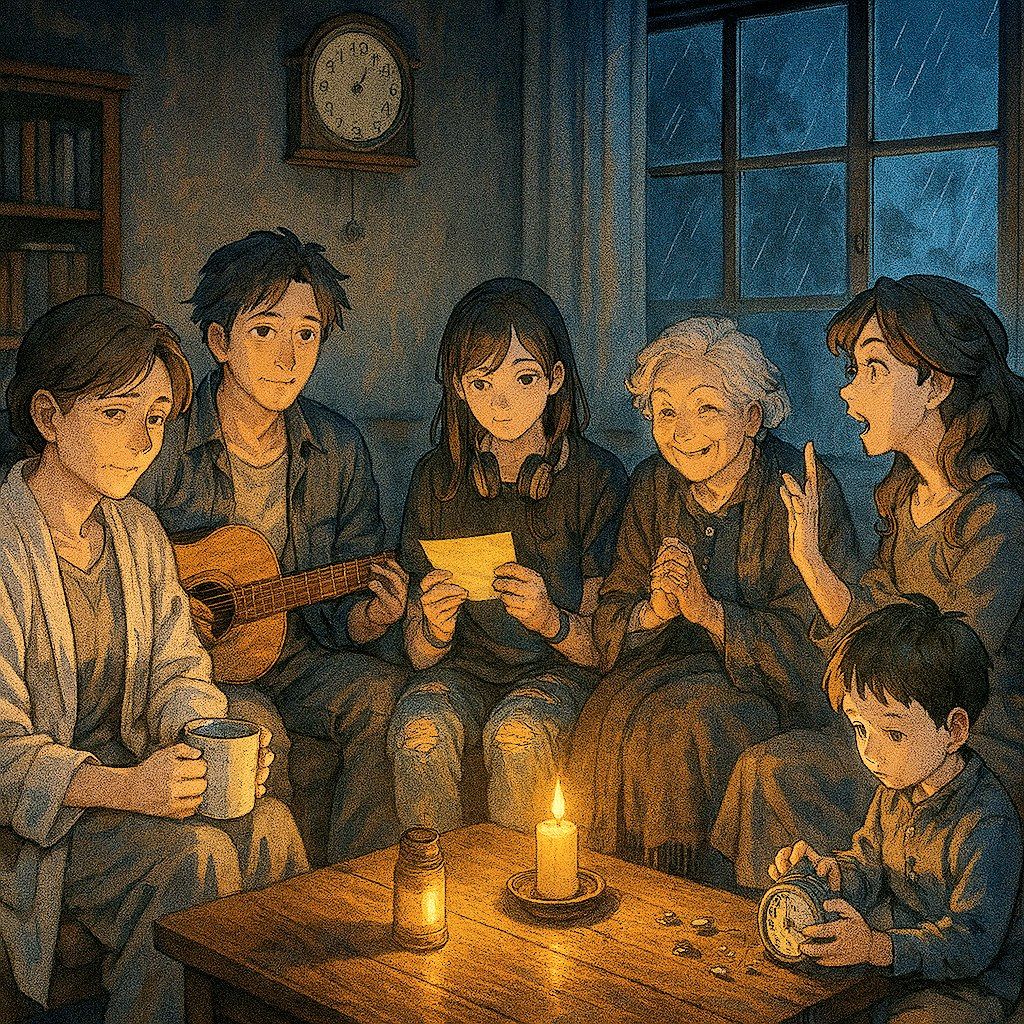
The house of broken clocks breathed in disconcerting intervals: desynchronized ticks, motionless hands, chimes that arrived late. It was a house of long rooms, corridors that smelled of dust and paper, and scraps of life accumulated in crooked-framed photographs. For Clara, the thirty-six-year-old art therapist, that home functioned as both capsule and map of everything she had lost. After her husband’s funeral she had tried to domesticate the chaos of grief: she turned the living room into an improvised consulting room, hung pictures with breathing instructions, and put a task chart on the kitchen wall as if schedules could contain the avalanche of emotions. Her fine irony and measured replies were, for the moment, a carefully chosen armor. Mateo returned one morning carrying a little box of records, bills folded in his pocket, and with his habit of showing up without warning. He was thirty-nine, with an old guitar and a life lived between cities, short-term jobs, and expectations that never quite settled. He had come back for the paperwork, for the keys, for the silence that had joined the family after the loss. He did not leave. His presence was a wind that began to undo the order Clara had built to contain her anxiety. Where she marked schedules and lists, he left chords at any hour and plates unwashed; where she preferred to close, he opened windows. Ana spent afternoons with headphones and a sketchbook full of sharp strokes. She was sixteen and had learned to measure her emotions with sarcasm. After her father’s death she had taken refuge in drawing and isolation: she slept with music, avoided intimate conversations, and hoarded papers. The house did not belong only to Clara; it was also the territory where Ana tested her new autonomy, sometimes with loud gestures, sometimes with silences that drilled through the walls. In the mornings Doña Lita appeared at the door with a cup of tea and the naturalness of someone who thinks all important matters can be fixed with a stitch and a bit of gossip. At seventy, her hands weathered by needles and with a voice that asked no permission to enter other people’s lives, she became a regular presence: scolding, advising, mending. Joaquín, neighbor and family friend, was a methodical, shy lawyer; he brought cookies, organized paperwork, and harbored a contained romantic inclination toward Clara. Vera, Clara’s patient and an aspiring actress, attended sessions as if trying on a role: dramatic, histrionic, and capable of turning any object into a scene that the others, begrudgingly, ended up feeling. Santi, the child Doña Lita raised after his parents died, wandered through the house with the seriousness of someone exploring the world carefully, always asking why things break and whether they can be made to run again. The clash between Clara and Mateo soon became recurring domestic drama. Clara proposed schedules: breakfast at eight, household chores, work times; he improvised living-room concerts at eleven at night, left a stack of bills on the table, and played chords as if music could blur the crinkling papers. That clash was, on the surface, a dispute over order and disorder, but beneath the arguments lay the wounds of a split childhood: an absent mother, a father who left more silences than explanations, and Clara’s determination to hold everything together. “Always with your lists,” Mateo said one afternoon, tossing a napkin onto the task chart. “Do you want me to live by a timetable or to breathe a little?” Clara closed the notebook where she kept her patients’ notes and looked at him with the precision of someone who labels things. “I breathe with order, Mateo. I don’t know another way to contain this,” she replied, her voice contained. “If I don’t set limits, everything runs away.” “And hiding in control make you less lonely?” he asked more softly. “For me, a bad song is enough.” Ana listened from the stairs; her silence said as much as any words. That conversation, played out in different versions, left marks: every reproach, every silence became a bitter joke no one wanted to make real. Clara’s group therapy sessions turned into a stage where domestic tensions were exposed with accidental honesty. One day Vera brought a single object to a session: a broken sneaker. She turned it into a symbolic microphone and, with her theatrical skill, staged a scene that touched Ana in an unexpected place. The teenager exploded. “It’s pathetic that you turn everything into material,” Ana said after the session. “Don’t you get it? Mom uses this to practice. She practices on us like we’re puppets.” Clara felt the blow with a clarity that blurred her vision. The professional mask cracked, and for the first time the therapist found herself a patient. “I don’t do it for spectacle,” Clara said with difficulty. “I do it to understand us. To avoid repeating the same things.” “You collect broken pieces,” Ana shot back. “Then you tape them up so they shine in your office.” The words were not mere arrows; in that closed room they opened rifts. Mateo stayed to one side, watching that none of the accusations became a door that slammed shut. In private, in the kitchen while rinsing dishes no one claimed, he talked with Joaquín. The conversation was a hushed confession. “I’m scared,” Mateo said. “Scared of being like him. Scared of disappearing when they ask me to be there.” Joaquín adjusted his glasses, took a breath, and felt clumsy but determined. “We could organize a benefit concert,” he suggested. “Show you can commit. I’ll do the paperwork, you play. I can do more than stand on the sidewalk.” Mateo laughed with incredulity and, inside, with a flicker of hope. “You, Joaquín, organizing something that involves feelings?” he said. “Welcome to the mess.” The day of the concert was a collective gesture: neighbors put out chairs, Doña Lita improvised a tea table, people brought snacks and stories. Vera staged a piece that ended in laughter; Joaquín recited a poem in a trembling voice and received applause that left him blushing; Mateo climbed the small makeshift stage with hands that would not stop shaking. “This song is for those who think they don’t deserve forgiveness,” he said before playing. “I don’t know if songs forgive. But sometimes they accompany.” The performance was imperfect. There were off-key notes, a microphone that died mid-chorus, a guest who sang out of rhythm. But emotion slid through every mistake: for a few moments the community stopped seeing the characters as broken individuals and held them as parts of a shared story. When the last string went silent, the house applauded warmly. The real turning point arrived one rainy night that seemed determined to wash the silences with water. A power outage plunged the house into a dense dark. Flashlights made uncertain circles. In the gloom, the old wall clock that had belonged to their father began to chime again, as if an old pulse had decided to beat once more. The sound filled the living room with a clarity that made everyone stop. Clara came out in a robe, sleeplessness etched in her face; Mateo had his guitar across his lap; Ana leaned against the back of a chair with a letter in her pocket; Doña Lita’s hands were restless; Joaquín held a thermos of coffee; Vera kept an acted-but-contained gesture; Santi fiddled with a toy clock he had taken apart and watched it with concentration. They sat around the table as if the darkness had made possible an arena of truth. The intimacy of the blackout freed confessions. “I found these letters,” Ana said, setting the yellowed envelopes on the table. “I didn’t want to give them to you before. I thought you wouldn’t stand it.” Clara looked at the letters with trembling hands. “There was a moment,” she confessed, “when I thought of leaving. I thought about abandoning everything out of fear of ending up alone. I stayed out of fear, Ana. Not out of pure love.” The confession fell like a stone in a still pond: the ripples spread and no one could pretend they hadn’t heard them. Santi dropped pieces of his toy clock; they clicked on the floor with a plastic sound that, absurd as it was, felt like the night’s exact metaphor: something small breaking that could be reassembled. Mateo, with a voice smaller than usual, said, “I never finished the recording I wanted to send him. I wanted to ask for forgiveness and I didn’t have the courage.” Joaquín, seeing the naked fragility, spoke with the calm that habit gave him. “There’s no single right way to do things,” he said. “There are other ways. Some of them involve starting again. And it’s not always about fixing; sometimes it’s about accepting that we’re broken and learning to share the pieces.” The night ended with words that did not heal immediately but which opened paths. When the power returned, none of them pretended everything was the same. But the house had changed; the dialogues spoken in the dark remained as a new seam. Out of that night came small, concrete decisions. Clara sought professional help and began supervision for her own grief—something she had until then found near impossible. With the help of another therapist she acknowledged that her perfectionism was a control mechanism against uncertainty. She began delegating: she let Ana choose the paint for a living-room wall; she accepted Doña Lita’s help to mend curtains; she let Joaquín take on legal tasks she had handled alone. These were tiny gestures—doorways that opened with caution—but meaningful because they implied trust. Ana tested flights and returns. She tried to go to a concert with Vera one afternoon, but at the door she negotiated with Clara: outings with conditions, signals of return, time limits. It wasn’t surrender; it was learning about agreements and boundaries. She also started therapy with a young professional recommended by Vera, and in that distance she cultivated new words: less sarcasm as armor and more humor that did not cut. Mateo accepted Joaquín’s proposal and organized a larger benefit concert. Joaquín handled permits, called acquaintances, and proved he could act outside of neat routines and enter the emotional fray. The event was, again, an adorable chaos: technical failures, improvisations, neighbors clapping exaggeratedly as if they were life’s jury. Mateo played and, for the first time in a long while, felt that music could be a way of taking responsibility without betraying himself. They did not raise a fortune, but they received the gift of community: a network of sympathetic looks and shared dishes. Doña Lita continued to repair clocks without manuals. Her method was simple and a bit absurd: first she listened to each clock’s story and its owner’s story, then she turned screws with an almost religious patience. Her experience suggested many pieces started to work again after being heard. She gave Ana an alarm clock with a spare hand and murmured when she handed it over, “Clocks take their time, too. Sometimes all they need is someone to tell their story.” New small rituals settled in. Clara let the kitchen table be less neat, let the unpaid bills sit in an envelope marked in Mateo’s handwriting; he, for his part, began leaving paid receipts in a drawer with a note he wrote, as if signing a contract with himself. Ana stopped closing herself off so tightly: she opened doors, asked for help at particular moments, laughed more often and with less edge. Joaquín learned to invite himself to coffee and to stay when it was necessary; Vera landed an audition for a smaller play that didn’t launch her career but gave her room to breathe without manufacturing constant tragedy. Santi kept asking for his toy clock to be fixed and taught everyone the patience of play. There were bad days—relapses, forgetfulness, fights that reopened old wounds—but the general direction changed: toward collaboration rather than individual survival. There were no total resolutions or redemptions. The clocks never regained perfect synchrony: some hands remained still, others ran to different beats, some chimes struck late. What shifted was the way they listened to those rhythms. The house stopped sounding like a disaster and began to sound like an imperfect orchestra that, even when out of tune, could make music. One afternoon, when sunlight pierced a misaligned blind, the three main characters found themselves in the kitchen. Clara held a cup of tea; Mateo tuned his guitar; Ana drew at the table with paint-stained hands. Joaquín walked in with a packet of cookies and Doña Lita returned with the steady step of someone resuming a ritual that no longer aimed to order the world but to accompany it. “Can I play?” Mateo asked, his voice calmer than when he had arrived. “Play,” Clara said. “And if you fail, we play again.” Mateo smiled and began to strum. Ana left her headphones hanging and looked at the wall she had chosen, paint still on her hand. The father’s clock struck an offbeat chime, as if it had lost its place and then decided to go on. The hands completed a clumsy gesture, and they all laughed softly. They did not pretend everything was resolved; they accepted that the hands could follow different rhythms and that, even so, they could build something that sounded like them. The house of broken clocks closed its story without absolute promises. There were wounds healing slowly, imperfect agreements, and the certainty that music, shared tea, and desynchronized hands could, in their awkward and tender way, accompany them. In that accompaniment, each character learned their measure: Clara to ask for help without shame; Mateo to show steadiness without losing freedom; Ana to negotiate independence without severing affection; Joaquín to offer himself without fear of ridicule; Vera to exaggerate less and be honest about her sorrow; Doña Lita to repair with listening and patience; Santi to keep believing toys can tick again. There was no perfect ending. There were continuities instead: life moving forward with flaws, resentments that sometimes returned, and laughs slipping in where once there had been only tears. The house, with its desynchronized clocks, stopped being a mausoleum and became a workshop; a place where broken pieces were not trash but stories that could be told again. Source of the images. Image created with Bing.
No comments yet